What Are The Best Strategies For Reducing Late Payments And Write-Offs?
Learn how B2B SaaS founders eliminate late payments and write-offs. Discover proven strategies for reducing late payments and accelerating cash collection.
5 mins
March 11, 2026
.png)
Key Takeaways
Late payments in B2B SaaS occur when invoices go unpaid past their due date. Think of a $15K annual contract with Net 30 terms that's still outstanding at day 60. Unlike consumer subscriptions where declined credit cards trigger automatic retries, sales-led companies invoice customers who typically pay via ACH or wire transfer, making collections a relationship and process challenge rather than a technical one.
For founders and first finance hires at sales-led B2B SaaS companies, these late payments drain working capital you've earned but can't access. When a single customer pays 45 days late on a $20K invoice, you're short $20K in working capital for those 45 days. Multiply that pattern across dozens of customers, and the cash gap compounds, compressing your runway and limiting your ability to invest in growth.
Industry data suggests fast-growing B2B SaaS companies can lose 4 to 10% of ARR annually to invoice defaults and write-offs, yet most founders treat collections as a problem to solve later rather than as systematic billing and collections infrastructure.
This guide covers why late payments (late payments and write-offss) happen, how to prevent them through automated invoicing and structured follow-up, and how to recover revenue when invoices slip through the cracks.
What Causes Late Payments And Non-Payments In B2B SaaS?
Late and unpaid invoices stem from process gaps on your side and customer-side issues that indicate deeper relationship problems.
Invoice process friction creates delays
Missing purchase order numbers, incorrect legal entity names, service periods that don't match customer expectations, or amounts misaligned with quotes can all trigger disputes and delays. Manual invoice creation compounds this problem by sending invoices days or weeks late.
Lack of systematic follow-up (or dunning) means invoices sit unpaid because no one notices
Dunning reminders should begin 7 days before the due date, then continue at days 0, 7, 15, 30, and 45 past due. Without these structured touchpoints, customers forget or deprioritize invoices. Many B2B customers treat Net 30 as a suggestion rather than a requirement.
Poor accounts receivable visibility prevents proactive management
Without real-time AR (accounts receivable) dashboards showing aging buckets, founders don't know which invoices are overdue or how patterns evolve. Aging buckets group invoices by how overdue they are: 0-30, 31-60, 61-90, and 90+ days.
For SaaS companies with standard Net 30 terms, healthy AR distribution targets 60-70% of invoices in the 0-30 day bucket, with 90+ day invoices under 5%. PYMNTS Intelligence research shows that automating manual AR processes can reduce collection times by 67%, while Hackett Group research found that top-performing finance organizations using segmented collections outreach reduce delinquency by up to 83%.
Each root cause maps to a specific solution: invoice friction requires automated generation, lack of follow-up requires dunning sequences, and poor visibility requires real-time dashboards. The following strategies address each failure point with implementable tactics.
How Do Late Payments And Non-Payments Impact B2B SaaS Businesses?
Late payments create three compounding problems that grow worse as your customer count increases from 10 to 100 and beyond without dedicated teams to manage collections.
- They drain working capital through extended DSO. Days Sales Outstanding (DSO) measures the average number of days between sending an invoice and receiving the funds in your bank account. B2B SaaS companies offering Net 30 terms should target 30-45 day DSO, but industry reality averages 65+ days. For a company with $100K MRR, a 40-day increase in DSO (from 35 to 75 days) ties up approximately $133K in additional working capital. For a company with a $500K MRR, that’s $667K in additional working capital. That's cash owed to you but unavailable for operations.
- They signal customer health problems. Approximately 35-50% of customers more than 60 days overdue on invoices churn annually, making late payments a leading indicator of relationship trouble ahead.
These impacts vary by the type of late payment (or write-offs) you're dealing with, which determines whether the issue is recoverable or compounding silently.
What Are The Differences Between Late Payments And Non-Payments In B2B SaaS?
Here’s how late payments and write-offs differ:
1. Late Invoice Payments
Late invoice payments occur when customers receive correct invoices but pay late or not at all. A customer with Net 30 terms pays at day 45 or day 60. This typically happens due to approval workflow delays, lost invoices, disputed deliverables, or customer cash flow problems. These delays reduce cash flow, but systematic follow-up can enable recovery of most revenue.
2. Non-Payments And Write-Offs
Non-payments and write-offs occur when customers receive correct invoices but never pay, despite follow-up efforts. A customer signs a $20K annual contract, receives every invoice on time, but stops responding after month three. These situations typically stem from customer financial distress, organizational changes that deprioritize vendor payments, or disputes that escalate beyond resolution.
Without systematic escalation protocols (such as service suspension warnings at day 60 or executive-to-executive outreach at day 90), these invoices age beyond 90 days and eventually require write-off.
The financial impact differs significantly between these two types.
Late payments are recoverable with consistent follow-up since the customer intends to pay but moves slowly. Non-payments represent permanent revenue loss that directly reduces your realized ARR. A $15K invoice written off after 120 days of collection attempts is revenue you booked but will never collect, creating a gap between your reported metrics and actual cash performance.
Understanding why these issues happen reveals the specific process gaps you can fix before they compound.
How To Reduce Late Payments And Non-Payments In B2B SaaS
1. Automate Invoice Generation and Delivery
Manual invoice creation leads to missed or delayed billing cycles, transposed amounts, and forgotten customers. Automated invoice generation eliminates these errors by generating invoices instantly when contracts become active or renew.
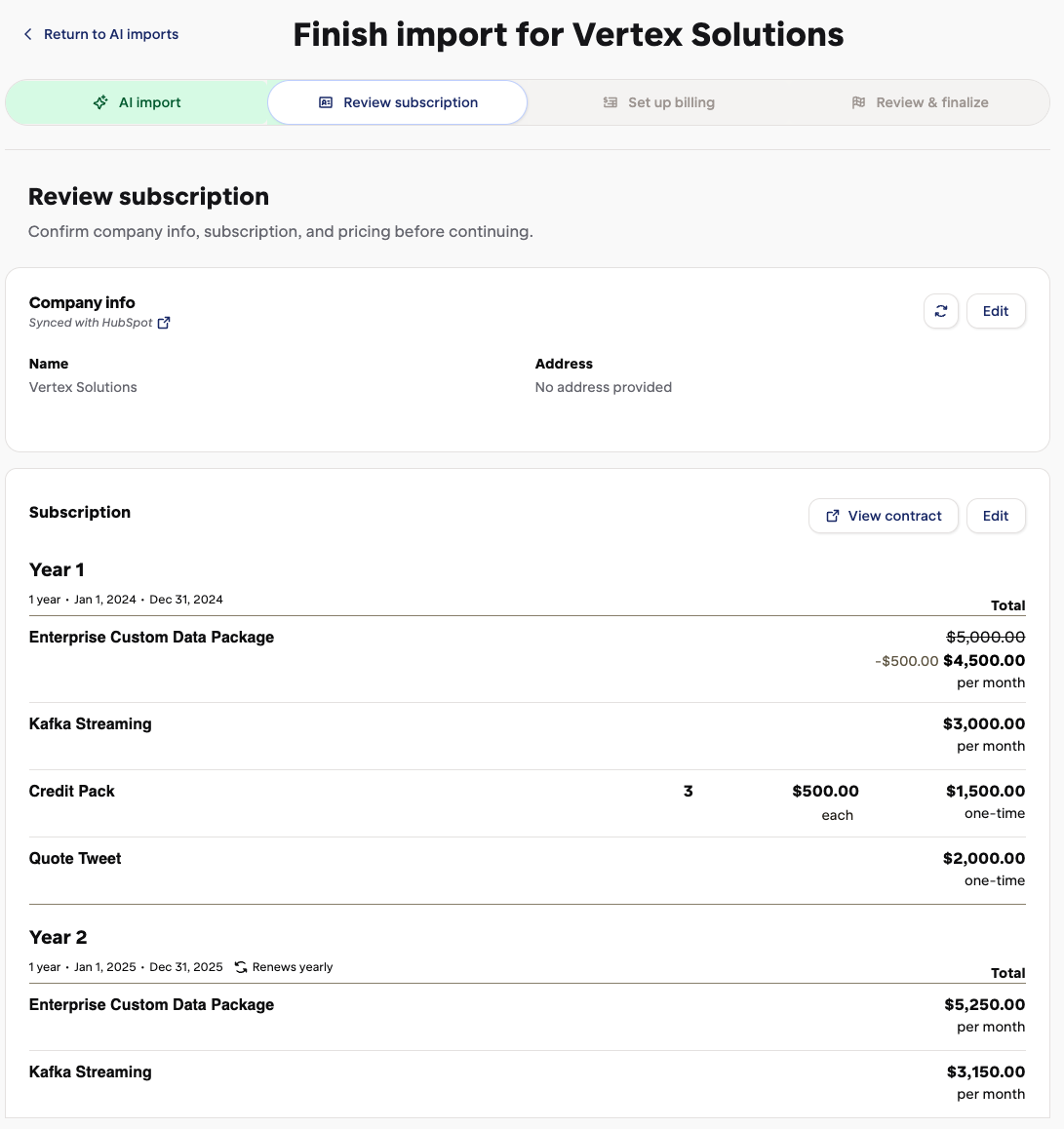
Turnstile stores commercial terms as structured data from the moment you create a quote. When the customer signs, the quote becomes the binding contract. There's no separate contract creation step and no manual re-entry into billing systems. The platform generates invoices automatically based on the contract's billing schedule, eliminating delays between signature and invoice delivery.
Adopting billing systems early means establishing proper processes before manual habits become ingrained. Companies starting with automated invoicing from their first customer avoid accumulating operational debt that requires painful unwinding later.
2. Implement Dunning
Multi-touchpoint communication reduces late invoices by keeping them visible throughout the billing cycle:
- 7 days before due date: Send a friendly reminder with the invoice attached, placing it on the customer's radar before their internal processing deadline passes.
- Due date (Day 0): Deliver a professional reminder with payment links and complete invoice details.
- Day 7 past due: Send the first past-due notice.
- Day 15 past due: Send a second notice with a firmer tone.
- Day 30 past due: Begin escalation phases, mentioning potential service impact.
- Day 45+ past due: Executive escalation or collections involvement, maintaining consistent pressure without requiring founder intervention.
Documented case studies show that companies implementing proactive communication can achieve 5-31 day reductions in DSO. For a company with $100K MRR, reducing DSO by 15 days frees up approximately $50K in working capital for operations.
Customer segmentation determines automation intensity. Customers with contracts under $10K annually can operate entirely through automated sequences. Mid-market customers ($10K-$50K) need account manager involvement by day 30. Larger customers (>$50K ARR) require personal outreach earlier because protecting these relationships often matters more than collection efficiency.
3. Maintain Real-Time Accounts Receivable Visibility
Weekly AR aging reviews prevent unnoticed accumulation of receivables in 60+ day buckets. For companies with standard Net 30 terms, healthy AR distribution targets 60-70% of receivables in the 0-30 day bucket with under 5% in 90+ days. When less than 50% sits in the 0-30 day bucket, systematic collection problems exist and warrant process evaluation.
Turnstile's financial reporting provides unified visibility into invoice status, payment history, and outstanding balances in real-time dashboards. The platform tracks receipts against invoices automatically, eliminating manual reconciliation that consumes hours during month-end close. Finance teams can drill into any metric to see the specific customers, contracts, and invoices driving AR aging.
This real-time visibility matters especially for companies without dedicated finance teams. In this case, dashboards replace spreadsheet tracking that breaks as customer count grows, eliminating manual aging-bucket updates and payment-confirmation chases.
4. Optimize Payment Methods for Deal Size
Method optimization reduces friction and accelerates collections based on contract value:
- ACH credit and wire transfers: These are standard for B2B invoices. Most business bank accounts can receive both, and your customers will choose based on their internal processes. ACH transfers cost significantly less than cards (processing $100K costs $120-$1,800 via ACH versus $1,500-$4,000 via cards), which is why most companies don't accept credit cards for larger invoices without an exception request or additional fee.
- Credit cards: For contracts above $10K annually, consider requiring approval for card payments or adding a processing fee surcharge. The 2.5-3% fee on a $50K invoice is $1,250-$1,500, a cost you shouldn't absorb. That said, maintain credit cards as a fallback for customers facing procurement constraints or specifically requesting card-based methods.
Launch with ACH credit as your primary method to minimize setup complexity while establishing best practices, then offer multiple options to reduce friction for different customer preferences.
5. Enable Auto-Pay with ACH Debit
The most effective way to eliminate late payments is to remove the manual payment step entirely. Auto-pay through ACH debit lets customers link their bank account once, then payments pull automatically when invoices are due.
Unlike traditional invoicing where you send a bill and wait for the customer to initiate payment, ACH debit flips the process. Turnstile triggers a pull from the customer's linked bank account for each invoice based on the contract's billing schedule. The customer authorizes the connection upfront, and payments happen automatically from that point forward.
This approach works well for customers with predictable billing amounts and established relationships. You can position it as a convenience that eliminates their internal AP processing overhead. For customers with variable usage-based charges or those requiring invoice approval before payment, traditional ACH credit (where they initiate payment) remains the better fit.
6. Structure Invoice Payment Terms Based on Customer Risk
Offering uniform terms to all customers creates unnecessary risk. New customers with no history shouldn't receive the same Net 30 or Net 60 terms as established large companies or customers who've paid consistently for months.
Structure terms based on relationship stage:
- Net 15: New or small customers until they've proven reliable history
- Net 30: Established customers with demonstrated success
- Net 45-60: Only after relationships are mature and credit-verified
Early discount incentives like 2/10 Net 30 (offering 2% discounts for remittance within 10 days while the full amount remains due in 30) accelerate cash collection. Companies implementing early discounts reduce receivables outstanding by as much as 20 days.
History tracking identifies chronic late payers requiring graduated response. First, at renewal, reduce their terms to Net 15 or require prepayment, then consider late fees of 1.5% monthly for invoices 30+ days overdue as a final escalation option.
7. Use AI-Assisted Collections Follow-Ups
Manual collections follow-up becomes unsustainable at scale. This typically happens when managing 100+ customers or exceeding $1-5M in ARR, as tracking invoice deadlines and sending timely reminders across multiple customers exceeds founder capacity.
Turnstile uses AI to assist with dunning by sending follow-up reminders based on structured contract data: customer segment, contract value, and payment history. This ensures appropriate escalation without manual tracking. The system triggers appropriate communications at the right times, maintaining consistent follow-up during busy periods when founder attention shifts to product launches or rapid growth initiatives.
How To Recover Late Payments And Non-Payments In B2B SaaS
When dunning sequences fail to collect and invoices age past 60 days, you need escalation tactics beyond automated reminders. The following tactics are ordered from least to most severe, allowing you to preserve customer relationships while progressively increasing pressure.
1. Offer Payment Plans
Payment plans can recover revenue from customers in financial distress. When a customer acknowledges the debt but can't pay the full amount, offering a 3-6 month payment plan often recovers more than writing off the invoice entirely. Document these agreements formally and set up automated billing for the installment amounts.
2. Employ Executive-to-Executive Outreach
Executive-to-executive outreach works for high-value accounts. When a $50K+ invoice sits unpaid at day 60, a direct email or call from your CEO to theirs often breaks through bureaucratic delays that automated reminders cannot. This signals the issue has escalated beyond routine collections.
3. Try Service Suspension
Service suspension is your strongest leverage but requires careful deployment. Warning customers at day 45 that services will suspend at day 60 gives them time to resolve issues while demonstrating you enforce consequences. Actually suspending service for customers who ignore warnings establishes credibility. However, abruptly suspending mission-critical services without adequate warning damages relationships and creates customer support crises.
4. Know When to Write Off
Know when to write off and move on. Invoices past 120 days with no customer response rarely convert to collected revenue. Continuing to chase them consumes time better spent on active customers. Write off uncollectible invoices quarterly, adjust your reported metrics accordingly, and consider whether the customer relationship warrants termination.
Automate Invoicing and Collections from Day One
The prevention and recovery strategies above work together as an interconnected system. Automated invoicing ensures billing accuracy. Reminders keep AR from aging. Real-time AR visibility enables proactive intervention. Risk-based net terms determination protects cash flow before problems emerge. Each layer reinforces the others.
Tracking this manually works until it doesn't. Maintaining spreadsheets of due dates, sending individual follow-up emails, reconciling payments against invoices: the complexity that breaks manual processes arrives faster than most founders expect, typically right when you're scaling the sales team or managing increasing customer counts.
Turnstile stores commercial terms as structured data from the moment you create a quote. When the customer signs, invoices generate automatically on schedule, reminders trigger at the right intervals, and AR dashboards show exactly where collections stand. No manual tracking, no missed invoice sending, no operational debt accumulating in the background.
The founders who treat invoice management and payment collections as core operational infrastructure from day one avoid the revenue leakage and working capital drains that constrain otherwise viable companies during growth.
Book a demo to see how Turnstile automates quote-to-cash for sales-led B2B SaaS startups.


.png)
.png)