What Does ARR Mean? How to Calculate Annual Recurring Revenue
ARR is annualized subscription revenue, and the number investors ask first. Learn how to calculate ARR correctly, avoid common mistakes, and track it from day one.
5 mins
February 3, 2026
.png)
Key Takeaways
Annual Recurring Revenue (ARR) is the annualized value of your recurring subscription revenue: the predictable income from contracts that automatically renew without requiring new sales conversations. For sales-led B2B SaaS founders, ARR strips out one-time fees, implementation charges, and professional services to reveal what your business can count on next year if nothing changes.
ARR is the single number investors ask about first. When a VC asks "What's your ARR?", they're not just checking a metric; they're testing whether you understand your own business well enough to defend the number with data that reconciles across all your systems.
This is why accurate ARR tracking matters long before you start fundraising. When the numbers don't match, the consequences surface at the worst possible moment: during due diligence. Investors interpret discrepancies between your billing systems and reported ARR as either incompetence or intentional inflation. Neither interpretation leads to a term sheet.
This guide covers what revenue counts toward ARR, how to calculate it accurately, why it matters for fundraising, and how to track it without the manual spreadsheet work that creates data discrepancies in the first place.
What Revenue Counts Toward ARR?
ARR only includes revenue that recurs automatically, and this distinction determines your company's valuation. Investors value recurring revenue at 5-10x higher multiples than one-time transactions, which is why misclassifying revenue types can negatively impact your valuation.
ARR includes:
- Subscription fees: A $15,000 annual contract contributes $15,000 to ARR. A $1,200/month subscription contributes $14,400 ARR.
- Recurring platform fees: Monthly maintenance fees that automatically renew count toward ARR when they're part of ongoing access.
- Recurring add-ons: Additional user licenses, premium support packages, or feature modules on subscription billing. Five extra seats at $100/month adds $6,000 to ARR.
These three categories share one characteristic: they renew automatically without requiring a new sales conversation or contract negotiation.
Which Revenue Doesn't Count Toward ARR?
Not everything that brings in cash qualifies as ARR, and including non-recurring revenue inflates ARR while misrepresenting your sustainable revenue base. Here's what to exclude from your ARR calculations and why:
- One-time fees: Setup charges, hardware sales, data migration, and license transfer fees don't recur. You collect them once when a customer signs, but they won't repeat next year.
- Professional services: Consulting packages, custom development, and training services require new quotes each time. They depend on project scope, not automatic renewal.
- Setup and implementation: Onboarding fees, platform deployment, and initial configuration are one-time events tied to getting a customer live, not ongoing subscription value.
- Variable usage fees: Include only committed minimums in ARR calculations. Highly variable month-to-month usage doesn't represent what you can count on next year: if it's not contractually guaranteed, take the conservative approach and exclude it.
Getting these classifications right from day one prevents the painful reconciliation work that derails funding conversations.
How to Calculate ARR
The ARR calculation follows one core formula: ARR = MRR × 12.
Simply take your Monthly Recurring Revenue (the total subscription revenue you bill every month from all active customers) and multiply by 12. This gives you the annualized run rate of your current subscription base, assuming no changes in customers or pricing. But remember: you must only include revenue that recurs automatically, including subscription fees, recurring platform fees, and recurring add-ons. Exclude one-time fees, professional services, and variable usage charges.
While the formula is simple, real-world scenarios require adjustments.
Here are five common situations and how to handle each:
1. Basic ARR Calculation
When all your customers pay monthly, the calculation is straightforward.
- Add up the monthly subscription revenue from all active customers
- Multiply by 12
If you're billing $50,000 this month from active subscriptions, your ARR is $600,000.
2. Mixed Billing Cycles
Most sales-led B2B SaaS companies have customers on different billing schedules. You need to normalize everything to monthly before calculating ARR.
- For monthly customers: use their monthly amount directly
- For quarterly customers: divide quarterly amount by 3 to get MRR
- For annual customers: divide annual amount by 12 to get MRR
- Add all MRR together
- Multiply total MRR by 12
Example: 12 monthly customers at $800/month = $9,600 MRR, plus 8 quarterly customers at $7,200/quarter = $19,200 MRR ($57,600 ÷ 3), plus 5 annual customers at $18,000/year = $7,500 MRR ($90,000 ÷ 12).
Total MRR: $36,300

ARR: $36,300 × 12 = $435,600
3. Contracts with Ramps
For contracts where pricing changes over the contract term (such as increasing seat counts), use "Terminal MRR" (the MRR in the final month of the contract rather than an average across the contract term).
Let's say a contract starts with 10 seats at $100/month for six months, then increases to 15 seats at the same price for the remaining six months. The contract's MRR reflects the 15-seat price of $1,500/month total, not a blended average.
Why Terminal MRR? Assuming this customer is happy and renews, this contract sustainably adds $1,500 of monthly revenue to the business. Terminal MRR reflects the revenue you'd actually retain if the customer renews. It's forward-looking and more useful for forecasting and valuation than a historical average, which becomes obsolete the moment the ramp completes.
4. Mid-Year Customer Changes
When customers upgrade, downgrade, or cancel mid-year, adjust your MRR immediately and recalculate ARR from the new baseline.
Net New MRR = (New MRR + Expansion MRR) − (Contraction MRR + Churned MRR)
Here's what that looks like in practice:
- Track each type of MRR change separately:
- New MRR: A new customer on a $1,500/month plan adds $1,500 to MRR
- Expansion MRR: When a customer upgrades from $800/month to $1,200/month, add $400
- Contraction MRR: A customer dropping from $2,000/month to $1,200/month costs you $800
- Churned MRR: Losing a $1,000/month customer reduces MRR by $1,000
- Apply all changes to your existing MRR
- Multiply the new MRR total by 12
Tracking these components separately shows whether your ARR growth is real or just replacing churned revenue. When Expansion MRR exceeds the combined total of Contraction MRR and Churned MRR, you achieve negative net churn: the hallmark of exceptional B2B SaaS businesses where existing customer value grows even as some customers leave.
5. Discounted Quotes
Always calculate ARR using the actual transaction price customers pay, not list pricing.
- Use the discounted rate the customer actually pays
- For permanent discounts: a customer on a $1,000/month plan with a 20% discount contributes $800/month ($9,600 ARR)
- For time-limited promotions: use the discounted rate during the promotional period, then adjust ARR upward when the promotion expires
- For "pay for X months, get Y months" discounts: divide the total payment by the total months of service. A customer who pays $10,000 for 12 months of service (a "pay for 10, get 12" deal) contributes $833.33/month MRR ($10,000 ÷ 12), not the $1,000 monthly list price
Getting the calculation right is foundational, but understanding why ARR matters determines how you'll use this number to make strategic decisions.
Why Does Tracking ARR Matter for Sales-Led B2B SaaS Startups?
ARR reveals whether you're growing fast enough to reach company targets, whether revenue is leaking, and whether you can defend your numbers during due diligence.
Tracking ARR as a B2B SaaS business is important for the following reasons:
- It helps in forecasting runway accurately: ARR growth does not equal cash in your bank account. When you close a $15,000 annual contract paid via ACH with NET 30 payment terms, your ARR increases immediately, but cash arrives 30+ days later. This gap matters when you're planning hires or timing your next fundraise so you can build hiring plans on actual cash timing, not ARR increases.
- It helps in setting sales targets that match investor expectations: Series A investors have specific ARR expectations and growth rate benchmarks they use to filter opportunities (typically seven-figure ARR, strong year-over-year growth, and healthy retention metrics). Tracking ARR monthly shows whether you're on pace or need to adjust your approach before the conversation starts.
- It helps in having credible investor conversations: When investors ask "What's your ARR composition?", they're testing whether you understand your own business. Founders who can't immediately explain their ARR bridge from last quarter to this quarter typically face serious funding obstacles.
- It helps in spotting growth patterns early: Separating gross ARR additions from net ARR growth reveals whether you're actually growing or just replacing churned revenue. You might add $40,000 in new ARR monthly while losing $35,000 to churn and downgrades. That represents only $5,000 in net growth and paints a dramatically different picture than your sales dashboard shows.
Understanding why ARR matters is the first step. The next question is how to actually grow it.
How To Increase Your ARR
ARR growth comes from the four levers below:
1. Acquire new customers strategically
Focus on ICP fit over volume. A $20,000 annual contract with a well-matched customer who will expand contributes more long-term ARR than three $5,000 deals with poor fit.
2. Expand existing accounts
When a customer on a $15,000/year plan adds departments or upgrades to enterprise features, that expansion MRR compounds without additional acquisition costs. So, track usage patterns that signal expansion readiness (approaching license capacity, increasing feature adoption, growing active users, or requests for higher-tier capabilities). For example, you can initiate upgrade conversations when customers hit 80% of license capacity.
3. Reduce churn through leading indicators
Track usage patterns that predict churn 60 days early: declining logins, reduced feature adoption, or support ticket escalation. Intervene before renewal conversations begin. A customer paying $18,000 annually represents $90,000 in five-year lifetime value; preventing their churn delivers more ARR impact than acquiring two new customers.
4. Increase pricing at renewal
Annual renewals offer natural pricing adjustment moments for customers receiving ongoing product improvements. Justify increases based on expanded value delivery.
When Should You Start Tracking ARR?
Understanding how to grow ARR is essential, but knowing when to make it your primary metric is equally important. Start tracking ARR from your first paying customer. While the absolute numbers won't be meaningful until you reach $500K-$1M ARR, establishing clean tracking systems early prevents the painful data reconciliation that can derail fundraising.
As you approach $1M ARR and start preparing for Series A conversations, ARR transitions from informal tracking to primary strategic metric. Investors begin expecting you to speak fluently about ARR growth rates, cohort retention patterns, and unit economics. Specifically, they'll want to understand LTV:CAC (Lifetime Value to Customer Acquisition Cost), which measures whether you make more from a customer over their lifetime than it costs to acquire them.
After crossing $1M ARR, make it your primary strategic planning metric. Beyond $1M ARR, investors increasingly evaluate early-stage SaaS companies through ARR-derived metrics, particularly Net Revenue Retention (NRR is the percentage of revenue retained from existing customers after accounting for upgrades, downgrades, and churn), and they'll also focus on ARR growth rate quarter-over-quarter and customer acquisition efficiency.
What's The Difference Between ARR, MRR and Total Revenue?
MRR serves as your operational management metric for understanding immediate revenue changes. Track MRR internally through new MRR from new customers, expansion MRR from upsells, contraction MRR from downgrades, and churn MRR from cancelled subscriptions. ARR is a non-GAAP metric that measures forward-looking annualized recurring subscription revenue. It explicitly excludes one-time fees, professional services, and non-recurring items.
Total revenue works differently. It's the revenue you officially recognize on your P&L (Profit and Loss statement) as the service is delivered, not when the contract is signed. When a customer signs a $12,000 annual contract on December 15th, your total revenue for December might be only $1,000 (reflecting one month of service delivery), but your ARR increases by the full $12,000 immediately.
ARR is forward-looking and shows recurring contract value, while recognized revenue is a historical accounting metric governed by ASC 606 (the accounting rule for when revenue counts as "earned"). When you sign a $12K annual contract on January 1, your ARR immediately reflects $12K. But January's recognized revenue is only $1K because you've only delivered one month of service. The remaining $11K sits on your balance sheet as deferred revenue: a liability representing unearned service commitments.
Skip the Spreadsheets: Track ARR Automatically from Day One
ARR is the vocabulary investors use to evaluate your business. When they ask detailed questions during due diligence, founders who confidently answer with data that reconciles across all systems move forward. Founders who discover inconsistencies typically don't.
Manual tracking with spreadsheets creates the exact data entry errors, version control issues, and billing-vs-sales discrepancies that kill fundraising conversations. The solution is structured data from day one.
Getting ARR calculations right depends on how contract terms are captured in the first place. In sales-led B2B SaaS, the signed quote is the contract. Your quote contains all contract terms: pricing, payment schedule, start and end dates, and usage commitments. This means your quoting system must capture every contract term as structured data: machine-readable fields your systems can process automatically, not just text in a PDF.
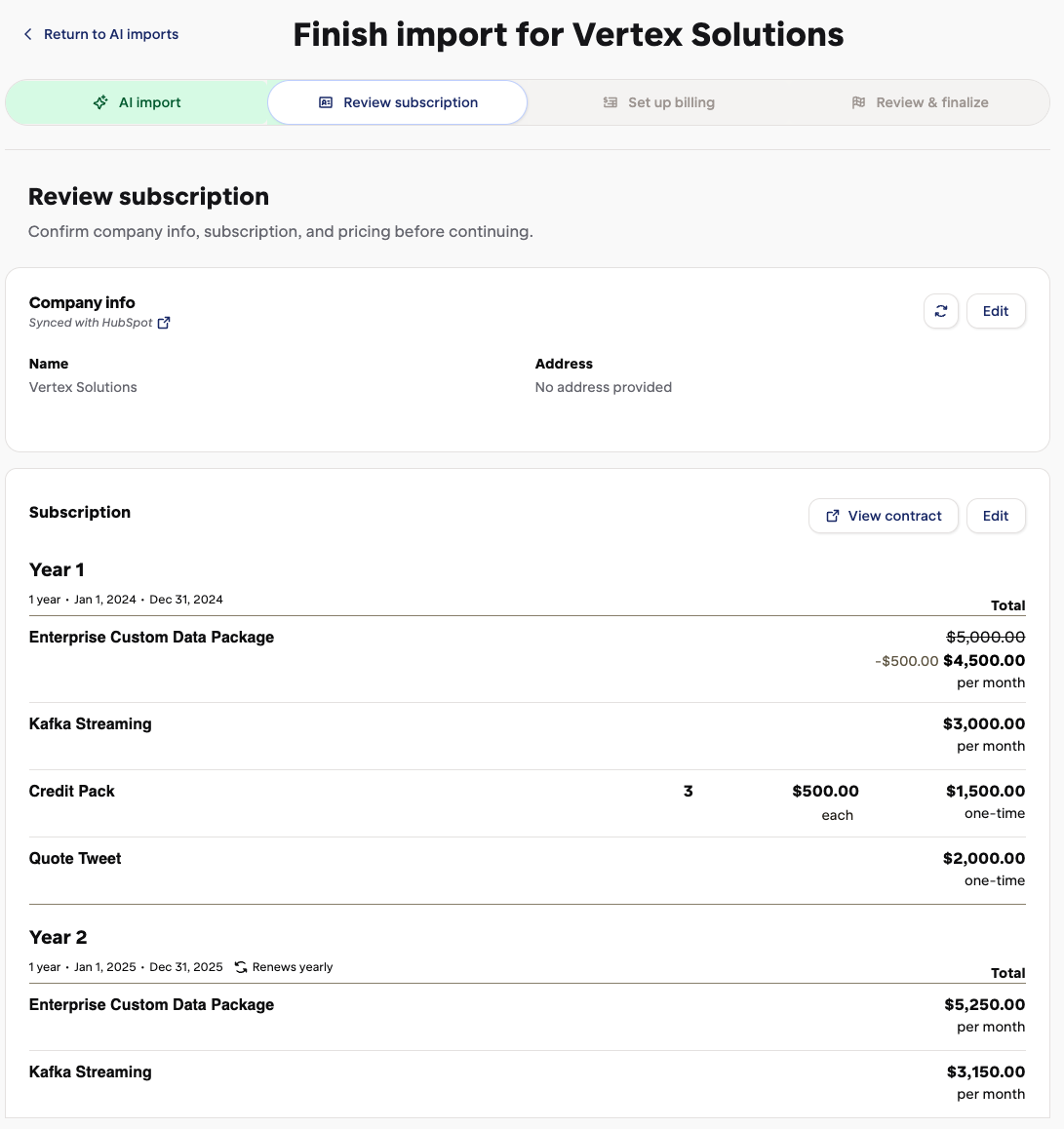
Turnstile is a quote-to-cash platform that stores contract terms as structured data rather than unstructured PDFs. When you build a quote, you're structuring pricing, billing schedules, and entitlements as data. When the customer signs, those terms automatically become the subscription configuration: no re-entry, no manual setup. Your ARR calculates automatically from active subscriptions, updating in real-time as deals close and customers change.
The earlier you adopt structured data infrastructure, the fewer reconciliation issues exist when investors start asking questions.
Book a demo to see how Turnstile automatically tracks ARR from structured contract data for sales-led B2B startups.


.png)
.png)