Accrued Revenue vs. Accounts Receivable: What's The Difference?
Accrued revenue is money you've earned but haven't invoiced. Accounts receivable is money you've invoiced but haven't collected.
5 mins
February 16, 2026
.png)
Key Takeaways
Accrued revenue is money you've earned by delivering a service or product but haven't invoiced yet. Accounts receivable (AR) is money you've invoiced but haven't collected yet. The invoice is the dividing line: before it's sent, you have accrued revenue; after it's sent, you have AR.
For sales-led B2B SaaS founders, finance leaders, and ops teams, mixing up these terms creates three specific failures:
- Revenue leakage when earned services never get invoiced
- Cash flow miscalculations when you mistake accrued revenue for accounts receivable
- Operational blind spots when you can't reconcile what you've earned against what you've billed
Consider a $15,000 annual contract. Your sales dashboard shows the booking, your product team provisions the account, and the customer starts using your platform on day one. Three months pass before you realize you never sent an invoice.
That $15,000 appeared in your revenue projections as accrued revenue, meaning service delivered but not yet billed. Your financial reports would recognize revenue monthly as the service was delivered, but your bank account received nothing. It never converted to an invoice, so it never became AR that could be collected as cash.
This guide breaks down the operational differences between accrued revenue and AR, explains why each matters to your business, and shows you how to ensure earned revenue actually converts to collected cash.
What Is Accounts Receivable?
Accounts receivable, also known as AR, is money customers owe you after you've sent them an invoice but before they've paid. It represents the gap between "we billed the customer" and "cash hit our bank account."
AR tells you exactly how much cash is in your collection pipeline with specific invoice due dates. When you email a $12,000 annual contract invoice with Net 30 terms, that $12,000 becomes AR the moment you send the invoice. It stays in AR until the customer's ACH transfer is deposited in your account. For B2B SaaS contracts, this typically takes 30 to 60 days from the invoice date, sometimes longer when enterprise procurement processes add delays.
Real scenarios for B2B SaaS companies:
- Annual contracts invoiced upfront: You invoice $24,000 annual value upfront with Net 30 terms. The entire amount becomes AR until the customer pays. Though revenue must be recognized monthly at $2,000 over the service period, the full amount enters AR immediately.
- Implementation fees at milestones: You complete a $15,000 implementation project and send the final milestone invoice. That $15,000 becomes AR. The work is done, the invoice is out, and now you're actively managing collection.
- Quarterly billing cycles: A customer on a $36,000 annual contract receives quarterly $9,000 invoices. Each invoice sits in AR until cash clears, while revenue recognition happens monthly at $3,000 regardless of quarterly invoicing or collection timing.
The critical insight is that AR represents active collection. You've completed your billing obligation by sending a formal invoice with clear payment terms. Now the customer's process determines when AR converts to cash.
Why Is Accounts Receivable Important To B2B SaaS?
AR directly impacts day-to-day operations through cash flow forecasting, financial visibility, and working capital management.
- It determines cash flow forecasting accuracy: When you know which customers owe what amounts and when invoices are due, you can forecast cash arrival. This helps you plan spending and prioritize collections efforts. Quote-to-cash systems like Turnstile automatically track outstanding invoices and aging buckets, giving you real-time visibility into your collection pipeline.
- It reveals operational health at a glance: Three AR metrics tell you whether your billing and collection processes work. Days Sales Outstanding (DSO) measures how long it takes to collect cash after invoicing, with a target of 30-45 days for SaaS companies. AR aging reports signal health when less than 10% sits past 90 days. Customer concentration should keep no single customer above 10% to 15% of total AR. More than 15% of AR past 90 days signals collection problems requiring immediate attention.
- It drives working capital management: High AR balances mean cash remains tied up in customer cycles. For companies closing $10,000 to $20,000 annual contracts with annual invoicing and Net 30 terms, significant working capital sits in AR rather than your bank account. This affects how quickly you can hire, invest in product development, and invest in new growth opportunities.
Jason Lemkin at SaaStr establishes the benchmark: SaaS companies should collect at least 100% of their MRR each month in cash, ideally over 110%. The 110% target breaks down as the current month's MRR successfully collected (100%) plus collecting on previous AR backlog, expansion revenue, or advance invoicing (over 10%). If you fall below 100% monthly collection rate, you're accumulating uncollected revenue, which means AR is aging without converting to cash.
While AR tracks what you've billed, accrued revenue captures what you've earned but haven't billed yet. This is where the biggest revenue leakage risks hide.
What Is Accrued Revenue?
Accrued revenue is money you've earned by delivering service but haven't invoiced yet. The service period passed, you provided value, but you haven't sent the bill.
This timing gap exists because service delivery and billing operate on different schedules. Your platform delivers value continuously, but you invoice monthly, quarterly, or annually. Between service delivery and invoice generation, that earned-but-not-billed amount is accrued revenue.
Real scenarios creating accrued revenue:
- Mid-cycle subscription upgrades: A customer on a $5,000/month plan adds 10 users on day 16 of your billing month at $50 per user. You've delivered 15 days of service for those additional users ($250 in value) but won't bill until the next invoice cycle. That $250 is accrued revenue because you earned it by providing additional user access, but you haven't invoiced it yet.
- Usage-based billing before invoice generation: Your API service charges $0.01 per API call with monthly invoicing. Throughout November, a customer makes 10,000 API calls ($100 consumed). You can't bill until month-end, when usage totals are calculated and validated. During November, that $100 accumulates as accrued revenue, with services delivered and invoices pending.
Tracking accrued revenue is straightforward, but converting it to invoices before it falls through the cracks is where companies fail.
Why Is Accrued Revenue Important To B2B SaaS?
The gap between earning revenue and billing revenue is where money disappears permanently. Understanding accrued revenue prevents three serious problems:
It exposes your biggest revenue leakage risk
A damaging operational failure in subscription businesses happens when companies properly recognize revenue on their books (accrued revenue entries showing value delivered) but never generate corresponding invoices. The customer received the service, accounting captured the revenue, but the actual bill never went out, which means collections teams have no receivable to pursue.
Mid-cycle upgrades activate in-product but never reach billing systems. Usage overages accrue but fail to convert to invoice line items. This costs 4% to 10% of annual revenue, or $80,000 to $200,000 at $2M ARR.
It creates significant blind spots in your financial data
When accrued revenue and AR don't reconcile, you can't trust your numbers. Your CRM shows one revenue figure, your accounting system shows another, and your bank account tells a third story. These discrepancies can build up when founders rely on inadequate tracking, making confident decision-making on hiring, spending, or growth investments more difficult.
It causes runway miscalculations
Founders who calculate runway using P&L revenue (which includes accrued revenue) can overestimate how long their cash will last. Accrued revenue appears on your income statement, but it isn't cash you can spend. That gap between earned revenue and collected cash can mean the difference between 18 months of runway and 12 months.
These risks compound when founders and finance teams don't clearly understand how accrued revenue and AR relate to each other.
Key Differences Between Accrued Revenue And Accounts Receivable
Accrued revenue represents earned but unbilled income, while AR represents billed but uncollected income. The invoice marks the transition between the two.
Here are the key differences between the two concepts:
Take note, accrued revenue that never converts to invoices vanishes from your collection pipeline, representing earned revenue that never becomes cash.
Understanding these two concepts individually clarifies how they work together in your revenue cycle.
Why Is It Important To Understand The Difference Between Accrued Revenue Vs Accounts Receivable?
The operational distinction between accrued revenue and AR determines whether earned revenue becomes collected cash. Three breakdowns occur when you conflate these concepts:
1. The conversion gap harms businesses
Tracking accrued revenue and AR individually matters less than ensuring accrued revenue systematically converts to invoices. When companies lose this discipline, services get delivered and revenue appears on financial statements, but no invoice exists for your customer to pay or collections teams to pursue.
Consider this scenario: Your platform delivers $100,000 in services throughout March as accrued revenue accumulates. April 5th arrives, billing runs, but only $85,000 in invoices are generated due to system disconnects or configuration errors. That $15,000 gap does not initially enter formal AR, but under accrual accounting it should exist as a contract asset (unbilled receivable) and remains collectible if identified and corrected. Your revenue recognition already shows it was earned.
2. You can't manage what you can't measure
When you can't distinguish between what you've earned (accrued revenue), what you've billed (AR), and what you've collected (cash), every business decision becomes a guess. Should you hire that next engineer? What's the right budget for the marketing campaign? Are your unit economics actually working? Without clean data flowing from accrued revenue through AR to cash, you lack the visibility needed to make informed decisions.
Founders and finance leaders who experience wildly different numbers between CRM-reported bookings, finance-tracked billings, and actual collections face a 30% to 40% revenue discrepancy problem. This makes strategic planning difficult and often surfaces at inconvenient times, such as when you need to make a critical decision quickly.
3. Operational decisions depend on accurate classification
When you distinguish accrued revenue from AR, you can forecast cash flow accurately. You know that AR converts to cash in 30 to 60 days, while accrued revenue must first convert to invoices. This prevents the 30% to 50% runway miscalculations that occur when founders and finance teams confuse accrued revenue with accounts receivable.
Once you understand the distinction, the next step is implementing systems that track both correctly.
How To Record Accrued Revenue vs. Accounts Receivable
Your accounting system tracks three stages: service delivered creates accrued revenue, invoice sent moves it to AR, and cash received converts AR to cash. Your accounting software handles journal entries automatically, so what matters operationally is ensuring accrued revenue converts to invoices, then to cash.
The best approach is to build on a structured foundation from your first customer. When contract terms exist as structured data rather than scattered across emails, PDFs, and spreadsheets, the conversion from accrued revenue to invoice to cash happens automatically. Mid-cycle upgrades generate invoice line items without manual intervention. Usage charges are calculated and billed on schedule. Nothing falls through the cracks.
If you've already started with manual processes, moving to automated systems now stops further operational debt accumulation before it undermines your ability to make confident business decisions. The longer you wait, the more accrued revenue sits unbilled, and the harder reconciliation becomes.
Warning signs your tracking system is failing:
- Revenue leakage from manual workflows, where services are delivered but never invoiced
- Month-end close taking more than 10 days
- Frequent discrepancies between CRM revenue and finance records
- Inability to reconcile accrued revenue with invoiced amounts
When you experience three or more warning signs simultaneously, you've accumulated operational debt that compounds monthly. Companies with usage-based pricing face the highest risk because billing in arrears is required: you can't invoice until the service period ends and usage is calculated, which means accrued revenue sits unbilled while the clock on payment hasn't even started.
Automated quote-to-cash systems like Turnstile prevent this operational debt from accumulating by storing contract terms as structured data. Every delivered service automatically generates a corresponding invoice, and every invoice enters your collection pipeline without manual re-entry or tracking.
Convert Earned Revenue to Cash from Day One
The gap between accrued revenue and AR is where subscription businesses lose 5-15% of annual revenue. Manual tracking systems can't reliably ensure every delivered service converts to an invoice, then to collected cash.
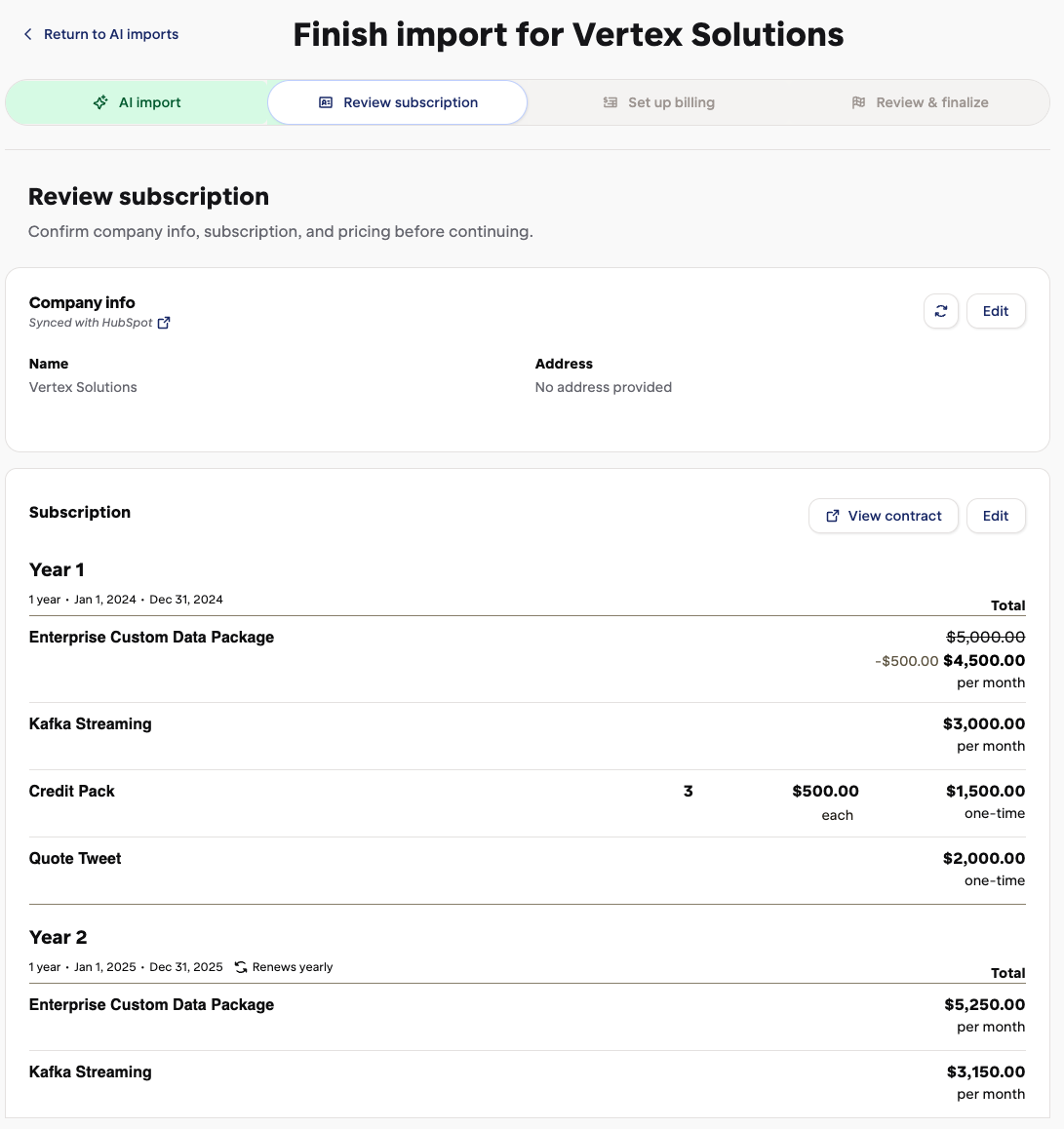
Turnstile eliminates this conversion gap through structured data. When you close a deal in Turnstile, the signed quote IS the contract. Pricing, billing schedules, and service terms flow directly into automated invoicing without manual re-entry. Mid-cycle upgrades, usage-based charges, and contract amendments automatically generate corresponding invoice line items. Every service delivered becomes an invoice sent, which becomes cash collected.
This isn't just about solving problems when they appear. It's about preventing revenue leakage from day one, before operational debt accumulates.
Book a demo to see how Turnstile ensures your accrued revenue systematically converts to collected cash for sales-led B2B startups.


.png)
.png)