7 Contract Negotiation Strategies for B2B Founders
Seven contract negotiation strategies for B2B founders. Protect deal economics and execute every term after signature.
5 mins
June 8, 2026
Key Takeaways
- Protect margin with give-get. Every concession you give should get you something in return, such as longer term, more seats, upfront payment, or faster signature.
- Store negotiated terms as structured data, which means contract terms stored as data your systems can read and use, not just text in a PDF. That is what keeps ramps, escalators, and custom schedules from turning into manual cleanup.
- Strong execution keeps your invoices accurate. Accurate invoices reduce churn from invoice disputes and protect revenue you have already earned.
Strong contract negotiation in sales-led B2B SaaS rests on the give-get trade: never concede without something in return. Every ramp, custom discount, or milestone fee you agree to in the deal room only protects deal economics if your billing system can actually execute it.
Once the contract is signed, execution determines whether those negotiated economics hold. Every term has to flow into a Q2C workflow that can run it without manual re-keying.
This article covers seven negotiation strategies built on the give-get model. Each one protects deal economics in the room and should translate into terms that billing can execute automatically after signature, without manual cleanup.
What Is Contract Negotiation in B2B SaaS?
Contract negotiation in sales-led B2B SaaS is the process of agreeing on the terms of a customer relationship before the contract is signed. It goes well beyond price. The terms on the table include discount structure, term length, billing cadence, payment method, expansion commitments, ramp schedules, service-level agreements, and a long list of clauses that procurement teams add through redlines.
For sales-led B2B SaaS companies, where deals are custom rather than self-serve, contract negotiation is a critical lever on margin, retention, and revenue predictability. A poorly structured contract can lock in below-market pricing for years. A well-structured contract converts the same buyer into a multi-year, predictable revenue source.
The discipline that holds the whole process together is the give-get principle: every concession the seller offers must be matched by something the buyer provides in return. Without that anchor, every negotiation collapses into a one-way discount conversation. With it, every concession becomes a trade that gets you closer to signature. The seven strategies that follow are specific trades that work well in sales-led B2B SaaS deals.
Strategy 1: Anchor Every Contract Negotiation with Give-Get
A discount without a corresponding ask is a price cut. The give-get principle requires that every concession you offer is matched by something the buyer provides: a longer commitment, more seats, an add-on purchase, or a signed-by deadline.
The fix is a trade menu you build before any negotiation starts. When a prospect asks for 15% off, you do not say yes or no. You say: "We can get there. In exchange, we need a two-year commitment with annual prepayment."
One practice applies to every strategy in this article: document the agreed terms in writing immediately after the meeting, whether that is a follow-up email or, ideally, a quote document. Signature can take days or weeks. Locking terms in writing the same day prevents drift and gives the person owning billing execution a clean record of what needs to run. A quote document generated from a quoting tool carries the additional benefit of capturing those terms as structured data that the rest of the workflow can read.
Give-get is the operating system. The next six strategies are specific trades you can run.
Strategy 2: Trade Discounts for Term Length
Multi-year commitments are a strong give-get trade to consider. The buyer gets price relief. You get churn protection, competitive insulation, and revenue predictability.
Watch for two clauses that erode the value of your trade. The first is a missing annual escalation clause, a built-in price increase that takes effect each year. The second is a billing frequency concession layered on top of the multi-year commitment. Buyers often push for quarterly payment even in a multi-year agreement, creating a second concession with no second get.
If a multi-year commitment is off the table, consider the next trade.
Strategy 3: Trade Discounts for Expansion Commitments
When term length is unavailable as a lever, committed growth is the next-best trade. The buyer gets a lower per-unit price today. You get growth the customer is contractually obligated to deliver.
The structures that work: committed seat growth, usage minimums, and add-on products committed. The structure that fails: verbal expansion promises. A buyer who says "we plan to roll this out to 200 users by year-end" is not making a commitment unless they agree to pay for the 200 users and that number appears in the contract with clear charges tied to it. Every expansion commitment needs a contractual mechanism in the original agreement: a minimum spend clause, a scheduled seat ramp with automatic billing adjustments, or an add-on products committed.
Expansion commitments lock in growth. The next lever locks in timing.
Strategy 4: Trade Discounts for Deal Velocity
A signed-by deadline converts time pressure into a give-get instrument. The buyer gets a concession that expires. You get a closed deal instead of open pipeline.
The most effective version ties the deadline to the buyer's own business constraint, not the seller's quarter close. End-of-quarter discounts lose effectiveness at higher deal values, and they train buyers to wait for the next quarter.
A waived price escalator is a cleaner velocity lever than a cash discount. Instead of cutting list price, offer to waive the standard 5-7% annual escalator if the deal closes by a specific date.
The deadline must have visible consequences: the escalator reinstates, the implementation slot moves, or the pilot timeline shifts. The quote document should also expire on that date, so the buyer cannot sign at the discounted rate after the window closes. Without that enforcement, the deadline is a verbal threat instead of a system-enforced one. Vary the concession type every quarter so buyers cannot pattern-match a predictable discount cycle.
Velocity trades accelerate signature. Packaging structure determines what you have available to trade.
Strategy 5: Stop Bundle Stuffing Your Packaging
Every feature you force into a single bundle that a buyer does not want is ammunition for their next discount request. Prospects may argue that they should get a steep discount because they do not use or want a large share of the bundle.
Features inside a bundle typically fall into three buckets: anchor features that close the deal, supporting features that round out the value, and features that no buyer in your segment actually wants. Advanced integrations, SSO, and advanced security are mission-critical for enterprise buyers. For a buyer at $25K ACV who needs only core functionality, those same features make the package feel overpriced.
The contract negotiation consequence is direct: when everything lives in one bundle, a buyer has no reason to negotiate on anything other than the total price. Buyers use the fact that the bundle has more features than they need to negotiate against you, saying things like, “I only need 6 of the 10 features in the bundle, so I should get 40% off.” Two structural moves restore the trade menu, and they often work together.
The first is good/better/best pricing. Three pre-defined tiers give the buyer a clear way to trade scope for price without ad-hoc discounting. When a prospect pushes back on the middle tier, the negotiation move becomes "step down to the lower tier for a lower price," not "fifteen percent off the middle tier."
The second is modular packaging. With separate add-ons, you can include a premium module at no charge in exchange for a multi-year commitment, or discount a specific add-on in exchange for a case study. Features in your core bundles should be valuable for the majority of your target buyers. Niche features should be carved out as paid add-ons.
These packaging options restore trade choices. When price relief is still needed, scheduled growth can protect long-term economics.
Strategy 6: Use Non-Recurring Discounts or True Ramps Deliberately
When a buyer needs Year-1 price relief, be precise about the structure. A non-recurring discount preserves your standard pricing after the defined period. A true ramp means the number of seats or the committed usage increases during the contract period. The key question before any concession is what expectation you are setting about future pricing and volume.
A true ramp typically looks like this: five seats for the first six months as the buyer rolls out the product, ten seats for months seven through twelve as adoption grows, twenty seats for year two as their headcount expands. Each step is pre-agreed in the original contract, with billing adjustments that take effect automatically on the dates specified.
Ramp pricing converts the variable from a flat price to a pre-agreed schedule of growth. The contract explicitly states when additional seats take effect, which turns discounting from an ad-hoc concession into a deliberate system with multiple levers.
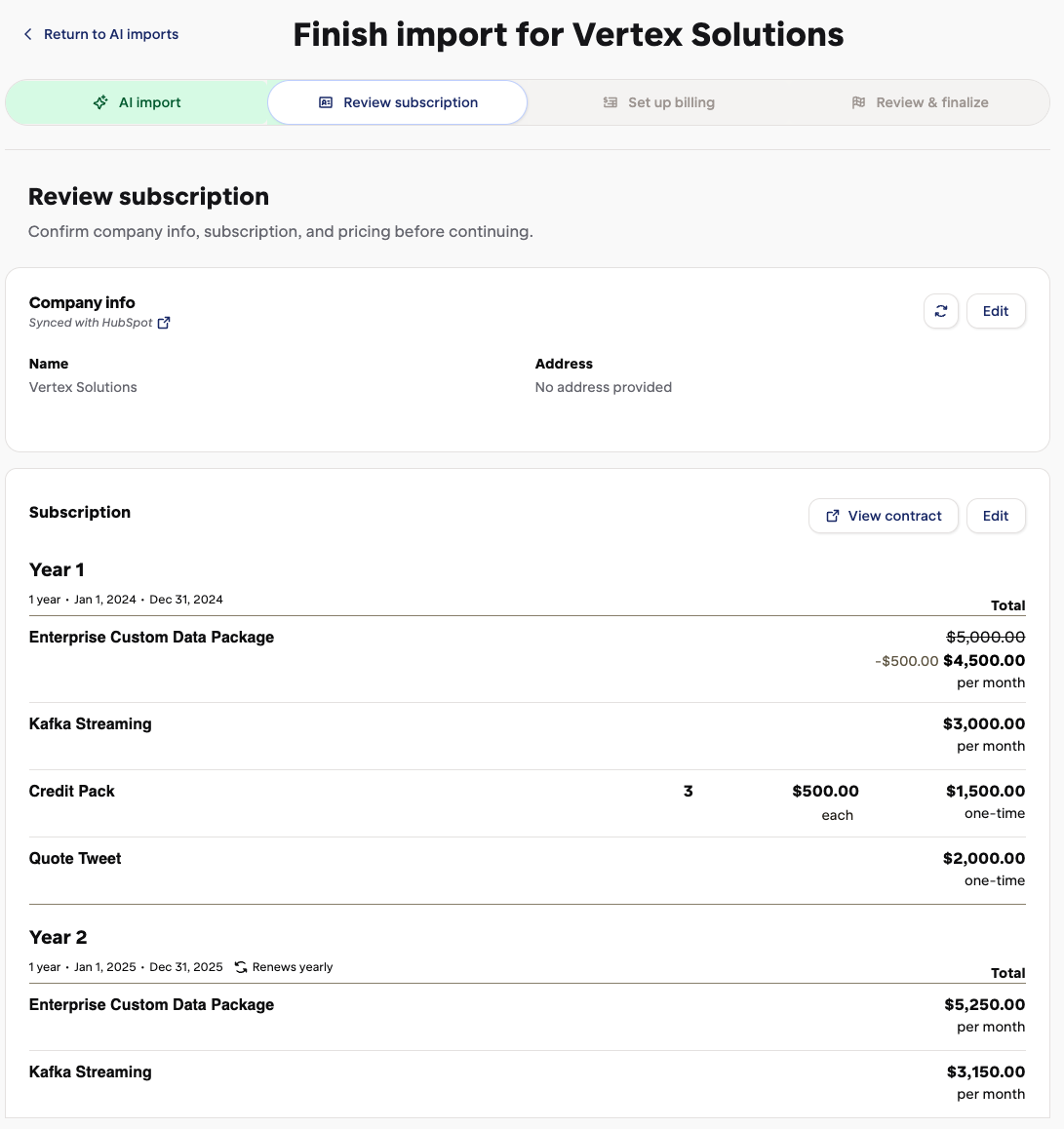
Ramps only work if your systems can execute them. The pattern that breaks teams is gradual: each custom ramp seems manageable in isolation, but they accumulate into hundreds of one-off contracts no one can track. When a step-up is missed, whether a discount ends or a scheduled seat or usage increase, the customer continues paying the prior period's amount. At renewal, sales discovers the historical under-billing, but customers routinely refuse retrospective charges on the grounds that the prior billing established the pricing they expect. The non-recurring discount you negotiated as a temporary concession is now a permanent price, or the seat ramp you negotiated as a growth schedule is now a static commitment. That is a common form of silent under-billing in sales-led SaaS.
This is also where teams end up doing avoidable manual work. Someone has to re-key terms from documents into the billing system, check whether the step-up happened, reconcile invoices against ARR, and explain pricing mismatches at renewal. Structured data removes that manual layer because the terms are already readable by the systems downstream.
Ramps address how seats and usage grow over time. SLAs address what you agree to deliver.
Strategy 7: Trade SLA Tiers Like Any Other Concession
SLA (service-level agreement) terms that look minor on paper become engineering mandates. Agreeing to 99.99% uptime for an early-stage company is a staffing plan you did not know you signed, which is why a default ask from procurement should never become a default give from sales.
99.9% uptime allows 8.77 hours of downtime per year. 99.99% allows 52.6 minutes. 99.999% allows 5.26 minutes. For a 20-person company, the gap between those tiers is not just a contract clause. It is a major infrastructure and support commitment, and that cost differential is what makes SLAs a give-get like any other.
Treat the SLA the same way you treat the discount. The standard tier should reflect what you can comfortably commit to without re-architecting the company. If a buyer asks for 99.99%, the move is not "yes" or "no." It is "we offer 99.95% on business-critical features at the standard tier, measured monthly. 99.99% is available as a paid premium support add-on or in exchange for a multi-year commitment." The same logic applies to expanded support windows: 24/7 support can be a paid add-on rather than a default term. The same logic applies to remedies: keep credits capped at the standard tier, with broader remedies reserved for higher-tier commitments.
The principle is the same as every other strategy: an SLA is not a procurement formality. It is a concession with real cost, and every tier above your default should be earned with something in return.
Every "Yes" Becomes Operational Debt Unless Billing Executes It
Strong contract negotiation protects your deal economics. Execution ensures those terms are billed accurately over the life of the contract and reduces churn from failed payments. Every ramp, price escalator, usage minimum, and custom schedule you agree to should be applied automatically, not tracked manually through quarterly reconciliation sprints to find what billing missed.
Book a demo to see how Turnstile applies negotiated ramps and scheduled contract changes automatically as a single system of record for the entire quote-to-cash workflow.


.png)
.png)