What Is Account Reconciliation? A Guide for B2B SaaS Companies
Learn what account reconciliation is and how B2B SaaS companies use it to prevent revenue leakage and fundraising problems.
5 mins
January 17, 2026
Key Takeaways
When you started your company, account reconciliation wasn't in your top five priorities. You wanted to build a product, close customers, and grow. But account reconciliation is one of those things you have to do, like brushing your teeth. And if you don't do it, it catches up with you.
Account reconciliation is the process of matching your internal financial records against external statements from banks, payment processors, and other financial institutions to verify accuracy and identify discrepancies. For sales-led B2B SaaS companies, this means comparing what your accounting software says you earned against what your bank actually received and what your payment processors deposited.
Here’s why this matters: First, even with a solid product you can easily leave up to 5% of revenue uncollected through payment failures and manual billing mistakes. Second, those gaps always show up during fundraising. When your revenue, cash, and contracts don’t reconcile cleanly, investors treat it as a risk signal and may drag out diligence, force price cuts, or kill the round because messy financials suggest weak controls and unreliable metrics
This guide covers how reconciliation catches problems before they compound, the types and methods that matter most for B2B SaaS companies, when to automate versus stay manual, and step-by-step processes for founders, finance leaders, and ops teams managing revenue operations.
How Account Reconciliation Catches Problems Before They Compound
Reconciliation starts with your internal records next to external statements. Line by line, you're checking: "does this transaction match," and flagging anything that doesn't. You're also investigating discrepancies to determine whether they're timing differences, data entry errors, or actual revenue leakage.
The process catches problems before they compound. A customer pays $12,000 upfront for an annual contract. Your bank shows $12,000 received today, but your accounting system should show $12,000 as deferred revenue, recognizing $1,000 monthly as you deliver service. Without reconciliation, you might report revenue you haven't earned or miss revenue you should have collected.
Many founders or Ops teams discover these problems during fundraising when billing numbers don't match sales data. Monthly reconciliation catches discrepancies early: failed payments, forgotten invoices, or subscription changes that never flowed through to billing.
The challenge is that reconciliation complexity grows with your customer count and pricing variations. Different reconciliation types require different priorities and cadences.
What Are The Types Of Account Reconciliation?
B2B SaaS founders and finance leaders must prioritize differently than traditional businesses. Focus on customer/payment reconciliation and bank reconciliation as critical priorities. These catch revenue leakage and cash flow problems. Treat vendor reconciliation, credit card reconciliation, and intercompany reconciliation as lower initial priorities.
- Customer reconciliation verifies that customer payments match invoices and subscription terms. This is the highest priority for subscription businesses. You're checking that every subscription charge generated a payment, every payment got recorded properly, and your revenue calculations actually match cash collected.
- Unlike traditional businesses where customer reconciliation happens quarterly, SaaS companies need this monthly at a minimum because discrepancies happen continuously. Failed payments, mid-cycle upgrades, and cancellations create mismatches between what you billed and what you collected. These compound quickly if left unchecked.
- Bank reconciliation matches your accounting records with bank statements to verify cash balances. This catches fraud early, identifies timing differences like outstanding checks, and spots bank fees you forgot to record.
- We recommend reconciling bank accounts monthly at a minimum. Increase to weekly when managing multiple payment processors or high transaction volumes.
- Credit card reconciliation has two dimensions: corporate card reconciliation verifying company expenses, and merchant services reconciliation verifying customer payments received via credit card, processor fees, chargebacks, and deposits.
- Vendor reconciliation matches vendor invoices and payments against your records. Start quarterly until you reach $500K-$1M ARR when vendor complexity justifies monthly reconciliation.
What Are The Methods Of Account Reconciliation?
How you reconcile depends on your customer count and pricing complexity.
- Manual reconciliation involves downloading bank statements, opening spreadsheets, and matching transactions by hand. This method works when you're processing under 20-30 customers with simple account structures and stable transaction patterns.
- Automated reconciliation uses software to match transactions, flag discrepancies, and sync data across systems. This method makes sense when pricing experiments mean every deal has slightly different terms, discounts, or payment schedules, or when transaction volume exceeds 50+ customers monthly and manual matching becomes unsustainable.
The threshold between manual and automated reconciliation sits around 10-20 hours weekly on revenue operations. Below that, experts do not generally consider spreadsheet-based reconciliation processes to be adequately reliable, even at low workload levels. Above the threshold, manual processes start drowning you in administrative tasks while errors compound.
How To Choose The Right Reconciliation Method For Your Transaction Volume
Your reconciliation method should match your transaction volume and pricing complexity. The wrong choice either wastes time on manual work that software should handle, or pays for automation you don't need yet.
1. Manual reconciliation (under 50 transactions monthly).
Open your bank statement and accounting software side by side, matching transactions one by one. While there's no software cost, you're spending 2-4 hours monthly, time you need for product development and customer conversations. Error rates run above 2%, and problems surface only at month-end. Even at low volumes, this adds up to more than a week of founder time annually.
2. Structured contract data from day one (any volume).
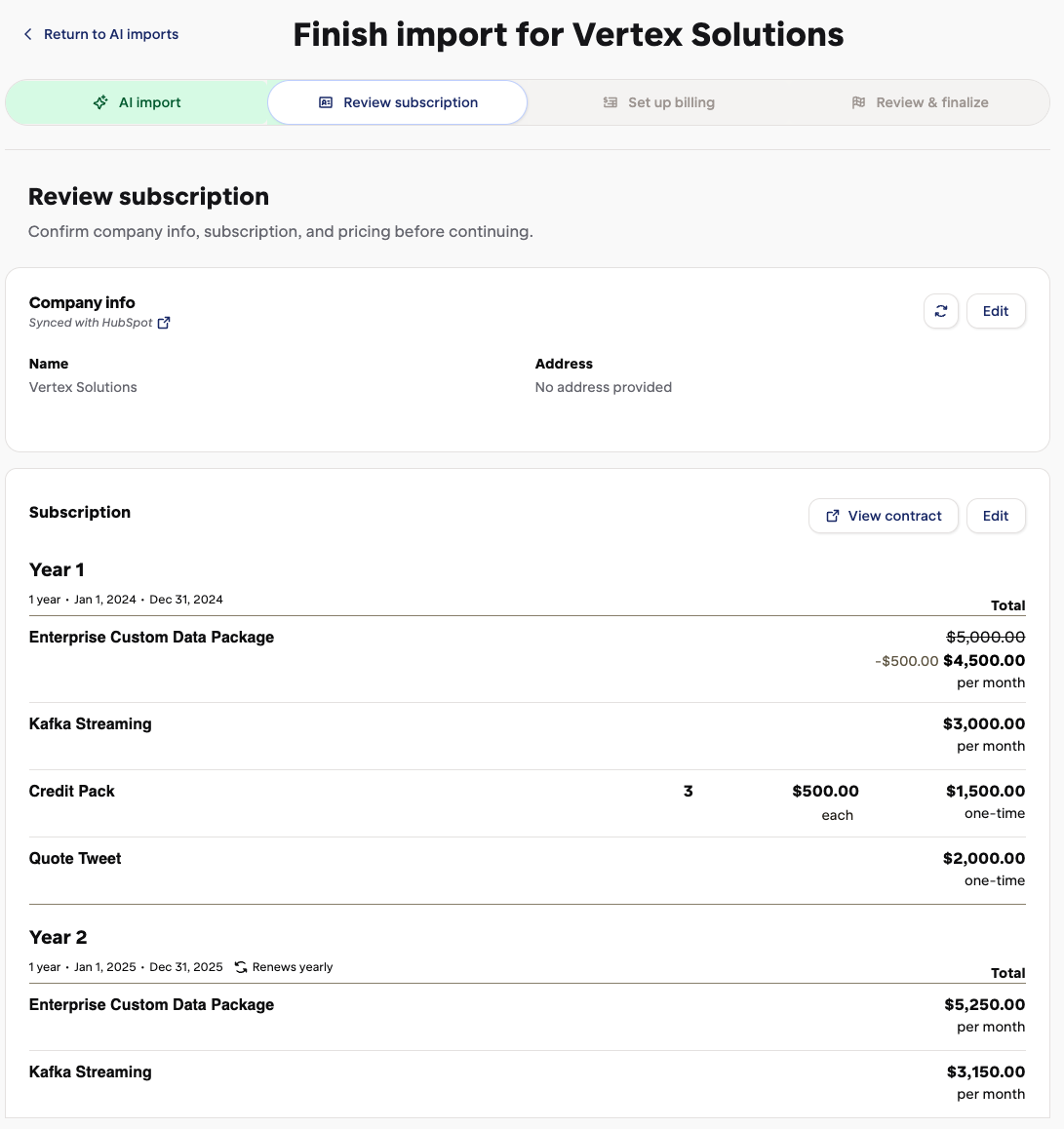
Turnstile captures contract terms as structured data from your first customer, preventing reconciliation complexity before it starts. When pricing and billing schedules flow automatically from signed contracts into your accounting system, you're reconciling against a single source of truth instead of manually-transferred data across disconnected systems. This prevents the handoffs and data re-entry that create discrepancies.
If you've already started manually, moving to structured systems (even solely on a go-forward basis) stops the accumulation of further operational debt.
3. Automated reconciliation (100+ transactions monthly).
Specialized software matches transactions across systems with minimal manual intervention, reducing errors by up to 95% and cutting reconciliation time by 70-85%.
Monthly software costs for reconciliation automation used by early-stage companies are around $15 – $200/month, with significant variation by tool and feature set. When you're spending 8-16 hours monthly on reconciliation, software investment pays for itself through time savings alone.
Choosing the right method protects more than operational efficiency. Clean reconciliation can directly impact investor confidence and fundraising outcomes.
How To Reconcile Your Revenue From Contacts To Cash
Account reconciliation for B2B SaaS means verifying that every deal you closed actually generated the invoices and payments you expected. Here is how you can reconcile your accounts:
1. Verify Every Signed Deal Became an Invoice
Pull your signed contracts and compare them against invoices sent during the period. Then, check that every deal actually generated billing, and that the invoice matches the contract exactly: same pricing, same billing schedule, same payment terms.
Be wary of common problems like contracts signed but never invoiced, annual prepayments accidentally billed monthly, or discount percentages that differ between the signed contract and what actually got charged.
Next, document which deals are missing invoices and investigate why. Sometimes it's a timing issue (maybe a contract signed late in the month). Other times it's actual revenue leakage.
2. Match Invoices to Payments Received
Compare every invoice sent against payments received from your payment processors. Pull reports from Stripe, PayPal, or ACH processors and match them line-by-line against your invoice register.
Ensure you flag failed payments immediately, as these are the most common source of revenue leakage for subscription businesses. Also, look out for partial payments (e.g., a customer paid $8,000 on a $10,000 invoice), duplicate payments (a customer paid twice), or completely missing payments (an invoice was sent but nothing was collected).
For failed payments specifically, categorize them according to declined cards that need updating, insufficient funds that might clear on retry, or disputes that require follow-up. Each category needs different handling, but all need tracking to ensure nothing gets lost.
3. Reconcile Revenue Metrics to Cash Collected
Your accounting software shows certain revenue numbers. Your bank account shows what actually arrived. These should align when you account for timing differences and deferred revenue.
Start with your reported recurring revenue and work backward. If you're showing $100,000 MRR, you should be collecting roughly $100,000 monthly after accounting for annual prepayments (which get recognized over time) and failed payments (which reduce collections).
Large discrepancies signal problems like deals that were marked as closed but customers never paid, pricing in your CRM that doesn't match what you actually billed, or deferred revenue calculations that are wrong. Track these down systematically because they compound monthly.
Remember to document everything: beginning balances, discrepancies found, root causes identified, and corrections made. This documentation matters during fundraising when investors ask how you know your numbers are accurate.
The Structured Data Alternative
This entire manual process exists in account reconciliation because contract terms live in PDFs while billing lives in separate systems. Turnstile eliminates this complexity by storing contract terms as structured data from day one.
When you close deals in Turnstile, the signed contract automatically becomes the billing configuration. Pricing, schedules, and terms flow directly into invoices without re-entry. Payments reconcile automatically against those invoices. Your revenue metrics calculate directly from signed contracts and actual payments, becoming one source of truth instead of manually-matched data across systems.
The result? Reconciliation shifts from "hunt down mismatches after they happen" to "verify that your single source of truth is working correctly.”
Book a demo to see how it works.
FAQs About Account Reconciliation
How often should you reconcile accounts?
A minimum of monthly for bank accounts. Weekly when you hit high transaction volumes. Customer and payment reconciliation should happen monthly for subscription businesses since failed payments and billing changes create constant discrepancies.
Credit card and deferred revenue reconciliation work monthly or quarterly depending on your contract volume.
What happens if accounts don't reconcile?
Unreconciled accounts create an inaccurate financial picture where you don't know your true cash position. Monthly reconciliation catches fraud and errors early.
Tax complications emerge when errors compound over months. During fundraising, investors see unreconciled books as major red flags. Revenue recognition problems can lead to dragging out due diligence, restatements, and loss of investor trust.
Who should handle reconciliation at early-stage companies?
Founders typically handle reconciliation initially at 1-5 person startups due to limited staff and budget. However, separation of duties matters even at a small scale. The person who reconciles should not be the same person who handles cash.
Once you hire accounting staff, a bookkeeper performs reconciliation while an owner or manager reviews the work. For founders, finance leaders, and ops teams at growth-stage companies, consider outsourced bookkeeping when your revenue exceeds $1M ARR, headcount surpasses 8-10 employees, or transaction volume exceeds 500/month.
Can you automate account reconciliation?
Yes, and you should once transaction volumes exceed manual capacity. Accounting software with bank feed integration automatically matches transactions, reduces manual data entry errors, accelerates monthly close, and maintains better audit trails.
Businesses processing 50+ monthly transactions should strongly consider automation. These platforms reduce reconciliation time by 70-85% and the ROI becomes clear once reconciliation consistently exceeds 8-10 hours monthly.


.png)
.png)