Revenue Recognition Under ASC 606: What Sales-Led SaaS Founders Need to Know
ASC 606 determines when SaaS revenue counts as earned. Learn how sales-led B2B founders implement compliant revenue recognition that passes due diligence.
5 mins
March 2, 2026
.png)
Key Takeaways
ASC 606, officially titled "Revenue from Contracts with Customers," is the Financial Accounting Standards Board (FASB) accounting standard that governs how and when businesses recognize revenue. It provides a universal five-step framework that requires companies to record revenue when they satisfy performance obligations, not simply when a contract is signed, when they invoice or receive cash.
For sales-led B2B SaaS founders, this means when you invoice a customer $15,000 upfront for an annual subscription, you can't recognize all $15,000 as revenue immediately. Instead, you recognize $1,250 each month as you deliver the service.
This guide covers what revenue recognition means under ASC 606, who the standard applies to, why compliance matters for operational clarity, and how the five-step model works in practice for sales-led B2B SaaS companies.
How Does The ASC 606 Five-Step Framework Work?
ASC 606 provides a structured framework for recognizing revenue, and for sales-led B2B SaaS founders, the five-step model determines how your deal structures translate into recognized revenue: how much you can recognize and when, how bundled services like implementation affect timing, and why a strong sales quarter might not immediately show up in your revenue numbers.
Here's how each step works:
Step 1: Identify the Contract
You need an approved contract with identifiable payment terms and a probable likelihood of collecting the consideration (the payment owed).
The contract may be written, oral, or based on customary business practice, but all five contract criteria must be satisfied before you start recognizing revenue:
- Both parties have approved the contract and are committed to perform their obligations
- You can identify each party's rights regarding the goods or services to be transferred
- The entity can identify the payment terms for the goods or services
- The contract has commercial substance (meaning the transaction will change your future cash flows)
- It is probable the entity will collect the consideration it's entitled to
Suppose a customer signs your annual SaaS agreement for $15,000; you may have a valid contract under ASC 606. However, you should not start recognizing revenue during free trials unless you've established an enforceable commitment with the customer.
Step 2: Identify Distinct Performance Obligations
Performance obligations are the distinct things you promised to deliver, where each promise represents something the customer could benefit from independently. Ask yourself: could the customer benefit from this service on its own? If the answer is yes, it's likely a separate performance obligation.
Practical application: If you sell a $15,000 annual subscription plus $5,000 in onboarding services, you might have two performance obligations if the onboarding is distinct, meaning the customer could hire someone else to provide it.
Step 3: Determine the Transaction Price
The transaction price is the actual amount you expect to receive after discounts and refunds, not your list price.
Practical application: If your list price is $15,000 with a 20% discount, your transaction price is $12,000. Recognizing the full $15,000 overstates revenue and creates audit issues.
Step 4: Allocate Price to Performance Obligations
You split the total transaction price among your performance obligations based on their standalone selling price (SSP), which is what you'd charge if selling that service on its own (which may differ from your list price, as explained in the example below). The math is straightforward once you understand the concept, and it helps you structure deals properly from the start.
What this means in practice: When you bundle services at a discount, you can't arbitrarily decide which service gets the discount. Instead, you split the discount proportionally based on what each service would cost if sold separately.
For example, say your subscription has a list price of $12,000, but you typically sell it standalone for $11,000 after standard discounts. And maybe your implementation has a list price of $3,000, but you typically sell it standalone for $2,500. The SSPs are $11,000 and $2,500, respectively (totaling $13,500), not the list prices.
If you bundle both for $12,000, the subscription represents about 81% of the combined SSP ($11K out of $13.5K), so it gets 81% of the bundle price ($9,720). Implementation gets the remaining 19% ($2,280).
Step 5: Recognize Revenue When Performance Obligations Are Satisfied
For SaaS subscriptions, you recognize revenue over time as customers consume the service. If a customer has the same number of seats for the entire contract term, you recognize revenue in equal monthly amounts. But if performance obligations vary through the contract term (say, a contract that ramps from 10 seats to 50 seats over the year), revenue recognition follows that pattern rather than being spread evenly.
For discrete services like implementation, you recognize revenue when that specific service is delivered.
Who Does ASC 606 Apply To?
ASC 606 applies to every company that enters into contracts with customers, regardless of size, funding stage, or revenue volume. From pre-seed startups closing their first $10,000 contracts to public companies with billions in ARR, the standard applies equally.
Early-stage founders know ASC 606 applies to them, but the harder question is when compliance becomes operationally urgent. Three triggers typically force the issue:
- External audit requirements: When you engage an audit firm, they'll test your revenue recognition methodology.
- Contract complexity increases: Multi-year deals, bundled services, or custom pricing create recognition questions that simple monthly subscriptions don't raise.
- Institutional investor due diligence: Series A investors may review revenue recognition policies to assess financial controls and operational maturity.
The standard applies equally whether you're VC-backed or bootstrapped, though enforcement timing differs. Bootstrapped companies might delay formal compliance until acquisition due diligence or external financing, but the underlying accounting principles apply from day one.
Waiting until an external trigger to address revenue recognition creates painful historical reconstruction. Establishing proper contract infrastructure from your first customer prevents this operational debt from accumulating.
Once you understand that ASC 606 applies to your company, the critical question becomes: what's actually at stake when you get it wrong?
Why Does ASC 606 Compliance Matter To B2B SaaS Companies?
ASC 606 compliance impacts whether your financial metrics accurately reflect business performance. At the earliest stages, revenue recognition gaps may not feel urgent. But as your contract volume grows and deals get more complex, inconsistencies become harder to unwind, especially when investors or auditors start asking questions. This can significantly reduce valuations when discovered during due diligence, but the operational confusion starts much earlier.
Accurate Metrics Require Proper Revenue Recognition
When your recognized revenue doesn't tie back to your underlying contract data, you lose the ability to understand your business clearly. You can't identify which customer segments drive growth, forecast accurately, or set pricing confidently. Three areas suffer most:
- Revenue forecasting: Without proper deferred revenue tracking, you can't predict future recognized revenue from existing contracts.
- Unit economics: Customer acquisition costs and lifetime value calculations depend on accurate revenue attribution.
- Operational planning: Hiring, investment, and growth decisions built on flawed metrics lead to resource misallocation resulting in waste.
Founders often discover these disconnects at the worst possible times: during board meetings, strategic planning sessions, or when trying to understand why cash flow doesn't match expectations.
Investor Due Diligence Creates Hard Requirements
Institutional investors examine revenue recognition policies to assess financial controls and operational maturity, not just revenue growth. They scrutinize three key areas:
- Deferred revenue reconciliation: Can you tie your deferred revenue balances back to specific contracts?
- Consistency across periods: Is revenue recognition applied the same way every quarter?
- Audit trails: Can you trace the path from signed contracts to revenue entries?
When investors discover revenue recognition inconsistencies, deferred revenue that can't be documented to underlying contracts, or evidence of aggressive revenue recognition timing decisions, they interpret these as red flags. These issues suggest weak financial controls and unreliable reporting, which are concerns that affect deal terms or kill transactions entirely.
NStar Finance identifies three issues that commonly extend due diligence timelines or terminate deals: lack of contract intake discipline and standardized processes, unclear or inconsistent performance obligations in contracts, and improper transaction price allocation without defensible methodology.
Multi-Year Contracts Create Counterintuitive Results
Sales-led B2B SaaS companies frequently close multi-year deals. A customer signs a three-year contract worth $45,000. If the contract has the same number of seats and the same price throughout, ASC 606 requires recognizing this as $1,250 per month over 36 months, not $45,000 immediately.
The invoiced amount creates deferred revenue on your balance sheet, which is a liability representing your obligation to deliver future services. This accounting treatment creates a counterintuitive situation: your strongest sales quarter on booked revenue might show a relatively modest change in revenue recognition. Without proper explanation, weak reported revenue looks like poor performance despite demonstrating strong sales momentum with customers committing to long-term contracts.
Bundled Services Complicate Revenue Timing
A $120,000 subscription with $30,000 in implementation services could be recognized two completely different ways depending on whether implementation is distinct:
- If implementation is distinct (meaning the customer could benefit from it independently or hire someone else): You recognize $30,000 over the implementation period and $120,000 ratably over the subscription term.
- If implementation is not distinct (meaning it's necessary to make the software functional): You combine both amounts ($150,000 total) and recognize everything ratably over the subscription term.
This distinction can significantly affect Year 1 revenue recognition depending on the length of implementation relative to the subscription term.
Revenue Recognition Mistakes Compound Silently
Common founder mistakes include recognizing the full annual contract value at signing instead of spreading it over the service delivery period, treating all setup fees as immediate revenue regardless of when performance obligations are delivered, and maintaining insufficient deferred revenue tracking.
These errors compound silently until an external trigger forces a comprehensive review. Corrections can take weeks of work to reconstruct contract history and recalculate proper revenue schedules. More critically, restatement corrections often reveal that recognized revenue figures, payback periods, and unit economics all prove different after adjustment. Decisions you made based on flawed metrics may have been the wrong calls.
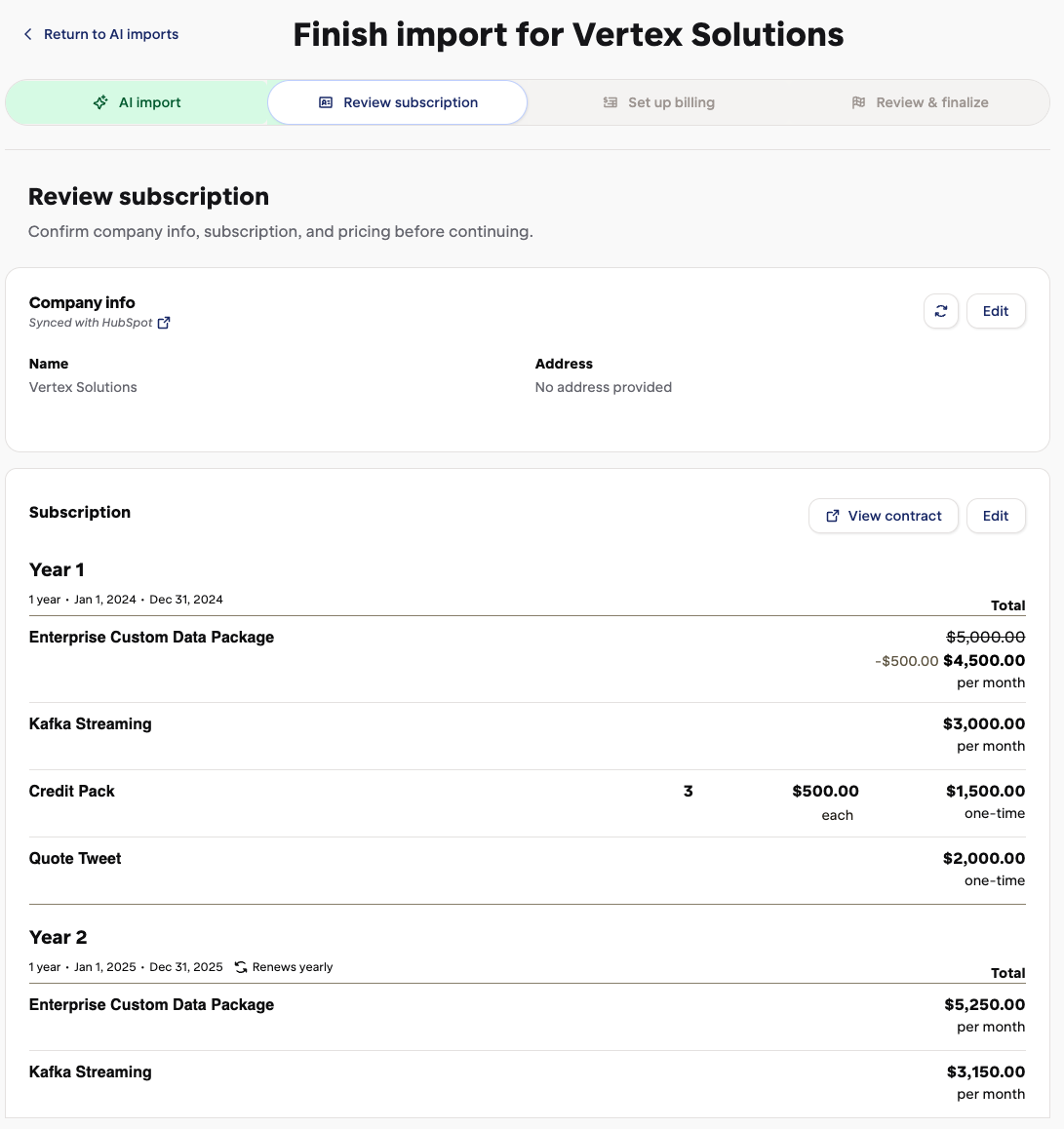
Structured contract management from day one prevents these reconstruction nightmares. When your quotes, contracts, and revenue schedules share the same underlying data (as with systems like Turnstile), revenue recognition consistency is automatic, not manual. You're not reconciling spreadsheets to PDFs; the contract terms exist as structured data your accounting systems can read.
Putting It Together: A Founder Scenario
This guide covers the fundamentals of ASC 606 for straightforward contracts. Real-world complexity increases when seat counts change mid-contract, pricing ramps over time, or service offerings evolve throughout the term. Those scenarios require more nuanced analysis, but the five-step framework still applies.
Say you close a $12,000 deal that includes a 12-month subscription (SSP of $11,000 based on what you typically sell it for standalone) and implementation services (SSP of $2,500). Implementation takes 6 weeks:
- Day 1: You record $13,500 as deferred revenue, which appears as a liability on your balance sheet.
- Week 6 (implementation complete): You recognize $2,700 in revenue for the implementation portion.
- Months 1-12: You recognize $900/month ($10,800 ÷ 12) as subscription revenue.
- End of Year 1: You have recognized $13,500 total, consisting of $2,700 from implementation plus $10,800 from subscription recognized monthly.
If implementation weren't distinct (meaning the customer couldn't benefit from it independently), you'd combine everything and recognize $1,125/month ($13,500 ÷ 12) over the subscription term instead.
The document-based quote builder in systems like Turnstile lets you negotiate deals naturally without configuration overhead, while the structured data underneath powers automated ASC 606 compliance. Pricing changes don't break downstream systems because contract terms exist as data your systems can read, not just text in PDFs sitting in folders.
Build the Audit Trail Investors Expect Without the Headache
ASC 606 compliance isn't complicated in theory. You recognize revenue as you deliver the contract’s performance obligations, not when you invoice or when cash arrives. The challenge is maintaining the documentation and audit trails that prove you're doing it correctly. When contract terms live in scattered PDFs, billing data sits in Stripe, and revenue tracking happens in spreadsheets, the reconciliation work becomes a weeks-long reconstruction project. The founders who avoid this pain are the ones who structure their contract data from the start.
Turnstile stores contract terms as structured data from day one. When a customer signs your quote, that signed quote IS the contract, and those terms automatically flow into revenue schedules without manual re-entry. You don't need to reconstruct contract history or reconcile disconnected systems. Your quote-to-cash workflow becomes the system of record for commercial terms, giving you the audit trail you need without the operational burden of maintaining it manually.
Book a demo to see how Turnstile automates revenue recognition compliance for sales-led B2B SaaS startups.


.png)
.png)