9 Best Billing Software Platforms in 2026
Compare the 9 best billing software platforms for sales-led B2B SaaS in 2026, organized by sales motion fit and graduation risk.
5 mins
June 8, 2026
Key Takeaways
- Sales motion matters most. The right billing platform depends on how you sell, because self-service checkout and negotiated contracts create different operational problems and demand different buyer experiences.
- Manual re-entry gets expensive fast. When signed contract terms do not flow into billing cleanly, teams spend time fixing invoices, correcting metrics, and chasing collections instead of running the business.
- Structured data changes the outcome. Platforms built on structured contract data invoice accurately, handle amendments cleanly, and keep reporting tied to signed agreements.
Most billing platforms work fine until the first custom deal closes. You picked the tool early, when standardized pricing covered every customer. Then a ramp, a mid-cycle amendment, or a one-time fee shows up that doesn't fit the plan model, and finance starts cleaning up by hand on every invoice.
The cost shows up everywhere. Invoices don't match the signed contract. Step-ups get missed. Discounts that should have expired keep running. Mid-cycle changes get prorated by hand, and the math isn't always right. Some of that becomes uncollected income, money you earned but never collected. Some becomes pricing mismatches at renewal that customers do notice.
This guide compares the nine billing platforms most often considered by sales-led B2B SaaS, organized by sales motion fit. Each section covers what the tool is built for, where it tends to create workarounds, and who it actually serves well.
Why Picking the Wrong Platform Is So Expensive
Platforms chosen too heavily for setup speed instead of sales motion fit usually cost more in manual work, billing errors, and cleanup than they save upfront.
OpenView's SaaS benchmarks found that 27% of SaaS companies don't even track what finance, tax, and compliance work costs them, while the ones who do track it report 5-9% or more of annual revenue going to that overhead. Manual finance work doesn't show up as a line item until something breaks, which is usually around the time a custom deal hits a billing platform that wasn't designed for it.
The nine platforms below are evaluated by how well they match specific sales motions, starting with the tools built for negotiated sales-led deals. A few are included as useful contrasts, because knowing which tools are stronger for product-led teams or more complex enterprise requirements helps you avoid buying a product built for the wrong motion.
The 9 Best Billing Software Platforms for Sales-Led SaaS
Every platform on this list handles billing for SaaS, but the scope varies. Some are pure billing engines focused on the invoicing and payment cycle. Some bundle quoting and billing into a single platform. Some are built specifically for subscription management, enterprise complexity, or international tax compliance.
The order here is intentional. It starts with tools that fit negotiated sales-led deals best, then moves into adjacent options that are stronger for more standardized self-serve motions or more complex enterprise requirements.
1. Turnstile
Turnstile is the billing platform designed for sales-led SaaS, with quoting and billing in a single system. Its core design principle is simple: contract terms are stored as structured data your systems can read and use, not just text in a PDF. That makes Turnstile a single system of record, the authoritative source of truth for signed agreements for sales, finance, and operations teams.
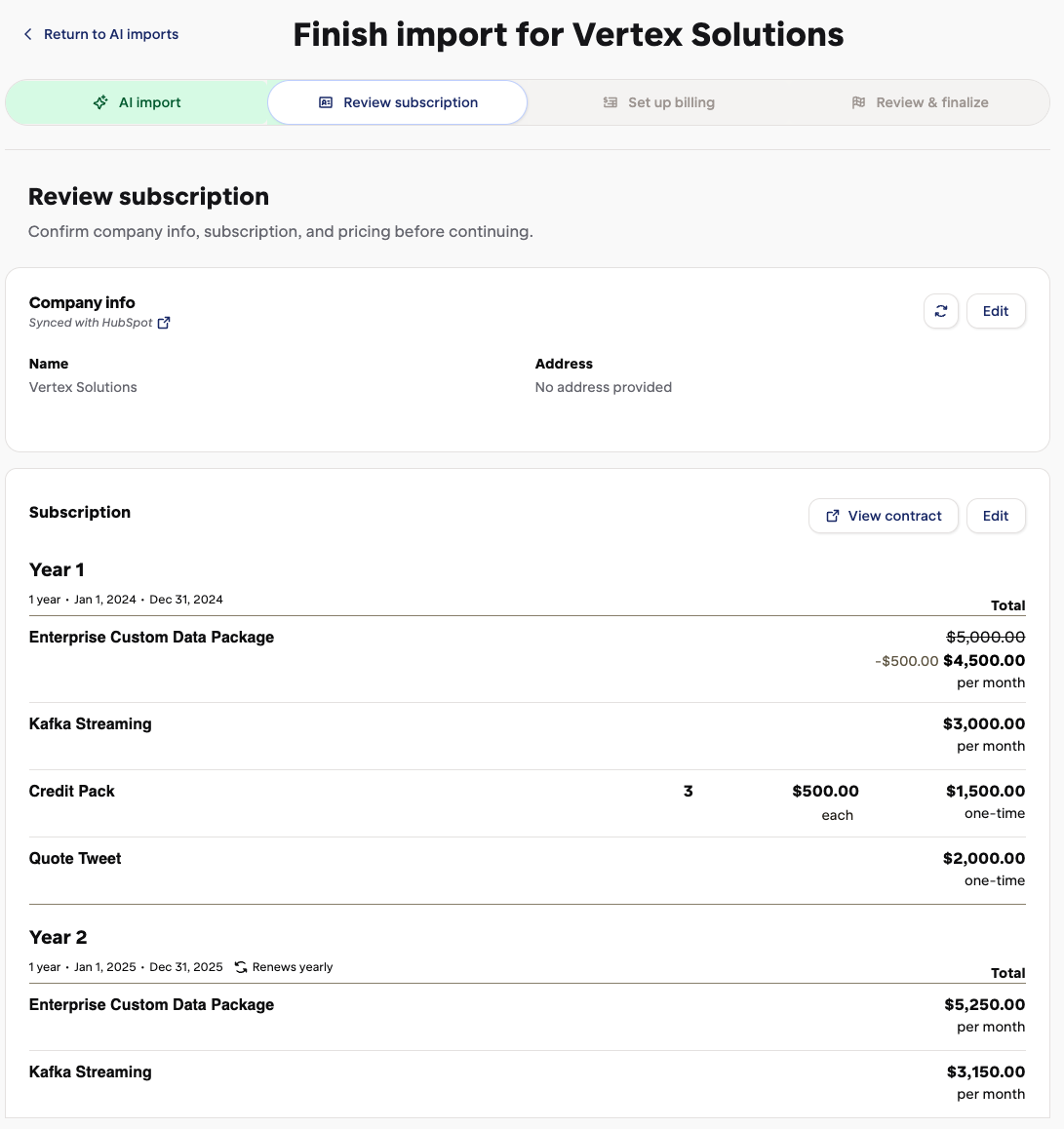
When a customer signs, subscription, billing, collections, and reporting workflows are configured automatically with no handoff and no data re-entry. The same platform serves the first $50K deal and the $500K renewal, so you start with the system you'll still be using at $20M+ ARR.
Pros:
- End-to-end coverage from the quote builder through invoicing, collections, and revenue dashboards in one platform; live in under a day with no implementation fees or engineering resources
- Handles mid-cycle amendments with partial-period adjustments and automatic invoice regeneration
- AI extracts terms from uploaded signed contracts and converts them into billing-ready subscriptions in minutes
Cons:
- Built for sales-led motions, so pure PLG companies with no negotiated deals won't need its contract-handling depth
Best for: Sales-led B2B SaaS companies handling negotiated deals that need one system of record for quoting, downstream billing workflows, collections, and reporting from the first deal onward.
2. Stripe Billing
Stripe Billing is often the default choice for product-led SaaS teams already using Stripe for payments. It handles standardized subscription tiers with automated checkout reliably and connects to the broader Stripe ecosystem of payment, tax, and fraud tools.
Originally, the platform wasn't designed for sales-led deals. When a rep closes a deal with custom pricing, a ramp schedule, or a mid-cycle amendment, the one-plan-per-customer model breaks. Finance ends up re-entering contract terms by hand, and the customizations live in spreadsheets next to the platform rather than inside it.
Pros:
- Excellent developer experience and strong documentation, with broad familiarity on engineering teams
- Strong multi-currency and global payment method support out of the box
- Self-service signup and invoicing flows that work out of the box for standardized plans
Cons:
- No native quoting or contract-to-billing handoff for negotiated deals
- Mid-cycle contract amendments require manual workarounds
Best for: Product-led SaaS teams with standardized self-service pricing tiers already using Stripe for payment processing.
3. Tabs
Tabs automates contract-to-cash workflows by ingesting signed contract data and generating invoices automatically. Its strength is import: companies sitting on a stack of legacy PDF contracts can use Tabs to turn that mess into billable subscriptions without changing the contracts upstream. Verified reviews report 90%+ reductions in invoicing time.
The trade-off is that import doesn't fix the upstream problem. Sales-led teams need structure and enablement at the point of quoting, where reps build quotes with structured terms that flow into billing without translation. A real CPQ front end provides that capability. Tabs cleans up what's already signed, but it doesn't align sales and finance on the same set of numbers, because it can only reconcile what's already in the PDFs and the PDFs themselves may be internally inconsistent.
Pros:
- Invoicing time reduced by 90%+ per verified user reviews
- Clean, intuitive UI for generating invoices and adjusting billing terms
- Accounting and reporting support through revenue schedule generation
Cons:
- No native quoting front end; reps build quotes elsewhere and Tabs ingests the signed result
- No controls/approvals on what is quoted since that happens outside Tabs. The quote may underprice, list incorrect product names, and more.
- Sales and finance can end up with different numbers, since alignment happens after the deal closes rather than at quote time
- Better suited to cleaning up an existing contract backlog than to running structured billing from your first signed deal or on a go-forward basis
Best for: Companies sitting on a stack of legacy PDF contracts that need to be turned into billable subscriptions.
4. Chargebee
Chargebee is a subscription management platform built for recurring billing at scale. It's strongest for companies operating an established catalog with thousands of subscribers, where the workflow is repeatable: standard tiers, predictable upgrade path, automated renewal. The platform has analyst recognition in the recurring billing category.
That recognition reflects the platform's design center. Chargebee wasn't originally built for heavily negotiated, deal-by-deal pricing, and Forrester's recurring billing review frames it as a fit for more straightforward subscription offerings. For sales-led teams whose first $50K deals all have custom ramps, one-off fees, and amendment cycles, the catalog-driven model adds workarounds rather than removing them.
Pros:
- Mature platform with broad feature coverage for standardized subscription billing
- Automated subscription management with minimal manual effort
- Consultative customer support praised by Forrester
Cons:
- Product development and feature rollouts are slower than customers would like
- Platform struggles with high-volume processing
- Heavier setup and configuration than founders running billing themselves typically need, leading to extended onboarding timelines
Best for: Subscription-first SaaS companies with standardized pricing tiers and growing subscriber volume that need recurring billing automation, less suited for companies with negotiated, non-catalog pricing.
5. Recurly
Recurly's documented strength is subscription lifecycle management and renewal automation. The platform centers on subscription billing, invoicing, and renewal workflows designed to reduce subscriber loss, with retry logic and reminder cadences that target involuntary churn specifically.
Recurly wasn't built for the front end of sales-led motions. Reps closing custom contracts with negotiated pricing, ramps, or one-time fees don't have a native quoting layer in Recurly, and complex usage-based billing typically requires upstream calculations passed in as totals. For companies whose primary revenue leak is failed payments on standard plans, Recurly fits well. For companies whose primary leak is misbilled custom contracts, it doesn't.
Pros:
- Automated renewal management and churn reduction as a primary differentiator
- Configurable retry logic and dunning cadences purpose-built to recover failed payments
- Clean subscription billing and invoicing workflow praised in verified user reviews
Cons:
- Less suited for complex billing models like usage-based pricing and sales-led quoting workflows
- Thin 3 Gartner Peer Insights analyst review footprint
Best for: Subscription businesses prioritizing automated renewal management and subscriber retention, not designed for sales-led teams with custom contracts.
6. Maxio
Maxio emerged from the merger of Chargify (billing) and SaaSOptics (financial reporting), creating a platform aimed at teams with a dedicated finance owner. Its positioning centers on revenue recognition, compliance-ready reporting, and investor-grade SaaS metrics: cohort retention, the SaaS Magic Number, bookings versus recognized revenue, and clean ASC 606 revenue recognition schedules.
Maxio fits best for companies with a dedicated finance hire who owns rev rec, audits, and board reporting. The platform automatically generates revenue and deferred revenue schedules across all revenue streams. The trade-off is implementation overhead. The setup time can mismatch the speed founders need at pre-Series A, when invoices need to go out this week, not after a multi-week implementation cycle.
Pros:
- Automated revenue recognition and compliance-ready reporting
- Investor-grade SaaS metrics (cohort retention, bookings vs. recognized revenue)
- QuickBooks Online, Xero, NetSuite, and Sage Intacct integrations
Cons:
- Fragmented architecture from the Chargify/SaaSOptics merger
- Rated among the weakest in invoicing, complex contracts, and global deployment in Gartner's 2025 Recurring Billing Magic Quadrant demo evaluation
Best for: Teams with a dedicated finance owner that need GAAP revenue recognition, ASC 606 rev rec compliance, and investor-grade reporting.
7. Zuora
Zuora is the enterprise incumbent in subscription billing. The platform supports highly configurable pricing models, multi-entity and multi-currency operations, and complex global workflows. For companies above $100M ARR with sophisticated billing requirements and a dedicated billing operations team, that depth is a real asset.
The practical constraint is operating burden. Zuora is 3-4 years down the maturity curve from where most sales-led companies start, and implementation typically takes months and requires dedicated partners or internal teams before the first invoice goes out. The platform was built for companies whose billing operations have become a function unto themselves, not for founders who need to send their first $50K invoice this week.
Pros:
- Strong analyst validation in the category
- Battle-tested at enterprise scale, with deep coverage of recurring, usage-based, and hybrid billing scenarios
- Highly configurable pricing models with deep compliance reporting
Cons:
- 6+ month implementation required with dedicated partners or internal teams
- Peer comparisons and user reviews commonly describe reporting as less flexible as setup complexity increases
Best for: Enterprises above $100M ARR with multi-entity operations, global billing complexity, and the budget and team to support a heavyweight rollout.
8. Zoho Billing
Zoho Billing is the billing component of the broader Zoho ecosystem. The platform integrates natively with Zoho CRM, Zoho Books, and the rest of the Zoho stack. Forrester's Zoho coverage highlights global data center ownership as a differentiator for companies prioritizing data residency and regulatory certainty.
The value of Zoho Billing scales with how much of your business already runs inside Zoho. Companies on Salesforce, HubSpot, or other non-Zoho CRMs face additional integration work, and the platform wasn't designed for the negotiated, sales-led deal flow that sales-led B2B SaaS companies run. For teams already committed to the Zoho stack with relatively standardized billing needs, it fits cleanly.
Pros:
- Deep integration across the broader Zoho suite
- Data residency options and global data center ownership
- Minimal setup overhead for teams already on the Zoho stack
Cons:
- Value maximized only within the Zoho ecosystem; non-Zoho CRM users face friction
- Limited customization for ramped, amended, or hybrid pricing common in sales-led deals
- Less mature subscription automation than purpose-built billing platforms
Best for: Teams already committed to the Zoho stack that want consolidated billing within their existing ecosystem and have limited customizations/negotiations to their deals.
9. Paddle
Paddle operates as a Merchant of Record (MoR), meaning Paddle becomes the legal seller in your customer transactions and handles global VAT and sales tax compliance automatically. For SaaS companies selling internationally who want to avoid managing tax obligations across multiple jurisdictions, that simplification has real value.
However, the MoR structure creates friction for sales-led companies selling to Enterprise customers who often push back when the legal seller is a third party rather than the company they negotiated with directly. A 2025 legal analysis documented a $5 million FTC settlement and enhanced monitoring obligations for Paddle, which adds further scrutiny during procurement review.
Pros:
- Global tax compliance is handled by Paddle as Merchant of Record
- Checkout, payment, subscription management, invoicing, and international taxes in one flow
- Wide global payment method support beyond credit cards
Cons:
- MoR model means Paddle is the legal seller, creating enterprise procurement friction
- 2025 FTC settlement ($5M fine, enhanced monitoring) documented in legal analysis
- Less suited for sales-led companies with negotiated contracts requiring direct seller relationships
Best for: Self-serve or product-led SaaS companies selling software globally that require automated international tax compliance.
Knowing what each platform does well and where it breaks down is half the decision. The other half is matching the tool to your actual deal flow. After narrowing tools by category, use the next section to pressure-test whether a shortlist fits your contracts, team size, and stage.
How to Choose the Best Platform for Your Sales Motion
The right platform matches how you actually close deals today and scales with how you'll sell three years from now. After narrowing by category, pressure-test your shortlist against these six operational questions.
- Match the tool to your sales motion. Product-led companies with self-service signups can use simpler billing tools. Sales-led companies with negotiated pricing need platforms that store contract terms as structured data and generate invoices from those specific terms.
- Pressure-test the platform's pricing complexity. Confirm the tool handles your real deal structures: recurring subscriptions, ramps, volume tiers, hybrid models, and custom one-offs. If every deal involves something off-catalog, choose tools built for negotiated, deal-by-deal pricing instead of catalog-driven subscription tiers.
- Look for quoting and billing in the same system. When a rep closes a deal, signed contract terms should configure billing automatically. Platforms that require manual re-entry from signed PDFs are prone to human data entry error and waste your team’s time.
- Prioritize automated mid-cycle change handling. Upgrades, downgrades, and amendments happen constantly. The platform should calculate proration and adjust downstream invoices automatically, without your finance lead running the math by hand.
- Verify the integrations you'll actually need. At minimum, connect with your payment processor, CRM, accounting system, and e-signature tool (or built-in signing).
- Separate must-haves from complex future overhead. Multi-entity support, complex approval routing, and advanced revenue recognition add cost without solving problems most early-stage companies face. Focus on what your team needs at this stage.
This matters in day-to-day operations first. Founders need clean numbers to decide when to hire. A finance lead needs invoices, renewals, and deferred revenue to reconcile back to signed contracts. An ops hire needs a system that new reps can use without creating cleanup work downstream. Investors and diligence teams will ask the same questions later. If those numbers live across spreadsheets and disconnected tools, fundraising gets slower and your revenue is harder to defend.
Pick the Platform You’ll Never Outgrow
The right billing platform turns signed contracts into accurate invoices without manual cleanup, mid-cycle reconciliation, or quarterly explanations to investors. The wrong one keeps you paying for the same problem over and over: every custom deal, every renewal, every reporting cycle.
For sales-led B2B SaaS, Turnstile pulls signed contract terms straight into billing, so each invoice matches what the customer agreed to. Most subscription invoicing options handle the post-contract cycle; Turnstile combines quoting, subscription management, collections, and revenue reporting in a single platform, so the system you start with at the first $50K deal still works at $20M+ ARR.
Book a demo to see how Turnstile turns signed contracts into accurate invoices for sales-led B2B SaaS companies.


.png)
.png)