8 Best Recurring Billing Software Tools
Recurring billing software automates invoicing and payment collection for SaaS. This guide compares the top 8 tools.
5 mins
January 15, 2026
Key Takeaways
Recurring billing software automates the cycle of generating invoices, collecting payments, and tracking subscription revenue on a set schedule. For sales-led SaaS founders, the right tool turns signed contracts into active subscriptions automatically, handling custom pricing, mid-cycle changes, and renewals without manual tracking.
This guide compares eight recurring billing tools by fit for specific use cases, so you can choose a system that matches your sales motion and won't require replacement as you scale.
1. Turnstile: Best for Sales-Led B2B SaaS From Day One
Sales-led companies need billing that understands custom contracts and negotiated pricing from the start. Turnstile is a quote-to-cash platform that lets founders send their first quote in minutes and scales without requiring replacement as complexity increases.
Turnstile’s capabilities for recurring billing include:
- Signed contracts automatically become active subscriptions, with invoices, proration, and ASC 606-ready revenue recognition generated from the contract terms
- WYSIWYG Drag-and-drop quote builder with embedded e-signature and checkout capabilities
- Support for recurring, usage-based, and hybrid pricing models
- Automated mid-cycle changes and renewal management
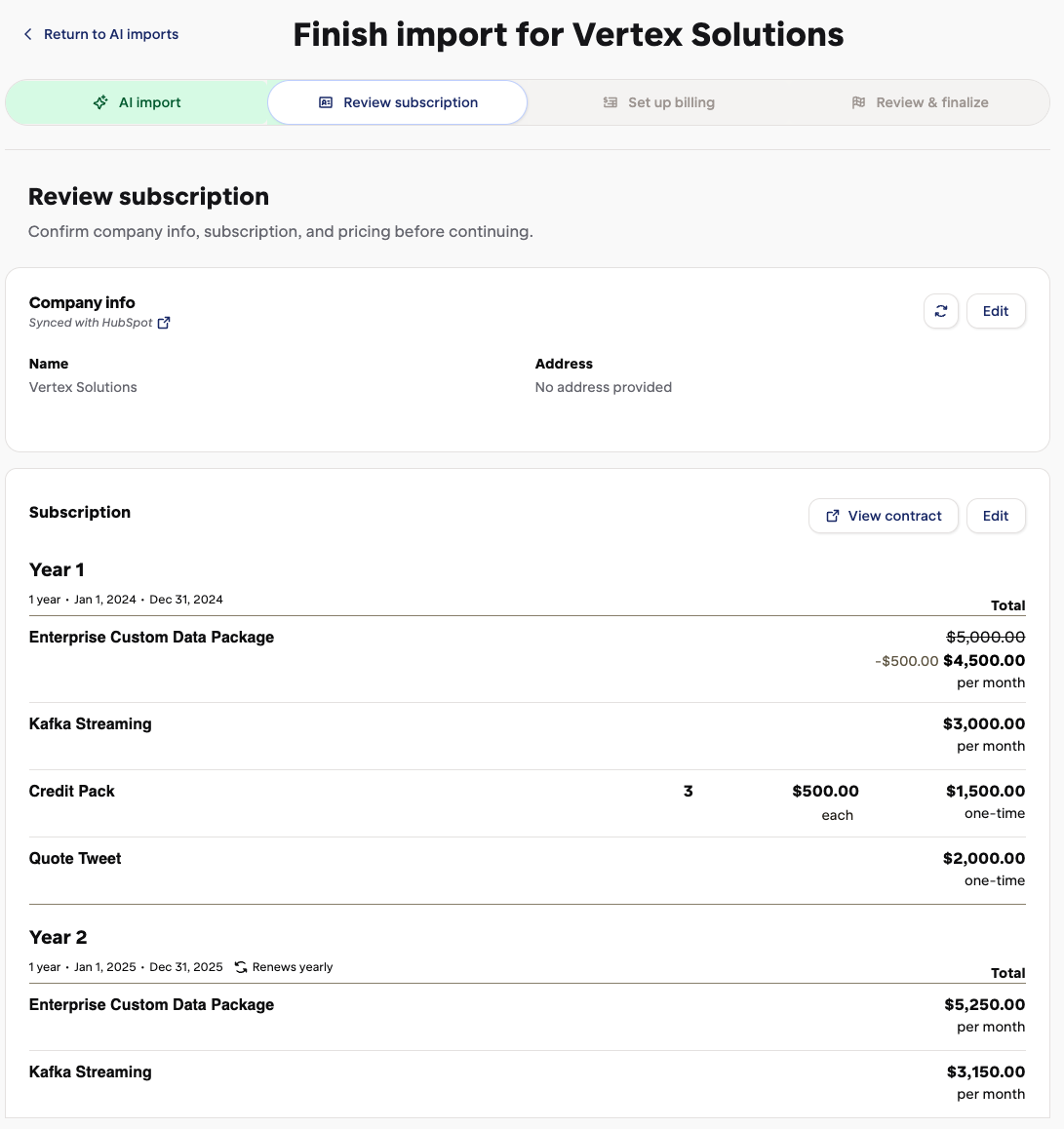
- AI-powered contract extraction that converts uploaded agreements into billing-ready subscriptions
- Support for AI agents
- Support for multiple entities and currencies
Pricing: $100 platform fee plus a percentage of billing volume (0.6%). Custom pricing available for high-volume or unique business models.
Best for: Pre-seed to Series B companies and beyond, sales-led motion, and growing pricing complexity. Founders and finance teams who want documented, scalable processes and want to build on a strong foundation for growth.
Limitations: Less suited for pure product-led growth companies with simple self-service plans and no custom deals.
2. Stripe Billing: Best for Product-Led Teams Already on Stripe
Teams already processing payments through Stripe can add simple subscription management without setting up on a new platform. Stripe Billing layers subscription and usage-based billing onto existing payment infrastructure, with a hosted customer portal for self-service account management.
Key capabilities:
- Native integration with Stripe payments, requiring no additional payment gateway setup
- Usage billing through the Meters API for consumption-based pricing
- Hosted customer portal for subscription and payment management
- Invoice customization and automated payment retries
Pricing: 0.7% of recurring billing volume plus standard payment processing fees
Best for: Product-led teams with straightforward subscription tiers who want to move fast without adding new vendors.
Limitations: The one-plan-per-customer model breaks down with sales-led and negotiated deals. Sales-led companies with flexible pricing end up building manual workarounds, and the percentage-of-revenue fee structure scales poorly as ARR grows.
3. Chargebee: Best for Subscription-First SaaS at Scale
When you have established pricing tiers and thousands of subscribers, Chargebee's mature automation handles the complexity of upgrades, downgrades, and renewals across your customer base. The platform excels at catalog-driven subscription management rather than deal-by-deal customization.
Key capabilities:
- Mature automation for renewals, upgrades, and downgrades
- Smart dunning workflows with configurable retry schedules
- Multi-gateway support beyond a single payment processor
- Revenue recognition and SaaS metrics reporting
Pricing: Billing is free for the first $250k per year, then 0.75%. CPQ, revenue recognition and subscription management pricing varies based on features and volume. Enterprise pricing available.
Best for: SaaS companies with thousands of subscribers and established subscription tiers who need robust automation.
Limitations: Pricing tiers and implementation overhead suit mid-market teams better than founders handling billing on nights and weekends. Limited native support for heavily negotiated, deal-by-deal pricing.
4. Recurly: Best for Churn and Dunning Optimization
Failed payments quietly destroy subscription revenue. Cards expire, payment methods change, and customers churn without intending to leave. Recurly's dunning workflows and retry optimization specifically target this revenue leak, helping recover payments that would otherwise disappear.
Key capabilities:
- Intelligent dunning automation with optimized retry timing
- Churn analytics identifying at-risk subscriptions
- Support for common SaaS billing patterns and plan structures
- Customer portal for self-service subscription management
Pricing: Contact sales; pricing based on revenue volume
Best for: Subscription businesses where involuntary churn from failed payments represents a significant revenue leak.
Limitations: The platform assumes you calculate usage elsewhere and pass totals in for invoicing, making it less suited for complex real-time usage billing. Sales-led companies with heavily customized contracts may find the workflow limiting.
5. Maxio: Best for Finance-Led Teams Needing GAAP-Level Reporting
Companies with a dedicated finance hire who owns rev rec, audits, and board reporting need different capabilities than founder-led operations. Maxio combines subscription billing, revenue recognition, and SaaS metrics for teams where audit-ready reporting is a requirement.
Key capabilities:
- GAAP-compliant revenue recognition with ASC 606 support
- Multi-currency billing for international customers
- Deep Salesforce integration for sales-led workflows
- Comprehensive SaaS metrics and financial reporting
Pricing: Contact sales; pricing varies by feature set and volume
Best for: Series A and beyond companies with dedicated finance leadership who need compliant revenue recognition and investor-ready reporting.
Limitations: Higher pricing and finance-heavy workflows add complexity early-stage founders don't need. Implementation typically requires weeks of setup time and often involves professional services fees ranging from several thousand dollars. This can make it poorly matched for founders who need to send invoices this week.
6. Zuora: Best for Complex Enterprise Billing
When subscription billing requires dedicated cross-team programs (multiple entities, global operations, complex usage scenarios), Zuora provides the enterprise infrastructure to support it. The platform handles sophisticated recurring and usage billing for companies where billing operations have become a function unto themselves.
Key capabilities:
- Highly configurable product catalog and pricing models
- Complex workflow automation for enterprise billing processes
- Multi-entity and multi-currency support for global operations
- Advanced usage rating and billing scenarios
Pricing: Contact sales; enterprise pricing based on implementation scope
Best for: Companies above $10M ARR with complex billing requirements, multiple entities, and dedicated billing operations teams.
Limitations: Implementation typically takes three months or longer and costs tens of thousands of dollars in professional services fees before you send your first invoice. The platform's power comes with complexity that requires dedicated resources to manage, making Zuora poorly matched for sub-$10M ARR startups who need billing working this quarter, not next year.
7. Zoho Billing: Best for Small Teams Already in the Zoho Stack
Teams committed to Zoho's ecosystem can add billing without introducing another vendor relationship. Zoho Billing handles recurring invoices, subscriptions, and payments while integrating natively with Zoho CRM and Zoho Books.
Key capabilities:
- Simple recurring invoicing and subscription plan management
- Native integration with Zoho CRM, Books, and other Zoho products
- Payment gateway connections for common processors
- Customer portal for invoice access and payment management
Pricing: Starts at $15/month for basic plans; higher tiers available
Best for: Small teams and freelancers already using Zoho products who want consolidated billing within their existing stack.
Limitations: Not built for nuanced sales-led pricing or advanced quote-to-cash workflows. Better suited for simple subscription models than complex negotiated deals.
8. Paddle: Best for Merchant-of-Record Simplicity
Selling internationally means managing sales tax and VAT across multiple jurisdictions. Paddle operates as a merchant of record, taking on tax compliance so you don't manage payment infrastructure directly.
Key capabilities:
- Merchant-of-record model eliminates tax compliance burden
- Subscription billing with upgrade, downgrade, and cancellation handling
- Global payment methods without individual gateway relationships
- Revenue delivery directly to your bank account
Pricing: Percentage of revenue; contact sales for specific rates
Best for: SaaS companies selling internationally who want to avoid managing tax compliance across multiple jurisdictions.
Limitations: The merchant-of-record model means giving up control over the customer payment relationship. Less suited for sales-led companies with complex negotiated contracts, as Paddle's strength lies in standardized checkout flows.
How to Choose the Right Recurring Billing Software
The right billing tool depends on how you sell, not just what features sound useful. Sales-led companies with custom contracts need different capabilities than product-led teams with standardized pricing.
We recommend using this checklist to evaluate which platform fits your current motion and where you're headed:
- Match the tool to your sales motion. Product-led companies with self-service signups can use simpler billing tools. Sales-led companies with negotiated pricing need platforms that store contract terms as structured data and generate invoices from those specific terms.
- Evaluate billing model support. Confirm the platform handles your pricing complexity: recurring subscriptions, usage-based components, tiered pricing, and hybrid models. If every deal involves custom terms, avoid tools built for catalog-driven subscription tiers.
- Check for quote-to-cash integration. Look for built-in quote generation, e-signature capability, and contract terms that automatically drive billing. Platforms requiring manual re-entry from signed PDFs create the same gaps you're trying to eliminate.
- Prioritize mid-cycle change handling. Upgrades, downgrades, and amendments happen constantly. The platform should recalculate prorations and adjust downstream invoices automatically without manual intervention.
- Verify your integration requirements. At minimum, connect with your payment processor, CRM, and accounting system. For sales-led companies, e-signature integration (or built-in signing) eliminates the gap between closed deal and active subscription.
- Separate must-haves from enterprise overhead. Multi-entity support, complex approval workflows, and advanced revenue recognition add cost without solving problems most early-stage companies face. Focus on what you need now, not what larger more mature enterprises require.
The tool you select now becomes the foundation for every customer, renewal, and mid-cycle change you manage. Choose the platform that fits your current sales motion and pricing complexity, then let it grow with you rather than forcing a rebuild.
Stop Losing Revenue to Manual Billing Gaps
The right recurring billing software turns signed contracts into collected revenue without manual tracking, forgotten invoices, or spreadsheet chaos. For sales-led SaaS founders, that means choosing a platform built for custom pricing and negotiated deals from day one, not retrofitting product-led tools with manual workarounds.
Turnstile automates the entire quote-to-cash cycle, so contracts automatically become active subscriptions. Book a demo to see how sales-led teams eliminate billing gaps from the first customer through scale.
FAQs About Recurring Billing Software
What is recurring billing software?
Recurring billing software automates the cycle of generating invoices, collecting payments, and tracking subscription revenue on a set schedule.
What's the difference between recurring billing software and subscription management software?
Recurring billing software focuses on the invoicing and payment collection cycle: generating invoices, processing payments, handling failed payments, and tracking what's been paid. Subscription management software handles the broader customer relationship, including plan configurations, upgrades, downgrades, cancellations, and renewal workflows. Many platforms combine both functions, but some billing tools assume you manage subscriptions elsewhere and just pass them invoice amounts.
When should a startup switch from manual billing to recurring billing software?
The switch typically makes sense when manual processes start causing problems: you forget to invoice customers, discounts don't expire when they should, or your billing numbers don't match your CRM. For most startups, this happens somewhere between 10 and 20 customers. Another common trigger is hiring your first sales rep and realizing your billing process exists entirely in your head with no documentation or system anyone else can follow.
Can recurring billing software handle custom contracts and negotiated pricing?
Not all platforms handle sales-led complexity equally. Tools built for product-led growth assume standardized plans where every customer on a tier pays the same price. Sales-led companies with negotiated discounts, custom terms, and deal-by-deal pricing need platforms that store contract terms as structured data and generate invoices from those specific terms. If your deals regularly include one-time fees, ramped pricing, or mid-contract amendments, evaluate whether the platform handles exceptions natively or forces manual workarounds.
What integrations should recurring billing software have?
At minimum, your billing software should connect with your payment processor, your CRM (HubSpot, Salesforce), and your accounting system (QuickBooks, Xero). If you bill based on product usage, you'll also need integration with whatever system tracks that data so usage flows directly into invoices without manual exports.
These integrations prevent manual data entry between systems and keep revenue numbers consistent across sales, finance, and operations. For sales-led companies, integration with e-signature tools or built-in signing capability eliminates the gap between closed deal and active subscription.


.png)
.png)