What Is The Accounts Receivable Turnover Ratio?
The Accounts Receivable turnover ratio shows how fast you collect payments. Learn how to calculate it and what healthy ratios look like for B2B SaaS.
5 mins
February 16, 2026
.png)
Key Takeaways
The Accounts Receivable (AR) turnover ratio measures how efficiently you convert outstanding invoices into cash you can actually spend. It tells you how many times per year you cycle through your entire AR balance. The higher the number, the faster customers pay.
For sales-led B2B SaaS founders, this metric matters because the cash you're counting on to make next month's payroll is stuck in your customers' bank accounts until they pay. That $15,000 annual contract with upfront billing you celebrated closing? It's not real money until it actually arrives. If that customer takes 90 days to pay instead of 30, you're essentially providing them an interest-free loan with cash you need for AWS bills and salaries.
This guide covers how to calculate AR turnover, what healthy benchmarks look like for your business model, how to track the metric effectively, and practical strategies for improving collection efficiency.
What Does Accounts Receivable Turnover Ratio Tell You?
AR turnover reveals collection efficiency: how many times per year you actually convert outstanding invoices into cash you can spend. A ratio of eight, for example, means you're cycling through your entire AR balance eight times annually, collecting payments roughly every 45 days. Higher ratios indicate faster collection cycles and more frequent cash conversion, while lower ratios signal that receivables are aging and cash is tied up longer than optimal.
When you see your ratio drop from 10 to 6, it means cash that used to arrive in 36 days is now taking 60 days. That extra 24-day delay across your entire customer base affects how confidently you can plan hiring, marketing spend, and other growth investments.
A declining ratio between quarters signals either deteriorating customer quality or collection process failures that compound over time. Even with healthy runway, slower collections create unnecessary friction in financial planning and can mask underlying customer health issues.
Accurate, real-time AR tracking also matters for external credibility. Investors, lenders, and potential acquirers will request your AR aging report and compare it to your stated DSO (Days Sales Outstanding, the average number of days it takes to collect payment). Discrepancies signal either collection problems or sloppy financial operations.
Having unified visibility into every invoice's status from a single system that ties back to signed contract terms gives you defensible AR metrics whenever you need them.
How To Calculate Accounts Receivable Turnover Ratio
The formula:
AR Turnover Ratio = Net Credit Sales ÷ Average Accounts ReceivableThe numerator is everything you've invoiced on credit terms during the period. The denominator is how much typically sits unpaid at any given time. Divide one by the other and you get how many times per year cash actually cycles through your receivables.
A ratio of 12 means you're collecting your entire average AR balance once per month. A ratio of 6 means it takes two months on average. Higher numbers mean faster payments and less cash tied up in unpaid invoices.
1. Determine net credit sales
Net credit sales represent revenue you've invoiced on credit terms, not total ARR or cash collected before the invoice due date. Exclude prepaid annual contracts you haven't invoiced yet, and subtract any early payment discounts offered.
For a $1.2M ARR company invoicing on Net 30 terms:
- Total invoiced revenue: $1,200,000
- Less early payment discounts: -$20,000
- Net credit sales: $1,180,000
The critical distinction most founders miss: a $12,000 annual contract invoiced with Net 5 terms spends very little time in AR compared to the same contract invoiced with Net 60 terms, assuming both are paid by the due date. That same contract invoiced with Net 30 terms counts the full $12,000 in credit sales and sits in AR until cash arrives.
2. Calculate average accounts receivable
Average accounts receivable is the typical amount of unpaid invoices you're carrying at any given time. You calculate it by taking your AR balance at the start and end of a period and averaging them. This smooths out seasonal swings and one-time spikes, giving you a more accurate picture of your normal collection workload.
Pull your AR balance at the beginning and end of your measurement period, then calculate the average them. For an annual calculation in QuickBooks, go to Reports > Balance Sheet, set to January 1 for the beginning balance, then December 31 for the ending balance. Add those numbers and divide by two.
Using the same $1.2M ARR company from the previous example:
- Beginning AR balance (January 1): $95,000
- Ending AR balance (December 31): $85,000
- Average AR: ($95,000 + $85,000) ÷ 2 = $90,000
3. Divide net credit sales by average AR
The result tells you how many times per year you cycle through your receivables.
- AR Turnover: $1,180,000 ÷ $90,000 = 13.11 times per year
Converting to collection days: 365 days ÷ 13.11 = 27.8 days average collection period. With Net 30 terms, collecting in 27.8 days indicates healthy operations. Customers pay slightly ahead of terms on average.
Once you've calculated your ratio, you need context to know if it's healthy for your specific business model.
What Is a Good Accounts Receivable Turnover Ratio for B2B SaaS?
For B2B SaaS companies, a higher accounts receivable turnover ratio generally reflects faster, healthier cash collections. Many software businesses aim for turnover in the mid‑single to high‑single digits annually, which corresponds to collection periods of roughly one to two months. When turnover falls well below typical software benchmarks and collection cycles extend beyond about two and a half months, it can indicate structural issues in billing or collections processes that warrant closer review.
These aggregate benchmarks obscure that your target customer segment fundamentally determines your natural collection pattern. DSO benchmarks only make sense in the context of the payment terms you're offering.
According to data from KPMG’s Technology CFO Survey, summarized by Monetizely:
- Enterprise-focused SaaS ($50K+ ACV): Typically Net 45-60 terms, 45-60 days DSO (6.1-8.1x turnover)
- Mid-market-focused SaaS ($15K-50K ACV): Typically Net 30 terms, 30-45 days DSO (8.1-12.2x turnover)
- SMB-focused SaaS ($5K-15K ACV): Typically Net 15-30 terms, 15-30 days DSO (12.2-24.3x turnover)
Note that these turnover numbers show the standard relationship between DSO and accounts receivable turnover (turnover ≈ 365 ÷ DSO).
The key metric is how your actual DSO compares to your contracted payment terms. A 45-day DSO looks healthy if you're offering Net 60 terms (customers paying 15 days early on average), but signals collection problems if you're offering Net 30 terms (customers paying 15 days late on average). Always evaluate DSO relative to the terms you've extended, not against absolute benchmarks.
An enterprise-focused startup closing $25,000 annual contracts with Net 60 terms shouldn't benchmark against product-led competitors with Net 15 terms. You'll always appear slower even when collections are efficient for your model.
The more revealing metric is AR aging distribution. ResolvePay's analysis shows healthy companies maintain 60-70% of total AR concentrated in the 0-30 day bucket, 20-25% in 31-60 days, less than 10% in 61-90 days, and under 15% over 90 days. If your aging buckets don't roughly match this distribution regardless of your absolute turnover number, you have collection problems.
Track your own trend rather than obsessing over industry benchmarks. What matters most is whether your collection efficiency is improving quarter-over-quarter. If your AR turnover improves consistently and aging buckets concentrate increasingly in 0-30 days, you're moving in the right direction.
How To Track Accounts Receivable Turnover Ratio
Calculate your AR turnover ratio monthly as part of standard financial reviews, not daily or weekly. High-frequency metric tracking can be noisy rather than useful. What matters is whether your overall collection cycle is extending or contracting over time.
Complement monthly AR turnover calculation with weekly operational monitoring of actual cash collections and outstanding invoices:
- Cash in bank: Track weekly to catch collection delays early.
- Invoices exceeding 30 days: Flag these for immediate follow-up.
- AR aging buckets: Monitor the percentage of total AR in 0-30, 31-60, 61-90, and 90+ day categories weekly.
According to Kaplan Collection Agency, SaaS companies with Net 30 terms should keep 60-70% of AR in the 0-30 day bucket for healthy cash flow. If you offer longer terms like Net 60, adjust your target buckets accordingly. When these percentages shift unexpectedly, it signals collection problems before they appear as cash shortfalls.
The operational challenge: tracking these metrics manually across dozens of customers requires pulling AR balances from QuickBooks, invoice terms from signed PDFs, actual collection dates from bank statements, and reconciling discrepancies between systems. When you're managing 20+ active contracts, this reconstruction takes 3-4 hours monthly and introduces errors that make your AR calculations unreliable.
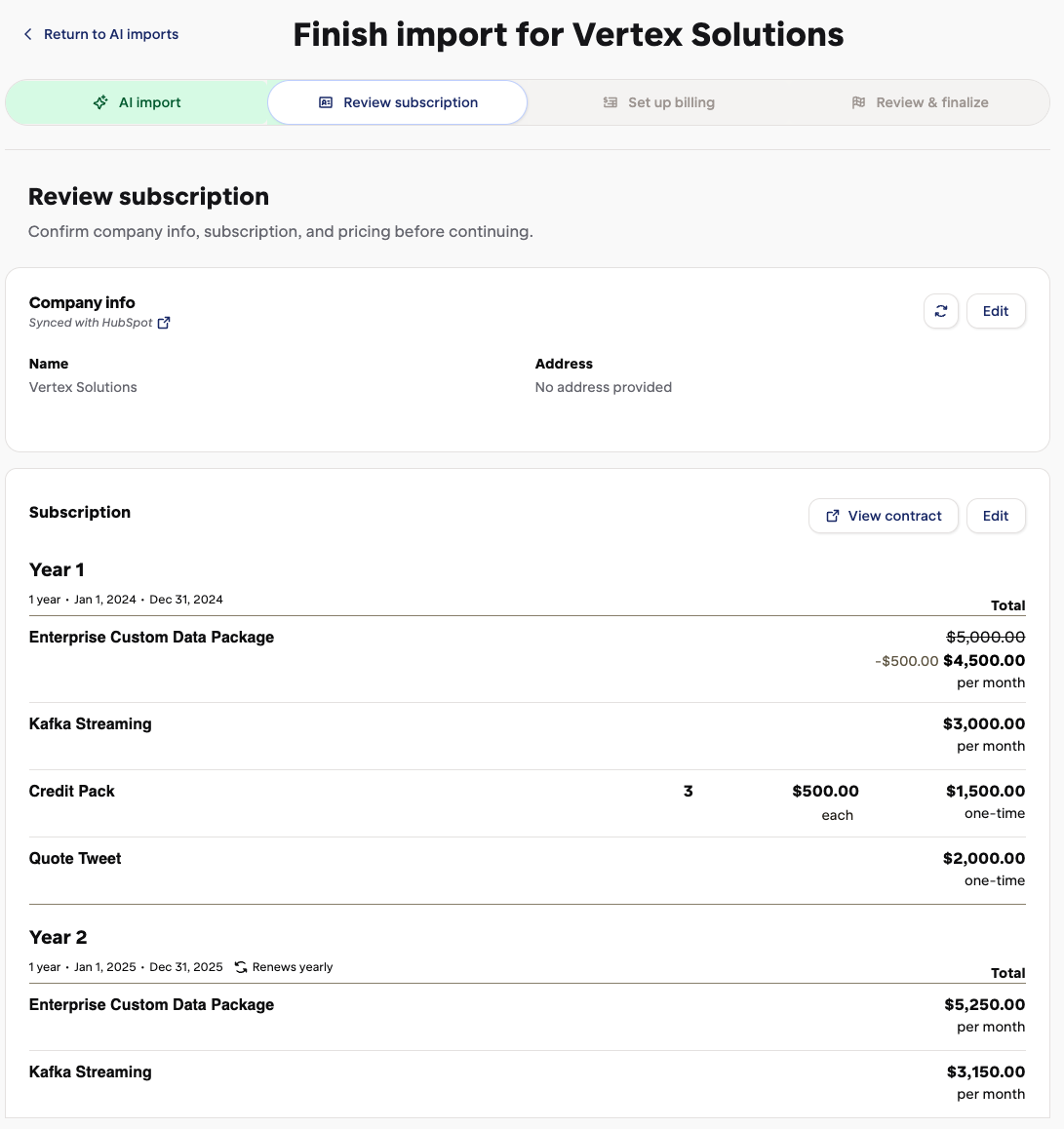
Turnstile eliminates this by storing contract terms as structured data from day one. When you create a quote, billing schedules and pricing are already configured as data, not buried in PDF contracts. Your AR calculations reflect actual operational reality automatically, not manual reconstructions from spreadsheets.
What Are the Limitations of the Accounts Receivable Turnover Ratio?
While AR turnover provides valuable insight into collection efficiency, it has several limitations that require supplementing it with other metrics.
- Invoicing frequency affects the ratio independent of collection efficiency. A company shifting from monthly invoicing to annual invoicing will see AR turnover decline dramatically, even if customers continue paying on the same terms. A $15,000 annual contract invoiced once per year creates a single large receivable entry, while that same contract invoiced monthly creates twelve smaller receivable entries cycling through AR more frequently. The metric can signal a change in billing cadence rather than a change in how quickly customers pay.
- The ratio hides problem concentration. A 6x turnover ratio could mean healthy collections across 50 customers with one invoice stuck at 90 days, or chronic delays across your entire base. AR turnover alone doesn't distinguish between these scenarios.
- Longer payment terms look like collection problems. If you're offering Net 60 terms while benchmark companies use Net 30, your AR turnover will appear worse even when customers pay within the terms you offered. A "slow" ratio might reflect your payment term strategy, not collection failures.
- Aging risk is invisible in aggregate numbers. According to ResolvePay, receivables overdue by 60+ days show 35-50% annual churn rates. This risk is invisible in the aggregate ratio.
For complete visibility, analyze AR turnover alongside AR aging buckets and cash flow metrics. The ratio signals that collection speed is changing; aging buckets reveal where problems concentrate; DSO relative to contracted terms shows whether issues stem from invoice terms or collection failures.
How To Improve Your Accounts Receivable Turnover Ratio
Improving AR turnover requires addressing collection efficiency at multiple points: before deals close, when invoices are sent, and as due dates approach.
1. Structure invoice terms by customer risk before closing deals
Established companies with verified funding receive Net 60 terms, growing companies get Net 30, and startups under six months old receive Net 15 or due upon receipt terms. This assessment during sales using LinkedIn verification and basic research prevents AR problems before they start.
2. Offer a direct payment link for smaller customers
Include a payment link on invoices that lets customers pay via ACH debit through your payment provider. Smaller companies without dedicated accounts payable teams often find it easier to click a link and enter their bank details rather than to log into their banking system and initiate an ACH credit.
This removes friction and speeds up collection for customers who don't have formal AP processes. Once you have their ACH debit information on file, you can also set up autopay for recurring invoices, eliminating collection delays entirely for future billing cycles.
3. Include clear payment instructions on every invoice
Every invoice should include virtual bank account numbers for ACH payments and wire transfer details directly on the document. Virtual account numbers assign a unique receiving account to each customer, so incoming payments automatically match to the correct invoice without manual reconciliation.
With a standard bank account number, you receive all payments into one account and must manually identify which customer sent each transfer. To make payment even easier, repeat these details in the email when you send the invoice. For customers with established accounting systems, provide vendor setup documentation upfront to eliminate delays in their internal processing workflow.
4. Automate proactive reminders before invoices become overdue
Send reminders 60 days before due dates, 30 days before, and 7 days before. This cadence gives enterprise customers time to route approvals through procurement systems, preventing lateness rather than responding to it.
According to The Paypers, proactive communication reduces late collections by 40-60%. Setting up this dunning process requires 2-3 hours of initial configuration in your billing platform, then operates automatically.
5. Consider early payment discounts strategically
Offering 2% discounts for payment within 10 days while maintaining Net 30 standard terms (the "2/10 Net 30" structure) can convert extended collection cycles into faster cash. That tradeoff often makes sense when faster cash collection lets you reinvest sooner in growth.
All of these improvements require real-time visibility into which customers have signed contracts but haven't been invoiced. Because Turnstile stores contract terms as structured data when you create quotes, invoices generate automatically when contracts are signed. No manual setup, no invoices lost in email folders, no revenue sitting unbilled.
Track AR from Day One
Your AR turnover ratio is only as reliable as the data behind it. When contract terms live in PDFs, billing schedules exist in spreadsheets, and invoice dates are manually tracked across systems, you're spending hours reconstructing numbers that should be calculated automatically. And the results are often wrong.
Turnstile treats contracts as structured data from the moment you create a quote. Payment terms, billing schedules and pricing are configured when the customer signs. No re-entry, no manual setup, no gap between closed deal and sent invoice. Your AR calculations reflect actual operational reality, giving you accurate visibility into your cash collection timeline whenever you need it.
The time to fix these operational foundations is before cash flow problems appear, when you're creating your first quote. Book a demo to see how Turnstile eliminates the manual tracking that makes AR metrics unreliable for sales-led B2B SaaS startups.


.png)
.png)