The Quote-to-Cash Process: From First Proposal to Paid Invoice
What goes into a quote, why structured quote data matters, and how to capture deal terms as structured data so billing runs without manual re-entry.
5 mins
April 20, 2026
Key Takeaways
- A quote trapped in a PDF means interpretation and manual re-entry into billing. That's where wrong amounts, missed ramp increases, and discounts that never expire all start.
- Eight key elements determine most billing accuracy: pricing, billing schedule, payment terms, contract dates, renewal conditions, multi-year ramps, discount expiration, and administrative details.
- Structured quote data means billing can follow the contract automatically from the moment it's signed.
A sales-led B2B quote is where your quote-to-cash process is either set up for success or quietly starts to break down. Get it right, and billing, invoicing, and renewals run consistently, often automatically. Get it wrong, and you spend every month untangling discrepancies between what was sold and what finance bills: wrong amounts, expired discounts that keep running, invoices going to the wrong contact, and ARR numbers that don't match what's in your CRM.
Most of those problems trace back to the same root cause: the quote existed as a document someone read, not as structured data a system could act on. So, someone had to manually enter all the terms from a signed quote document to the billing system. Additionally, the quote itself may also be unclear or internally inconsistent, requiring interpretation when manually entering that data. That's where billing errors, delayed invoices, and revenue leakage compound.
This guide walks founders, finance leaders, and ops teams through what a sales-led B2B quote needs to contain, and how to structure quotes so everything downstream (billing, invoicing, and reporting) is automated and accurate. The core principle: your quote should function as the foundation of a single system of record, meaning one authoritative source of truth for deal terms that billing, invoicing, and reporting can all run from, without re-entry or re-interpretation.
What Is a Quote?
Your quote needs to do two jobs at once: 1) present your offer professionally and 2) clearly state what the customer gets, for how much, and when. If the customer-facing document doesn't do both, you'll feel it later as late invoices, wrong amounts, and payment delays.
A quote is the specific offer: exact pricing, billing schedule, contract duration, renewal terms, and payment terms. When the customer signs the quote (often alongside or incorporating an MSA or standard terms), those terms are finalized and should be 100% clear to operationalize, meaning the signed terms should be usable for billing and invoicing without interpretation.
In sales-led B2B, the final pricing and terms are often captured in a quote and sent for e-signature. Once the quote is signed, your team should treat it as the authoritative operational reference for provisioning, invoicing, and collections. Operationally, those signed terms should immediately power: (1) provisioning of product and (2) an invoice schedule, with no "re-type the deal" step in between.
When deal terms live as structured fields in one authoritative place, billing can follow them reliably and know when to issue invoices. When they're ambiguous or buried across documents, finance has to manually interpret them before every invoice. At scale, that interpretation is how revenue leakage compounds: amounts you should have invoiced, invoice errors, or amounts invoiced but were never collected.
Why Sales-Led B2B Quotes Are More Complex Than Physical Goods
A physical goods quote names a price for a deliverable. A SaaS quote has to describe ongoing billing accurately: how charges work over time, what happens when the customer changes their plan, and every line item needs to be unambiguous so that your billing process can follow it for the life of the contract. Three factors make this uniquely complex:
Hybrid pricing models. According to the ICONIQ 2025 State of Go-to-Market report, more than a third of AI-native companies have adopted hybrid pricing models that blend subscription and usage-based components, combining subscription fees, seat-based charges, and usage-based components. A quote that says "10 seats + 5,000 API credits" is operationally incomplete without specifying how credits are pooled, whether unused credits roll over to future periods, and how additional charges are calculated.
Mid-cycle amendments. Customers upgrade, downgrade, and add seats mid-contract. Each change forces you to answer practical questions like: Do we charge for half a month? Do we credit the unused portion? Does everything renew on the original date? In practice, treating upgrades as changes to the existing contract (instead of new standalone deals) keeps billing and revenue continuity intact and makes audits and reporting much simpler.
Discount expiration. A 20% first-year discount that isn't set to expire will quietly continue into Year 2 and beyond. On a $100K annual contract, that's $20K in revenue leakage per year until someone catches it. At that point, the discounted rate becomes their exit price: the starting point for renewal negotiations.
If invoices don't match the signed quote, disputes follow. Beyond the cash impact, billing disputes put your customer success team on the defensive at exactly the wrong moment: after the deal is closed and before the customer has seen full value from the product.
What Belongs in Every Quote
If you want invoices to go out on time and match what the customer signed, your quote needs to capture a short list of must-have details that billing and collections can run with.
Every field in your quote is a future instruction to your billing process. Eight key elements determine most billing accuracy: pricing, billing schedule, payment terms, contract dates, renewal conditions, multi-year ramps, discount expiration, and administrative details.
- Pricing. Include the base subscription fee, per-seat pricing, including tiers if you have them, usage-based charges with the calculation method, and product line items with internal labels your invoicing tool uses, often called SKUs or billing codes. Without structured pricing data, every invoice requires manual math.
- Billing schedule. Specify whether billing is monthly, quarterly, or annual, and include rules for mid-cycle changes, for example, how you prorate.
- Payment terms. Specify whether payment terms are Net 30, Net 45, or Net 60, and whether payment is by ACH or wire transfer. Extended payment terms carry real cost: if a customer wants longer terms, you're taking on the direct cost of time-value-of-money as well as more Accounts Receivable risk and collections work.
- Contract dates. Specify the start date, end date, and total length in months. Missing end dates can cause renewal workflows to fire too late or not at all.
- Renewal conditions. Specify auto-renewal status, renewal term length, how price changes at renewal, and the notice period for non-renewal. For example, the quote might say that the price increases 5% at renewal.
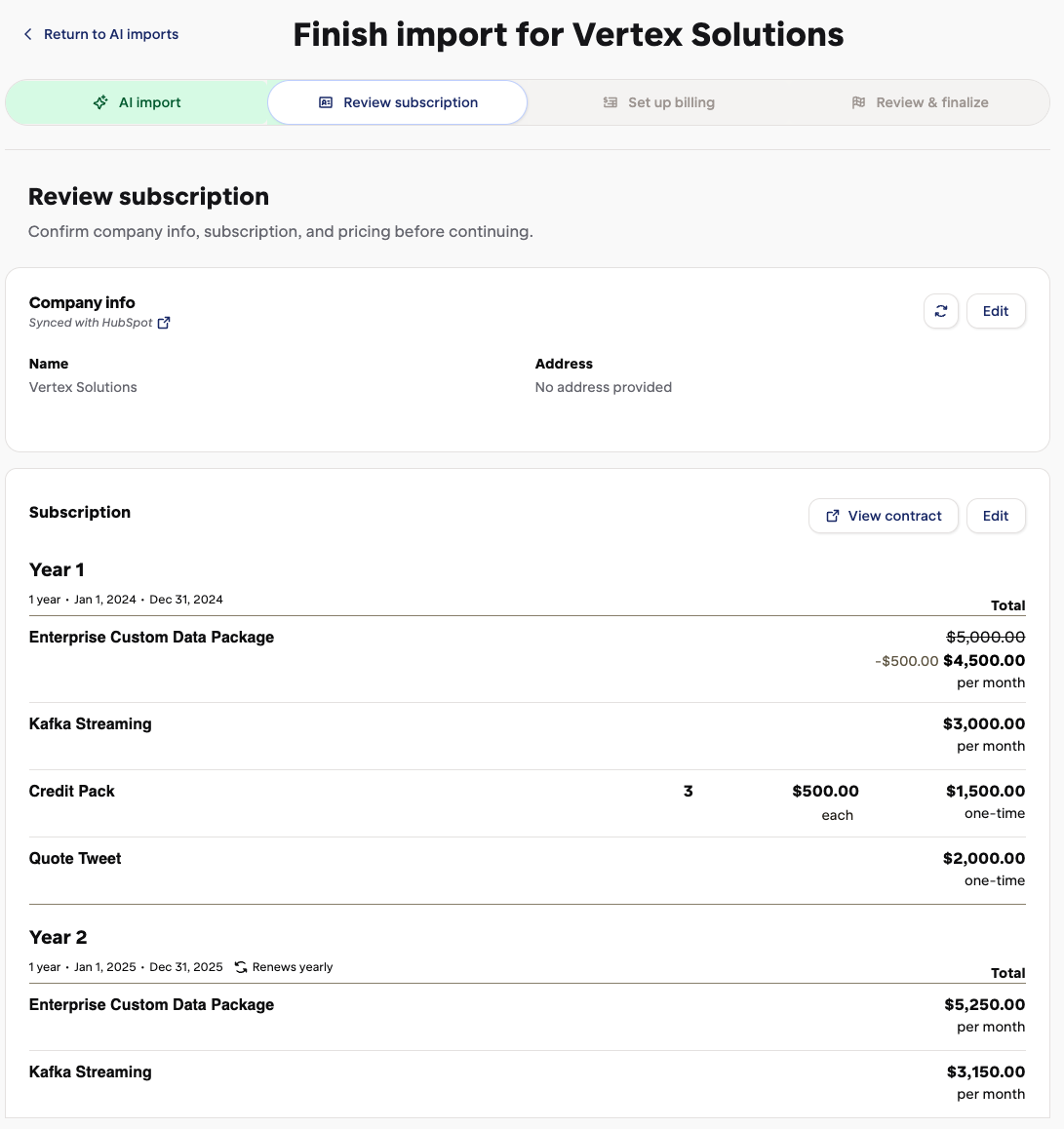
- Multi-year ramps. A three-year contract with annual price increases needs explicit dollar amounts for each year. "Year 2: +10%" leaves your customer and your billing process with a calculation to run and a change to execute at the right time. "$130,000 in Year 2" is an instruction it can follow without interpretation.
- Discount expiration. Specify the discount type, duration, quote expiration date, and eligibility conditions.
- Administrative details. Separate the contract signer from the billing contact. Include e-signature blocks with authorized signer names and the customer's billing address. You can also include a simple description of how changes get billed, including upgrades, downgrades, timing, and when changes take effect.
Why the quote expiration date matters: letting quotes or discounts linger without an explicit acceptance deadline increases the chance you honor stale terms and reduces the customer’s urgency to sign the deal.
PDF and Structured Data: Why Structured Quote Data Determines What Happens After Signature
What determines what happens after signature is whether the quote data is structured. Even a well-written PDF becomes a mess if the details have to be re-entered into billing by hand.
A PDF is what humans read. Structured quote data is what systems act on: dates, prices, ramp amounts, and discount end dates saved as discrete fields your billing setup can execute directly. The difference shows up immediately after signature: no re-entry, no delay, no invoice that goes out with last quarter's pricing.
When quote data is captured as structured fields from the moment you build the quote, billing follows it automatically. Ramp increases hit on schedule, discount expirations trigger without a reminder, and the downstream subscription is ready the moment the customer signs.
Quote-to-Cash Best Practices by Stage
Once a deal is signed, you should be able to send a correct invoice the same day as signature without heroics.
The practices below focus on eliminating the most common human handoff failures between quoting, invoice generation, invoice sending, and collections.
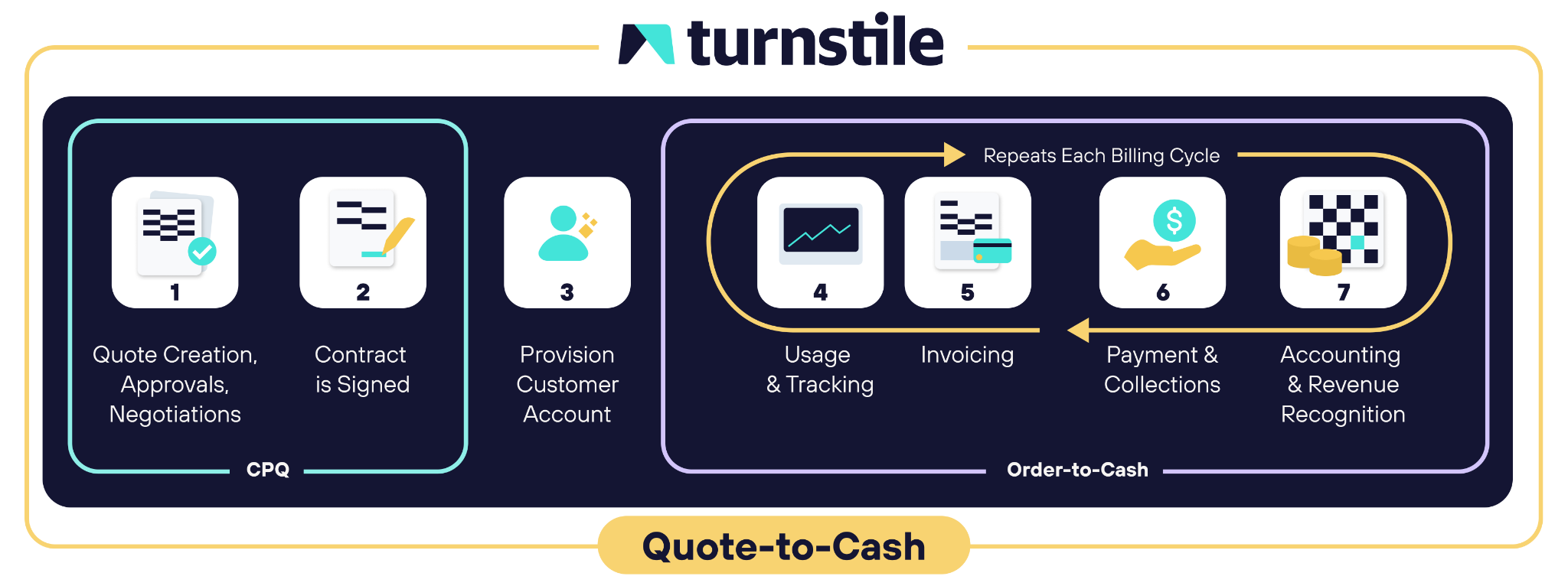
In many early-stage companies, that handoff is still just the founder moving data from a signed PDF into an accounting system and a spreadsheet.
For Founders Sending Their First Quotes
Set up one authoritative place for deal terms before your first sales hire. Before a rep joins, billing errors are yours to catch. Once a rep starts closing deals, non-standard terms get created in whatever tools are available (Google Docs, payment links, spreadsheets), and each one becomes an exception you have to manually manage instead of a deal your billing process can handle automatically.
Define renewal terms at initial sale. Everything about how a contract renews, changes, and gets repriced needs to be specified at signature.
For Ops Teams Building Repeatable Processes
At $2–10M ARR, the first finance or ops hire usually inherits a real backlog: active subscriptions spread across signed PDFs, invoices going out weeks or months after signature, and no single place that holds the authoritative version of each deal. The issue is the unnecessary re-entry of deal terms from a signed PDF into a billing system. Every hour spent retyping deal terms from a signed PDF into a billing system is an hour that should not exist. Eliminating that re-entry step is the entire point.
Eliminate every manual handoff between quote acceptance and invoice generation. As invoice volume grows, automation helps invoices go out accurately and on schedule, without a human acting as the relay between signature and billing.
Build systematic collection workflows for ACH and wire. For $10K+ invoices paid via ACH or wire, you need automated reminders at escalating intervals, from courtesy notice through overdue escalation.
Maintain one authoritative customer contract record (your system of record). When your customer's plan, term dates, and pricing live in multiple places (CRM, spreadsheets, invoicing tool, and accounting solution), teams create multiple versions of the truth that must be stitched together manually each time an invoice is generated. Keeping one single source of truth that syncs across systems supports invoice accuracy and collection workflows while eliminating the reconciliation burden that consumes finance capacity every month.
Get Your Quote-to-Cash Process Running from Day One
Every problem this guide covers (wrong amounts, missed renewals, discount terms that never expire) traces back to one thing: deal terms that exist as text in PDF documents rather than as data. When the quote captures structured fields in a system of record from the start, billing follows the contract automatically, accurate invoices are sent on time, and account reconciliation stops being a monthly firefight.
That's what a quote-to-cash process built on structured data actually buys you: not just faster invoicing, but a process your whole team can rely on as deal complexity grows.
Book a demo to see how Turnstile automates the complete quote-to-cash cycle for sales-led B2B companies.


.png)
.png)