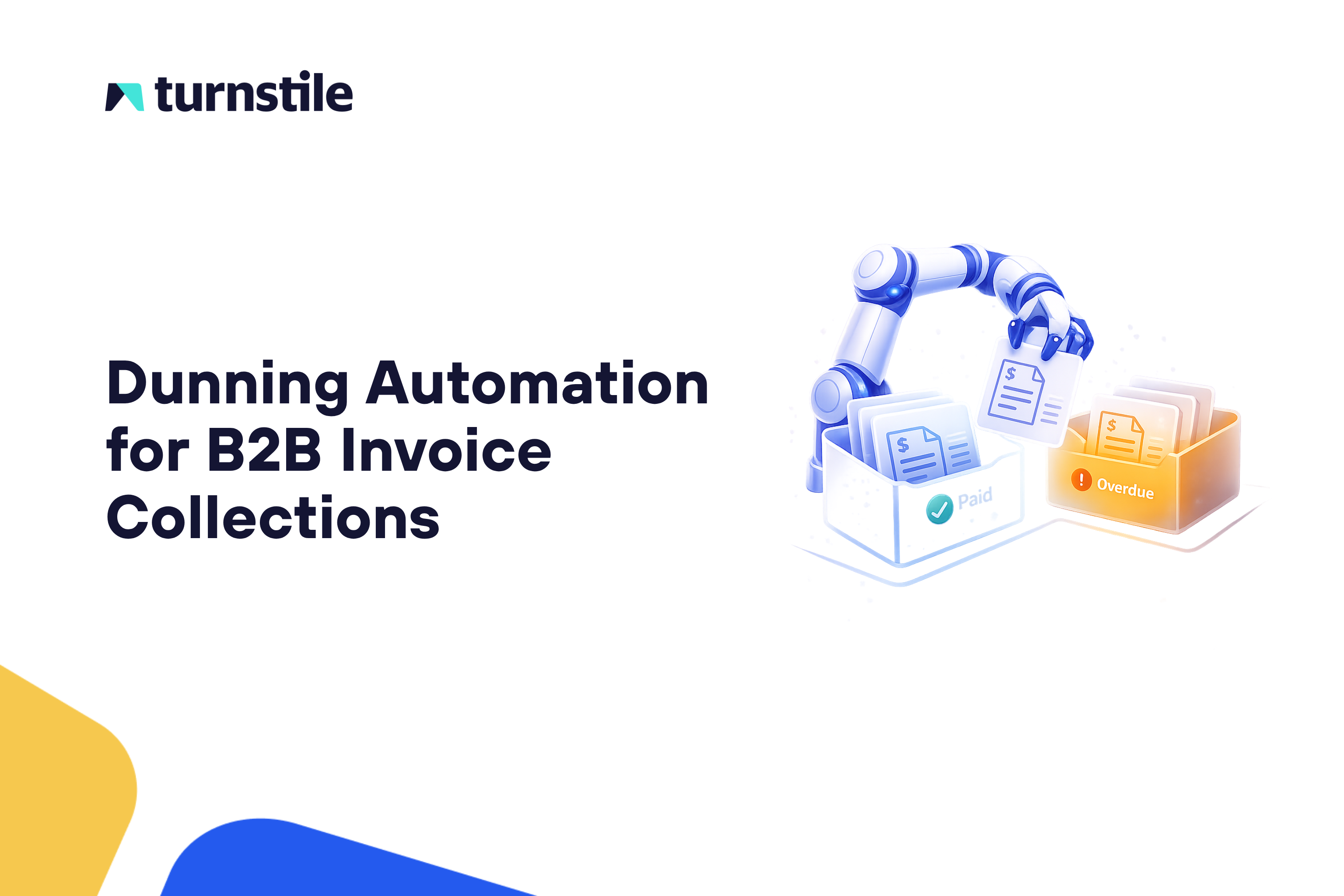
Dunning Automation for B2B Invoice Collections
How sales-led B2B SaaS teams automate invoice follow-up without damaging customer relationships.
5 mins
April 17, 2026
Key Takeaways
- In B2B, you typically do not pull money from your customer's card or bank account. Overdue invoices persist because no one inside your customer's AP team has initiated the payment yet. The lever you control is consistent, timely follow-up.
- Manual follow-up costs more than most teams realize. It drains founder and ops time, typically treats every customer the same regardless of payment history, and creates relationship risk every time someone has to calibrate tone from scratch.
- Turnstile's Agentic Dunning automates the full collections sequence, adjusting tone and timing to each customer's payment behavior so invoices get paid without anyone drafting a one-off email.
Dunning is the process of sending automated reminder notifications for unpaid invoices, on a schedule, with the right invoice details, and to the right contacts. At sales-led SaaS companies, it matters because a lot of revenue is tied up in $10K to $50K+ invoices paid via ACH or wire on Net 30 terms.
When follow-up is manual, overdue invoices sit. You probably have an overdue invoice now. Maybe it's $25K from a customer you onboarded six months ago. You know you need to follow up, but you want to take time to get the tone right, so it slips a day, then a week, and then ultimately, you forget about it.
A reliable collections workflow depends on clean, structured invoice data stored in a format your systems can read that is not just text in a PDF, so reminders stay accurate and tailored to each customer's payment history.
This article covers what makes B2B invoice collections hard to manage manually, what manual follow-up costs beyond the unpaid invoice, and how Turnstile's Agentic Dunning handles it automatically.
Why B2B Invoice Collections Are Hard to Manage
In B2B, overdue invoices usually persist because payment was never initiated. The invoice isn’t paid until the right person inside the customer's company approves it, batches it, and sends it.
High-value contracts are often paid via ACH credit or wire on Net 30 terms. In B2B, you typically do not pull money from your customer's card or bank account. The customer initiates the payment and pushes funds to you. When that transfer has not been initiated, there is nothing for your billing system to do to get payment. All you can do is remind the customer to initiate payment.
The stakes are also different. A $25K annual customer can represent $75K–$150K or more in lifetime value. Late payment in B2B transactions is commonly driven by internal approval processes, budget cycles, and how customers batch their payments.
B2B dunning works when you consistently remind the right contacts inside the customer's company to move your invoice through their internal process. That requires accurate data on what was sold, when it was invoiced, when it is due, and who should be contacted, plus enough context to keep outreach accurate and appropriately toned. For example, a customer who usually pays on time may only need a light reminder, while a customer who has been late several times may need earlier or firmer follow-up.
Why structured invoice data matters
When Turnstile creates an invoice, it does not just put data on a PDF. It also stores the invoice data in a structured format that is used downstream in the collections process.
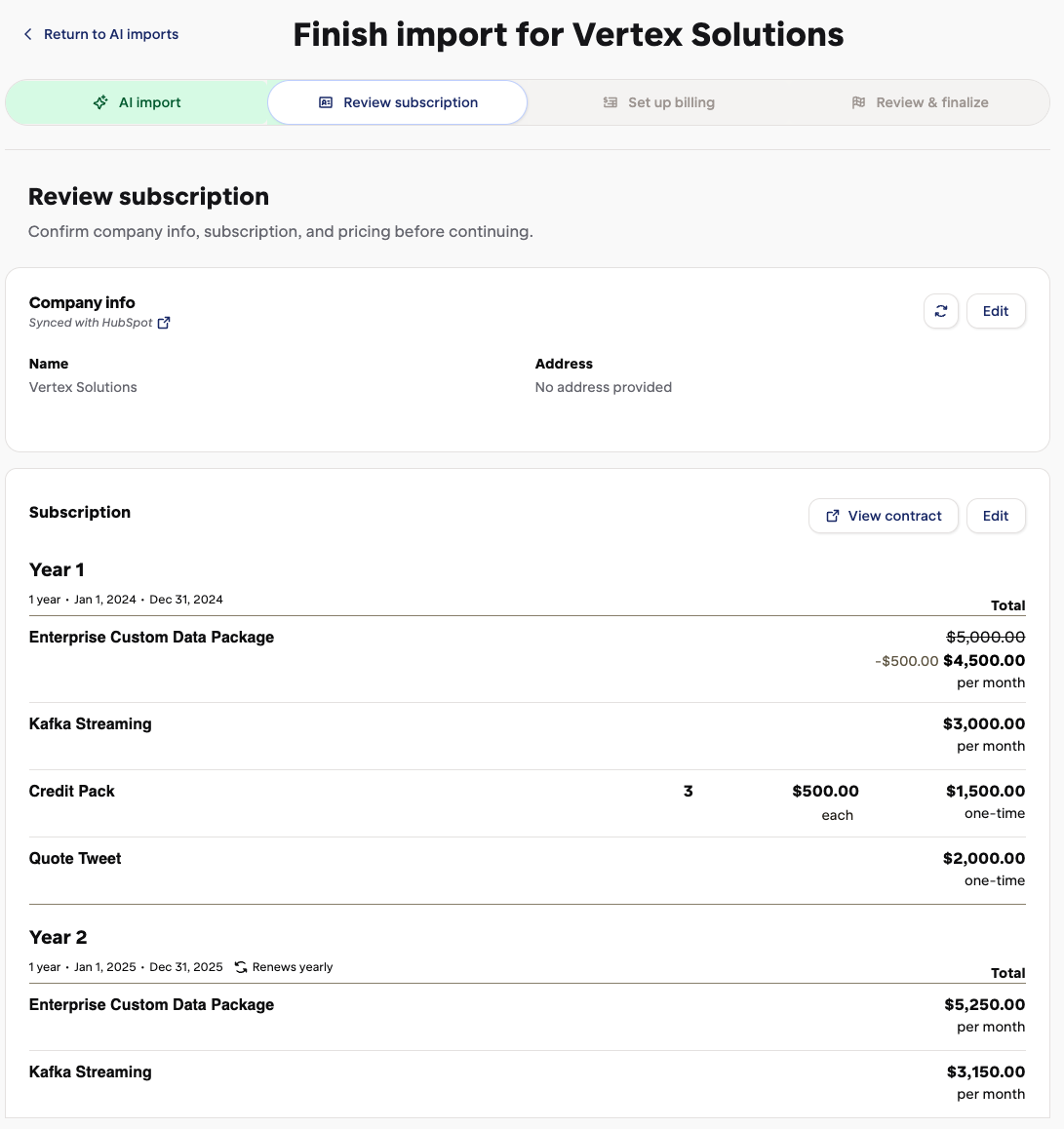
That includes fields such as the invoice issue date, invoice due date, billing contact, billing contact email, amount, and products. Because that information is stored as structured data outside the PDF, reminders can pull the right details automatically instead of relying on someone to open a document, copy information over, and manually decide who should receive the follow-up.
That difference is why finance and ops teams get stuck. If payment requires customer action, the lever you control is follow-up. The next question is what manual follow-up is actually costing you.
What Manual Follow-Up Actually Costs
For finance leaders and ops teams, manual collections can create more damage than the open invoice balance. It consumes founder and lean finance or ops time, produces inconsistent behavior across accounts, and may increase relationship risk every time you hit send.
Here is what this looks like at a $2-10M ARR sales-led B2B SaaS company. Say you are at $4M in ARR with $15K–$25K annual contracts. If 8 customers are late in a given month and the average overdue invoice is $20K, you are juggling roughly $160K in delayed cash collection plus the time and stress of chasing it down.
- Time is the first real cost: Every overdue invoice requires someone to draft a one-off email, decide on the right tone, find the correct contact, reference the right invoice number, and hit send. Multiply that across five or ten overdue accounts, and you are spending hours each month on follow-up. It is also easy to make mistakes in those emails, like referencing the wrong invoice or sending the note to the wrong person.
- Inconsistency is the second issue: Without a system, follow-up happens based on who remembers, not who owes. Reliable customers who happen to be a few days late get a polite nudge because you noticed. Chronically late payers who owe $30K slip through because you were focused on closing a new deal. There is no logic governing who gets contacted, when, or how firmly.
- Relationship anxiety comes third: Calibrating tone on a collections email is genuinely hard. Too soft and it gets ignored. Too direct and you worry about damaging a relationship you built over two years. Many people overthink it, delay it, or skip it. That concern is not academic. Manual follow-up can strain relationships when it is inconsistent and reactive.
- The absence of an audit trail is the fourth and last cost: When collections is handled through individual emails, nobody can answer basic questions: What was sent to this customer? When? By whom? If a customer disputes that they were notified, you are digging through sent folders. If a new hire takes over Accounts Receivable (AR), they are starting with limited context.
Taken together, these costs point to the same conclusion: if you want consistent collections without relationship damage, follow-up has to become a workflow, not a memory test. That is exactly what Turnstile's Agentic Dunning is built to do.
Introducing Agentic Dunning
Turnstile's Agentic Dunning is an intelligent automated collections system built specifically for B2B contract-based billing. Instead of sending the same reminder to every customer on the same schedule, it evaluates each customer's payment history and decides what to send, when to send it, and how firm to be.
Setup is a single toggle in Invoice Settings: Automated Invoice Collection, ON or OFF. It defaults to ON for new customers. Turning it off stops all automated reminders immediately; historical logs remain visible. The system handles sequencing and tone automatically from the moment it's on.
Because Turnstile stores invoice data in a way that can be accessed without manually looking at the PDF, every reminder ties back to the exact invoice, amount, and billing details. No manual re-entry, no reminders referencing the wrong amount or wrong due date. This works alongside Turnstile's single system of record for commercial terms.
How Customer Classification Works
The system evaluates each customer's payment behavior over the past 12 months and places them into one of three tiers.
Healthy customers pay reliably. They receive minimal reminders in a friendly, low-urgency tone.
Watchlist customers are occasionally late. They receive standard reminders in a direct but polite tone.
Unhealthy customers have a pattern of frequent or serious lateness. They receive stronger reminders in an urgent but still professional tone.
Within those tiers, the system selects from four tone levels: Gentle, Neutral, Direct, and Firm. No two customers get the same treatment. Your most reliable payer never gets the same email as someone 45 days overdue on a $30K invoice. Every message stays professional, with no threats, no legal language, and no collections-style wording.
The Reminder Sequence
Agentic Dunning covers the full invoice lifecycle. It sends reminders around the due date and continues following up on overdue invoices through a longer collections window, with timing adjusted based on the customer's payment behavior.
Two key ideas keep it from becoming noise. First, customers receive at most one reminder email per day, regardless of how many invoices are unpaid. If multiple invoices qualify on the same day, they bundle into a single digest. Second, overdue invoices are batched on a weekly cadence, so outreach stays consistent without repeatedly sending reminders for the same balances day after day.
Every reminder includes the invoice number, amount, due date, a payment link, and a clear breakdown of all included invoices. For digest emails, the total outstanding balance appears at the top, ordered from most to least overdue invoice.
Full Transparency
Because the system sends emails to your customers on your behalf, you get full visibility into exactly what went out. Across invoice detail pages, customer pages, and event history timelines, you can see whether agentic dunning is active, which reminders went out and when, the exact email content, and when the next email is being considered. If a customer says they never received a reminder, you have the full record. If a new finance hire takes over AR, they inherit complete context rather than an empty sent folder.
Customers can turn agentic dunning off at any time. Partial payments do not stop reminders until the full balance is settled.
Stop Chasing Invoices. Start Collecting Them.
Manual collection is a solvable problem. The fix is a workflow that runs consistently, adjusts to each customer's payment behavior, and keeps outreach professional, closing the door on revenue leakage before it compounds.
Book a demo to see how Turnstile's Agentic Dunning handles collections automatically for sales-led B2B SaaS companies.


.png)
.png)