What Is Quote To Cash? The Complete Guide for B2B SaaS And Usage-Based Founders
Quote to cash failures quietly drain ARR from early-stage SaaS companies. Here's how to prevent them.
5 mins
January 17, 2026

Key Takeaways
Quote to cash encompasses the complete workflow from generating a customer quote through collecting payment and recognizing revenue. For B2B SaaS companies, this process includes subscription management, automated billing, revenue recognition, contract lifecycle management, and increasingly complex billing schedules as you move upmarket and deal sizes grow.
When this process breaks, founders trade growth for administrative chaos. As pointed out by Michael Babineau, co-founder and CEO at Turnstile, the hidden cost of these manual processes shows up in multiple ways: revenue leakage surfaces during fundraising when billing numbers don't match sales data, deals get closed but never configured for billing (leaving money on the table), and you spend 10-20 hours weekly on work that should take minutes.
When deal terms are captured as structured data from day one, everything downstream stays consistent without manual re-entry needed. This guide explores what quote to cash is, how the process works from quote to payment, and why establishing quote to cash infrastructure early prevents the operational debt that compounds as you scale.
How Does Quote to Cash Work?
Quote to cash follows a defined sequence from initial customer proposal through final revenue recognition. Each stage builds on the previous one, creating a workflow that spans sales, finance, and operations teams.
Here's how the process typically unfolds:
- Quote Generation and Negotiation: Sales teams create proposals outlining products, pricing, payment terms, and service details. These quotes go through rounds of negotiation until both parties agree on the final terms. The result is a formal agreement specifying what the customer will pay, when they'll pay it, and what they'll receive.
- Contract Execution: Once both parties e-sign the agreement, the contract becomes a legally binding contract containing all the commercial terms we outlined above. This signed contract serves as the reference point for everything that follows.
- Subscription Setup and Billing Configuration: The finance or operations team translates contract terms into the billing system. This includes setting up recurring charges, usage tracking parameters, invoice schedules, and any special pricing arrangements. Accurate setup at this stage prevents billing errors later.
- Invoice Generation and Delivery: Invoices are generated and sent to customers according to the billing schedule in the contract. For recurring subscriptions, this happens on a schedule (either automatically or manually, depending on the system). For subscriptions with usage-based pricing, usage is metered (tracked over time), then rated (priced according to contract terms) to calculate charges. Invoices are then typically sent to customers through email or a customer portal.
- Payment Collection: Customers pay via their preferred method (typically ACH transfer or wire for B2B transactions). The accounts receivable team tracks which invoices have been paid and follows up on outstanding balances. Payment collection systems may use Dunning (automated retry attempts and reminder notifications) to recover failed payments.
- Revenue Recognition: The accounting team recognizes revenue according to GAAP standards and ASC 606 guidelines. For example, for a 1-year contract for 10 licenses of a SaaS product with annual invoicing in advance, revenue is recognized monthly over the contract period rather than all at once. Usage-based revenue recognizes as consumption occurs. Proper revenue recognition ensures financial statements accurately reflect business performance.
This workflow requires coordination across multiple teams and systems. Sales creates quotes, finance configures billing, operations tracks usage, and accounting recognizes revenue. When these stages connect smoothly, customers receive accurate invoices and companies maintain clean financial records. When they don't, you look unprofessional to customers who receive incorrect invoices, and internal problems compound as customer count grows.
Why Does Quote to Cash Break in Early-Stage SaaS?
Most early-stage companies don't fail at quote to cash because they choose the wrong approach. They fail because they never build an intentional process.
Here's what actually happens when quote to cash breaks down:
- You don't get paid. Deals close but never get configured for billing. Customers sign contracts, but subscriptions sit in limbo waiting for someone to manually set them up. Revenue you've earned stays uncollected because no system tracks what needs to be invoiced.
- You can't fundraise confidently. Billing numbers don't match what sales reported. When investors ask for your revenue, you can't give them a straight answer because contract terms, billing records, and revenue recognition all tell different stories. Board meetings turn into reconciliation exercises.
- Your customers receive incorrect invoices. Wrong amounts, expired discounts that should have ended, and charges that don't match what was sold. Every billing error damages trust and creates support tickets that consume your team's time. Customers start questioning whether you can actually deliver the product.
- Founders don't develop a process proactively. The first few deals happen through improvisation: copying quotes from Google Docs, sending for signature, and manually creating invoices when payment is due. This can work for customers 1 through 10, but breaks down under complexity and volume.
- Revenue operations scatter across disconnected tools. Without a deliberate system, quote to cash fragments into quotes in Google Docs, contracts in Docusign, billing schedules in spreadsheets, and invoice tracking in email threads. Each system holds part of the truth, but none connect to each other.
- Manual handoffs create opportunities for errors at every stage. When contract terms exist in one platform but billing happens separately, someone manually transfers that information. Every manual step creates opportunities for transcription mistakes, missed amendments, or forgotten discounts.
- No single source of truth means constant reconciliation. Sales knows what was sold based on signed contracts. Finance knows what was billed based on invoice records. The CEO wants ARR based on commitments. These three numbers should match, but often don't and end up consuming critical team hours.
- Pricing experiments aren’t possible without proper infrastructure. Early-stage companies need flexibility to test usage-based models, offer custom discounts, and even negotiate one-off deals. When systems can't handle variation, necessary experimentation creates downstream chaos where exceptions eventually outnumber the rules.
These failures are preventable. Building the right quote to cash foundation from day one eliminates most of these breakdown points before they compound.
How to Build Your First Quote to Cash Process
Establishing quote to cash infrastructure early prevents the operational debt that compounds as customer count and deal complexity grow. Most founders assume they should start with manual processes and graduate to automation once they reach a certain scale. However, this approach creates exactly the problems automation is meant to prevent.
The goal of a great quote-to-cash process is to automate your revenue workflow while maintaining quality at every stage. The strongest systems eliminate handoffs between teams, prevent data silos, and ensure nothing gets dropped as deals move from quote to payments:
1. Start With Quote Generation
Quote generation is where your revenue process begins. It’s the moment you define pricing, terms, and billing schedules. A well-structured quote captures everything downstream systems need, including contract duration, payment terms, usage thresholds, and renewal conditions.
However, the goal is to eliminate the handoff between signed contract and active subscription.
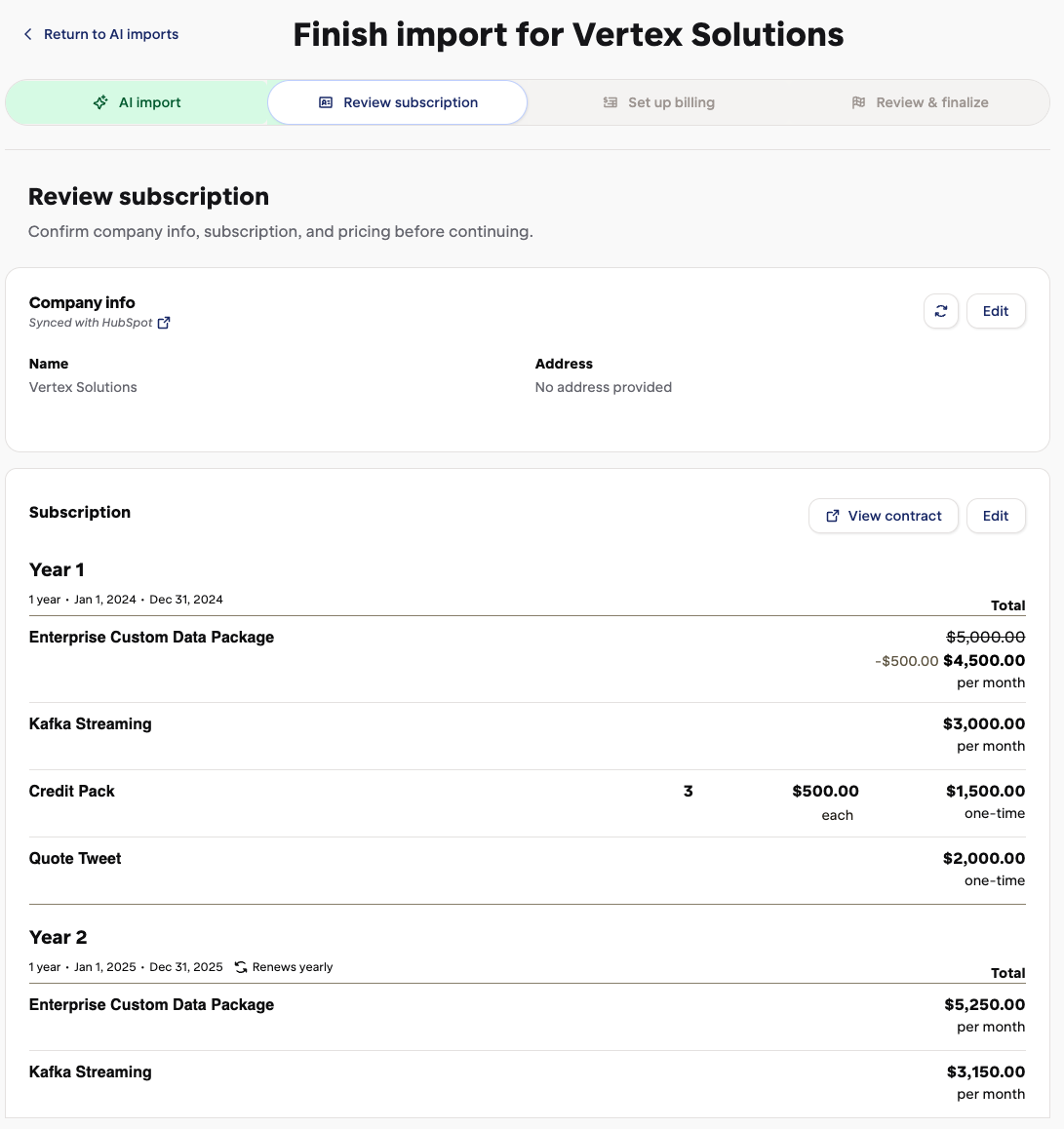
Most quoting tools only generate PDFs that someone then manually re-enters into billing systems. Some quote-to-cash platforms like Turnstile work differently. They store contract terms as structured data, so the moment a customer signs, billing is already configured. No re-keying, no manual setup, and zero room for error, the signed quote document is guaranteed to match what your billing system executes.
Turnstile's WYSIWYG quote builder (visual editor where what you design matches what customers see) lets founders create branded quotes in minutes, and its AI-powered contract term extraction handles import of existing contracts — capabilities that most standalone quoting tools don't offer. You can get your first quote or invoice out within 15 minutes of setup.
2. Personally Onboard Your First 20-30 Customers
Even with a quote-to-cash system in place from day one, understand what customer success actually looks like for your business. Personally onboarding your first 20-30 customers reveals friction points in your product, pricing, and process that no system can identify for you. These insights shape every downstream decision about how to structure your quote-to-cash workflow.
3. Experiment with Pricing Without Breaking Billing
Early-stage companies constantly experiment with pricing: testing different tiers, offering custom discounts, trying usage-based models, and negotiating one-off deals to close customers. This flexibility is essential for finding product-market fit.
The problem isn't pricing experimentation. It's that most billing systems force you to standardize before you're ready, or they break when you don't. Custom pricing for every customer creates downstream chaos only when your tools can't handle it.
This is exactly why Turnstile is built for early-stage companies: you get the flexibility of a Google Doc with the structure of a database. You can test new pricing models without reconfiguring your entire billing system, change pricing structures as you learn, and add custom line items on the fly to close deals.
Turnstile captures it all as structured data automatically, giving you the freedom to move quickly while preventing the revenue leakage and billing chaos that manual processes create. You don't have to choose between flexibility and scale: you get both from day one.
4. Store Contract Terms as Structured Data
This is the single most important decision in your quote-to-cash process. When pricing, discounts, billing cycles, and special terms exist as structured fields rather than buried in PDFs, they flow directly into invoicing, revenue recognition, and reporting without manual re-entry, eliminating errors.
Most early-stage companies store contracts as documents: a signed PDF in a folder, terms buried in email threads, amendments tracked in spreadsheets. Every downstream system then requires someone to read those documents and manually enter the information. This creates the handoff gaps where revenue leakage happens.
Turnstile structures your commercial data from day one, triggering billing configuration the moment a customer signs so there's no gap where contracts sit waiting for someone to manually create subscriptions and other downstream artifacts.
5. Connect Quotes Directly to Contracts
During the call with a prospect, you should be able to generate a quote they can sign immediately and that signed quote becomes the contract. Make sure your quote is ready to go upfront and separate your terms of service (TOS) or master services agreement (MSA) for ease of contracting. Having your TOS/MSA accessible through a public or private link rather than bundling it with quotes is best practice because it is easier for prospects to review and reduces the chances that customers will ask to negotiate the legal terms, and makes it easier to update your terms as your company grows.
Turnstile's embedded e-signature eliminates the need for separate contract tools. Customers sign directly within the quote (guaranteeing the quote you created is the exact one signed) with no risk of sending the wrong version through a separate e-signature tool. The signed terms immediately flow into your billing configuration, and Turnstile automatically updates the quote status to signed.
6. Provision Access Within 4 Hours
Customers who wait days for access after signing start doubting their purchase. The best practice is automatic provisioning. The moment a customer signs up, user accounts are created, licenses are allocated, and access is granted. Turnstile enables this through API-based provisioning that triggers automatically when contracts are signed.
If immediate provisioning isn't feasible yet (many early-stage companies aren't there), provision access manually within 4 hours of quote signature. Send a welcome email with login credentials and clear next steps immediately after provisioning, and schedule the onboarding call within 3-5 days of account creation.
7. Automate Invoice Generation
Invoice generation should be automated from day one. Manual invoicing creates operational debt that compounds with each new customer, and quote-to-cash automation eliminates this burden immediately, whether you have one customer or one hundred.
The beauty of the structured contract data Turnstile offers is that invoice automation is straightforward: the signed contract defines the billing schedule (annual, monthly, quarterly, or usage-based), and automation simply executes it.
You don't need to manually configure separate logic for each billing model. Instead, the contract terms you agreed to with the customer become the billing instructions your system follows automatically.
8. Automate Renewal Tracking to Manage Customer Relationships
Renewal tracking should be automated from day one. Manual spreadsheet tracking breaks quickly when managing renewals across different contract dates, payment terms, and amendment histories.
Turnstile's renewal dashboard provides visibility into all upcoming renewals, with automatically tracked usage, remaining term, and expansion potential. The system eliminates manual calendar tracking while identifying churn risk and growth opportunities as contracts approach renewal.
Stop Losing Revenue to Process Failures
Quote to cash is not a single workflow or a finance function. It is the connective tissue between sales, billing and revenue recognition. When it is designed well, every customer agreement flows cleanly from quote to contract to invoice to revenue, without interpretation, rework, or reconciliation.
The common thread across every section of this guide is structured data flowing through connected systems. Pricing experiments only work when billing can support them. Fast sales cycles only matter when invoices go out correctly. Clean ARR and MRR reporting only exists when contract terms are captured in a way downstream systems can actually use.
This is why quote to cash decisions compound over time. Early choices about how you generate quotes, store contract terms, automate renewals, and connect billing systems either reduce complexity or quietly add to it. The difference is not how hard teams work, but whether information moves through the system as structured data enabling automatically triggered workflows and business processes or as documents that require manual interpretation.
Turnstile is built around this idea. By capturing commercial terms as structured data at the moment of signature and letting that data drive billing, invoicing, and reporting, teams eliminate handoffs and keep sales and finance aligned as the business scales.
Book a demo to see how Turnstile handles the complete revenue lifecycle for sales-led B2B startups.
FAQs About Quote to Cash
When should I implement a formal quote-to-cash process?
From your first paying customer.
Quote to cash problems rarely start as “big company” issues. They begin with small gaps, such as discounts that never expire, amendments that never make it into billing, or renewal dates tracked in email threads. Those gaps compound as customer count and deal complexity grow.
Starting with a structured quote to cash foundation early prevents the need to unwind contracts, fix billing mistakes, or reconcile mismatched ARR later. It is significantly easier to design the system correctly from day one than to retrofit it once the business has scaled.
How is quote to cash different from order-to-cash?
Quote to cash starts earlier, beginning when you create a proposal for a prospect. Order-to-cash assumes the customer has already committed to purchase. For B2B SaaS companies with negotiated deals and custom pricing, quote-to-cash better captures the full revenue workflow because significant operational complexity exists before an order is formally placed. Custom terms, approval workflows, and contract negotiations all happen in the quoting phase, and these are the items that create the most complexity for the order to cash process.
What causes quote to cash to break at early-stage companies?
Disconnected systems force manual data transfer between tools, creating opportunities for errors at every handoff. Pricing model complexity compounds as early-stage companies run experiments and constantly change their pricing to see what sticks. Contract amendments and pricing changes get lost between systems because no single source of truth tracks the current agreement. Each issue compounds as customer count grows, with every new customer increasing the probability that your manual system fails in a new way.


.png)
.png)