Chargebee vs Stripe: Which Is Better for Sales-Led SaaS?
Chargebee vs Stripe for sales-led SaaS: where each fits, where each breaks, and what to do instead.
5 mins
April 28, 2026

Key Takeaways
- Chargebee and Stripe Billing both work well for standardized, catalog-based subscriptions. Neither was built for sales-led teams closing custom, negotiated deals as the default.
- The breaking point for both is the same: someone still has to read a signed agreement and manually re-enter those terms into a billing configuration. That is where invoices go wrong and revenue leaks.
- If most of your deals are negotiated, you need a quote-to-cash system of record that captures contract terms as structured data and drives billing automatically from signature. Neither Chargebee or Stripe Billing will solve that problem for you.
A sales-led SaaS deal is a signed agreement with custom discounts, quarterly invoicing, Net 30 payment terms, and sometimes scheduled price changes. Someone on your team has to read the agreement and manually re-enter those terms into your billing system. That is where invoices go wrong, discounts never turn off, and scheduled price increases never kick in.
Chargebee and Stripe Billing are two of the first tools sales-led teams look at. Both work best when you have a product catalog with standard prices that customers subscribe to. That setup fits self-serve signups cleanly. It starts to break when custom agreements become the norm, and someone has to translate signed terms into a billing configuration.
That handoff is a quote-to-cash problem (the process from signed contract through collected revenue). When contract terms live in a PDF instead of as structured data your billing system can act on, you are more likely to send the wrong invoice, miss a scheduled price increase, or forget to turn off a discount.
This guide breaks down what each platform actually does, where each breaks down for sales-led teams, and what to put at the center of your revenue stack when most deals look different.
What Types of Tools Are Chargebee and Stripe Billing?
The more useful distinction is between billing tools and the broader quote-to-cash problem. Both tools work best with standardized, catalog-based pricing. When your deals are negotiated, someone still has to translate each signed agreement into products, prices, and subscription settings. That is where mistakes and manual work pile up.
Stripe Billing is developer-first. It starts with the payment platform and adds billing objects on top, like customers, products, prices, and invoices. In practice, that works best when customers choose from a small set of predefined options.
Chargebee is more subscription-management-first. It usually sits above a payment gateway and focuses more on what happens after the subscription starts: upgrades and downgrades, renewals, mid-cycle proration (charging or crediting only for the partial period), collections follow-ups, and so on.
That difference matters, but for sales-led teams, the question is simpler: what happens between "customer signed" and "invoice sent"? That is where most teams feel the pain first.
Chargebee vs Stripe: Head-to-Head
Stripe Billing is a subscription and invoicing layer built on top of Stripe Payments. If you are already using Stripe to get paid, Stripe Billing adds recurring charges, invoice generation, and basic subscription management without introducing a new vendor. The tradeoff is that it inherits Stripe's developer-first architecture: billing is configured through products and prices in code, and custom deal terms require engineering work to encode.
Chargebee is a dedicated subscription management platform that sits above a payment gateway (often Stripe). It gives finance and ops teams more native control over subscription lifecycles, proration, collections, and revenue recognition without relying on developers for every change. The tradeoff is that it is still catalog-driven at its core: subscriptions are built from products and plans, and bespoke deal terms create exceptions that need manual handling.
Here is how they compare on the dimensions that matter most for sales-led teams:
The most important row is the one both share: contract-to-billing handoff is manual on both platforms. Neither tool was designed to ingest a signed order form and configure billing from it automatically. Someone still reads the PDF and sets up the subscription.
For standardized pricing, that handoff is low-risk. For negotiated deals with custom discounts, ramps, and payment schedules, it is where invoicing errors and revenue leakage start.
What Neither Chargebee nor Stripe Handles for Sales-Led Teams
Sales-led SaaS teams need signed terms to become invoices automatically, without anyone re-keying the deal into a product catalog. In this comparison, both platforms are generally used after a deal has already been converted into a subscription.
For product-led SaaS, this gap barely exists: the customer picks a plan, enters a payment method, and billing is activated. No handoff, no interpretation required.
For sales-led SaaS, someone reads a PDF, interprets the terms, and enters them into the billing system. Often, that "someone" is you (the founder) or your first finance or ops hire, juggling month-end close and invoicing. Temporary discounts become permanent because no expiration is tracked. Year-two price increases in multi-year deals never kick in. Seat additions go unbilled.
This is where revenue leakage shows up (money you earned but never invoiced and/or collected). Forbes estimates that 1% to 5% of EBITDA can leak due to execution failures in the quote-to-cash cycle.
A quote-to-cash system of record (a single source of truth for contract terms that drives downstream billing) usually solves this better than piling on more integrations. The key is capturing commercial terms as structured data at the point you generate the quote or order form and get it signed.
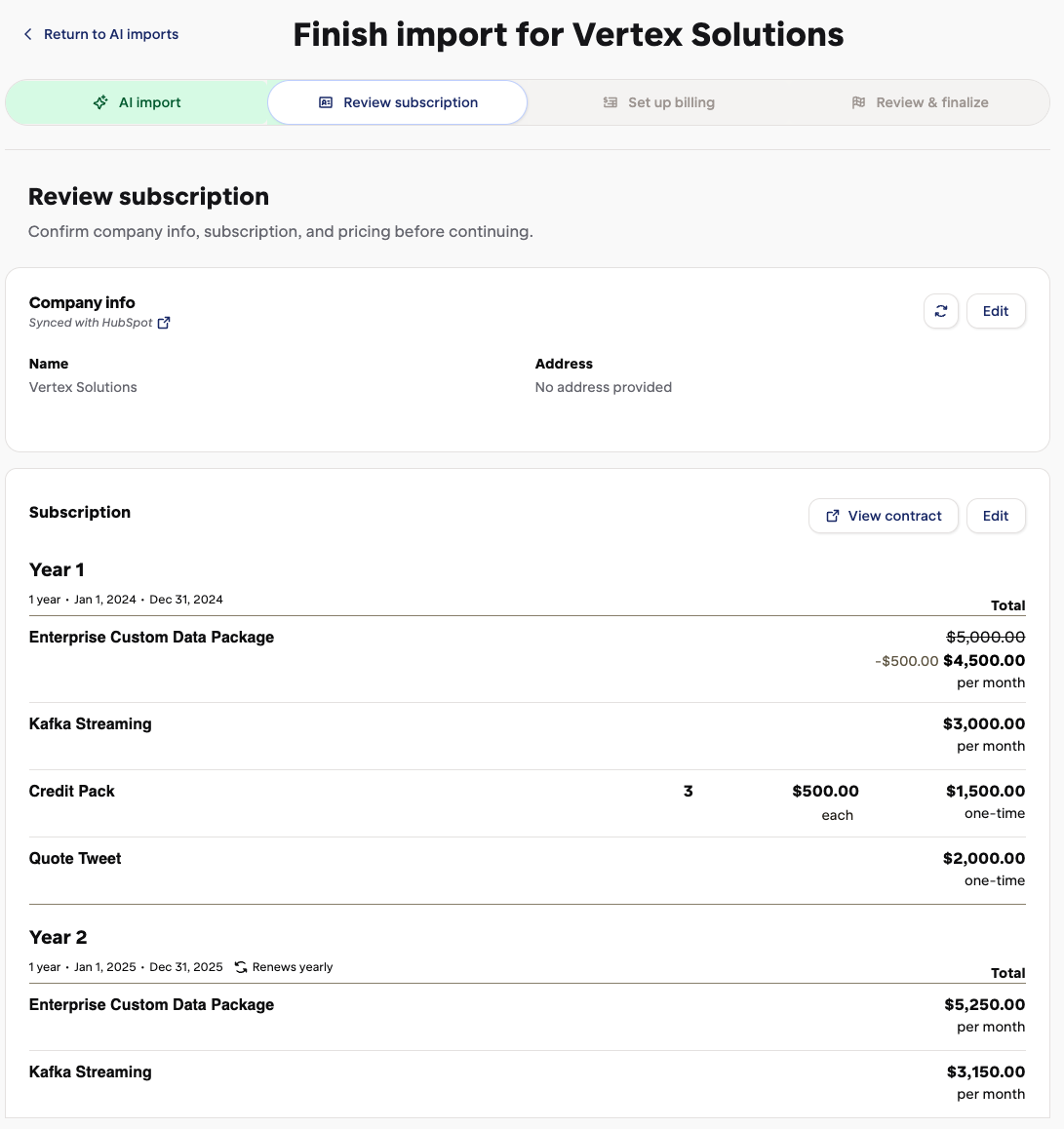
Turnstile is designed around that handoff. As the single system of record for commercial agreements, it captures pricing, discounts, and billing schedules at the point of signature and flows them directly into billing and reporting without manual re-entry.
Where Chargebee and Stripe Billing Each Break Down
Both Stripe Billing and Chargebee have a clear sweet spot and a clear breaking point.
Stripe Billing works well for standardized self-serve pricing: the customer picks a plan, billing activates, and you move on. Once you start closing custom deals, that breaks down fast. Deal-by-deal pricing turns into engineering work or a growing pile of one-off catalog items. Mid-cycle amendments become mini-projects. Enterprise invoicing requirements, like purchase orders, approval flows, and invoices that change because of upgrades, downgrades, or expiring discounts, either get built separately or stay manual.
Chargebee reduces some of that friction. Finance and ops teams get more native control over proration, renewals, and collections without pulling in developers for every change. The core architecture is still catalog-driven, and bespoke pricing and billing schedules become exceptions. Complex amendments stretch the system, and negotiated quoting still happens elsewhere, which creates the same handoff risk between what the customer signed and what gets billed.
In both cases, the breaking point is the same: when someone has to read a signed agreement and manually re-enter those terms into a billing configuration, you haven’t solved the handoff. You have just moved it.
How to Evaluate Chargebee vs Stripe for Sales-Led SaaS
For founders, finance leaders, and ops teams, the harder question sits one level above Chargebee vs. Stripe: can a billing tool alone take you from a signed, custom agreement to correct invoices without manual re-entry?
This question shows up once you start closing $25K+ annual contracts with invoice-based payment terms (like Net 30) and customer initiated payments (like ACH or wire). As soon as you have purchase orders, invoices that vary because of upgrades, downgrades, or expiring discounts, and collections workflows that do not fit a self-serve checkout flow, manual re-entry is already part of your process.
A practical way to evaluate any catalog-first setup is to take one real signed order form and ask:
- Can I represent these terms without creating one-off catalog items? (pricing, discount windows, ramps, billing cadence, payment terms)
- Can I apply amendments without pulling engineering into billing changes? (seat adds, renewals, renegotiations, upgrades, downgrades, expansions, mid-cycle proration)
- Will invoicing and reporting stay in sync with the contract without re-entry? (invoice timing, scheduled increases, discount expiration, what counts as ARR/MRR)
If your deals are mostly standardized and fit cleanly into a small catalog, a catalog-based billing setup can be a solid foundation, especially for product-led or self-serve motions.
If most terms are standardized but minor subscription changes (e.g., add 1 license) are getting complicated, subscription-management-first tools can make day-to-day subscription changes easier.
When most deals are negotiated, and each agreement has bespoke terms, neither tool typically supports, out of the box, the workflow you actually need: translating the signed agreement into accurate billing without someone manually translating and re-keying it.
If you decide you need true contract-to-billing automation for your sales-led SaaS company, teams typically either add a quote-to-cash system of record that stores pricing, discount schedules, and billing terms as structured data and drives everything downstream, or they handle the integration work themselves. Without an integrated quote-to-cash system, that usually means one of two things: your team manually types contract terms into the billing system, or you connect a quoting tool to billing and manage the exceptions when quoting allows terms your billing setup does not cleanly support.
Chargebee vs Stripe: The Right Tool Depends on How You Sell
Chargebee and Stripe Billing are both great tools for the right use case. The problem shows up when most deals are negotiated. Custom discounts, ramps, and mid-cycle amendments do not map cleanly onto catalog architectures. Someone still has to read the signed agreement and re-enter those terms by hand. That is where invoices go wrong, discounts never expire, and up to 5% revenue leaks quietly. If you are evaluating your full set of recurring billing software options, the Chargebee vs Stripe comparison is only part of the picture.
For sales-led teams where negotiated contracts are the default, you need Turnstile: a single system of record that captures pricing, discount schedules, and billing terms as structured data at signature and drives billing automatically from there.
Book a demo to see how Turnstile takes a signed agreement and flows it into billing automatically, without manual re-entry.


.png)
.png)