11 RevOps Best Practices: How Early-Stage Founders Build Scalable Revenue Operations
Explore 11 RevOps best practices for founders to centralize data, eliminate manual billing, and stop losing revenue.
5 mins
February 3, 2026
.png)
Key Takeaways
Revenue operations (or RevOps) connects your sales, marketing, and customer success teams through shared data and consistent processes across the entire revenue lifecycle from first contact through renewal, while working closely with finance and accounting teams.
For sales-led B2B SaaS companies, this means replacing fragmented spreadsheets and disconnected tools with unified systems. For founders, finance leaders, and ops teams managing revenue operations, RevOps prevents operational debt that can create major issues down the line: billing numbers that don't match sales data, revenue leakage, and teams burning hours weekly on administrative tasks instead of building product.
Fragmented systems compound into expensive problems as customer count grows. The solution is building on proper infrastructure from the start; systems designed for your revenue lifecycle, not makeshift processes patched together. RevOps best practices prevent the painful audits and system rebuilds that typically happen between Seed and Series A.
This article walks B2B SaaS founders through 11 RevOps best practices to centralize revenue data, automate repeatable workflows, and catch revenue leaks before they compound.
Build Foundation Systems That Prevent Expensive Problems
1. Map Your Complete Quote to Cash End-to-End
Map your quote-to-cash process, so you know exactly where deals stall and where to focus improvement efforts. Most founders operate with a fuzzy mental model of their quote-to-cash process. Sales marks a deal as "Closed Won," but the customer doesn't get provisioned until they ask, finance hasn't set up billing, and nobody realizes there's a problem until the customer follows up about access or their first invoice.
Start by documenting this journey in a simple spreadsheet or Notion doc, mapping every stage from first contact through payment collection. This visibility reveals exactly where deals stall and where manual work accumulates.
Here's the quote-to-cash process that most early-stage B2B SaaS companies actually follow:
- Initial contact: Logged in CRM (HubSpot or Salesforce)
- Discovery call: Notes scattered across CRM, Slack, and Google Docs
- Demo/technical review: Screenshots and requirements in email threads
- Proposal/quote: Built manually in Google Docs or copied from previous templates
- Contract review: Docusign or Dropbox Sign, with final PDF living in email or Drive folder
- Signature: PDF sent to finance via Slack or email
- Billing setup: Finance manually re-enters contract terms into Stripe or QuickBooks
- Invoice generation: Created manually each month, tracking renewals in spreadsheets
- Payment collection: Monitored through bank statements and payment processor dashboards
- Revenue recognition and accounting: Monthly spreadsheet calculations to match billed amounts to recognized revenue, manually tracking what's been earned versus deferred
- Mid-contract amendments: Customer upgrades or pricing changes tracked in spreadsheets, with manual proration calculations and uncertainty about what's already been invoiced
- Renewal: Calendar reminders trigger manual outreach and quote recreation
Once you map your actual journey, look for these specific warning signs:
- Billing setup taking days after signature? You're maybe manually re-entering data that should flow automatically. This handoff is where most revenue leakage begins.
- Customers receiving inaccurate invoices? When contract terms live in PDFs and get manually re-entered into billing systems, errors are inevitable. Wrong amounts, missing line items, or incorrect billing schedules create customer friction and revenue discrepancies.
- Not sure who has actually paid you? Payment tracking scattered across bank statements, processor dashboards, and email confirmations means you lack real-time visibility into collections and outstanding receivables.
- Spending hours chasing down payments? Manual follow-ups, reminder emails, and awkward conversations about cutting off product access consume time that should go to building your business.
- Invoices going out late or not at all? Calendar reminders and manual tracking lead to missed billing dates. When you're managing dozens of customers with different billing schedules, something always slips through.
- Customers provisioned with wrong entitlements? The disconnect between signed contracts and product access means customers get features they didn't pay for, or lack access to what they purchased.
- Can't confidently state your actual revenue? When you're manually calculating revenue recognition in spreadsheets, the gap between cash collected and revenue earned becomes murky, especially with annual prepayments and mid-cycle changes.
- Renewals requiring manual tracking? Subscription management should handle renewal dates and trigger notifications automatically.
When quote to cash lives in your founder's head or across disconnected tools, every deal requires manual orchestration. Document the journey first, then systematize the stages consuming the most time.
2. Build Connected Systems Around Your CRM
Your CRM holds customer and deal data, but it shouldn't manage your entire revenue lifecycle. The proper flow is: CRM to quote-to-cash platform to accounting systems.
When your quote-to-cash platform integrates with your CRM, customer data flows automatically into quotes and contracts. Those signed contracts then feed billing systems without manual re-entry. This connected flow, in turn, eliminates the spreadsheet tracking and duplicate data entry that creates discrepancies.
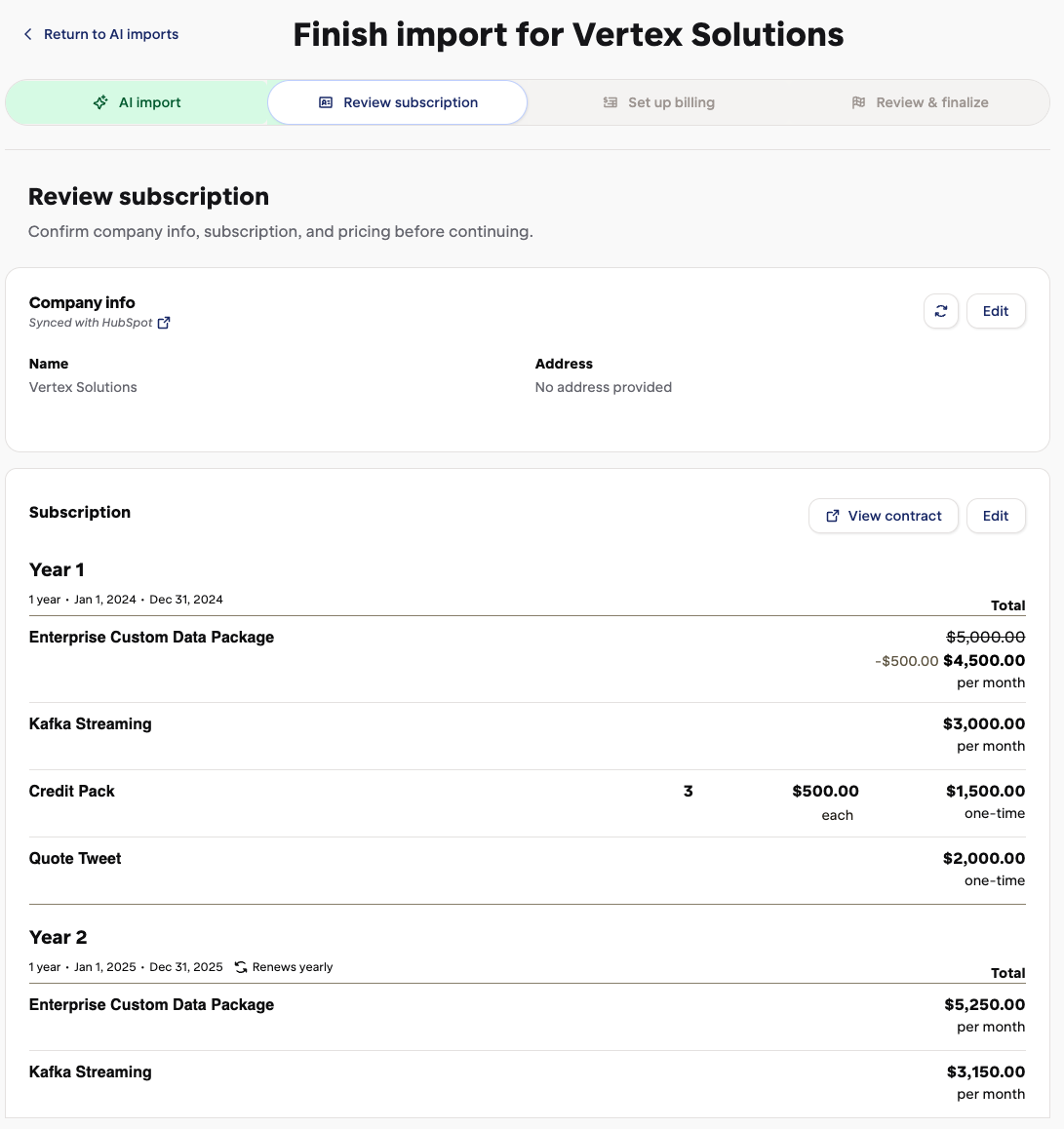
Turnstile integrates with CRMs, including HubSpot, Attio, and Salesforce, to pull customer data directly into quotes. When contracts are signed, those terms automatically become your billing configuration because everything is stored as structured data rather than static PDFs. The contract you negotiate is the same data that generates invoices.
Trying to make your CRM do everything, or maintaining parallel systems and spreadsheets, creates the fragmentation you're trying to avoid. So, pick specialized tools that integrate cleanly rather than forcing one system to handle workflows it wasn't designed for.
3. Design Your Systems for Scale from Day One
Poor implementations cost more to fix later and can derail growth trajectories. You sign up for Salesforce, click through setup, and start entering data. Three months later, your data structure breaks when tracking multi-year contracts, reports don't match reality, and fixing it requires rebuilding everything.
Most founders start with Google Docs for quotes, Docusign for signatures, and spreadsheets for tracking: simple tools that work initially but create operational debt as you scale. When contract terms (including pricing, discounts, billing schedules, payment terms, and usage-based components) live in PDFs and emails rather than structured data, you're setting up the same painful rebuild that the Salesforce example illustrates.
Turnstile approaches this differently by storing contract terms as structured data from day one. When you close a deal, pricing, billing schedules, and entitlements automatically flow into your subscription management and billing systems without manual re-entry. Turnstile gets you from signup to your first invoice in about an hour with zero implementation fees, and its structured foundation prevents costly rebuilds that occur when you start with makeshift processes and migrate later.
Connect Your Revenue Data So Numbers Actually Match
4. Create a Single Source of Truth with Unified Data
Integrate data from your CRM, marketing automation, and customer success platforms into a unified dashboard.
When contract terms live in document storage, billing data lives in payment processors, and revenue metrics live in spreadsheets, you're operating from different realities: sales thinks they closed their quarter number, finance can only reconcile what was actually invoiced, and you spend days before board meetings reconciling systems instead of using that data to improve your business (like identifying which products have growing average sale prices to inform your pricing strategy).
This is the costly consequence of operating without a single source of truth.
The fix has three parts:
- Define how you calculate critical metrics like ARR, pipeline, and churn; then use those same formulas everywhere.
- Ensure the same data feeds all your systems so you're not manually updating multiple places.
- Store your source data in one place that everything else references.
Structured data enables automatic flow from signed contracts into billing systems without manual re-entry. This is exactly what Turnstile does.
Turnstile stores contract terms (including pricing, quantities, billing schedules, discounts, and contract value) as structured data from the moment you create a quote. The signed contract becomes your billing configuration automatically, eliminating the manual re-entry that creates discrepancies between what you sold and what you bill.
5. Eliminate Manual Handoffs with Structured Data
Manual handoffs between sales and finance are the most common source of revenue operations failures. Sales extends a three-month discount to close a deal. Three months later, Finance neglects to ensure the discount doesn’t extend beyond three months because that data isn’t stored anywhere.
Or, the opposite happens. Finance neglects to reflect the discount, and now you're apologizing, issuing credits, and damaging trust: all because information got lost between systems.
The better approach is to eliminate handoffs entirely.
When contract terms exist as structured data from the moment you create a quote, those terms automatically flow into billing configurations when the deal closes. No manual re-entry. No transcription errors. No discovering too late that the discount wasn't applied.
Turnstile stores contract terms as structured data from day one. When your customer signs a quote, pricing, billing schedules, and entitlements automatically become your subscription configuration, eliminating the sales-to-finance handoff that breaks at most early-stage companies.
Automate Repeatable Workflows After You Understand Them
6. Automate Core Workflows From Day One
One mistake founders make is building manual processes first, then trying to automate them later. By then, you've accumulated months of inconsistent data, edge cases documented in Slack threads, and informal amendments stored in email
Revenue operations (specifically quoting, invoicing, and billing) are different from other early-stage workflows. While many processes benefit from manual experimentation to find what works, revenue operations create immediate, measurable pain. So founders may spend 10-20 hours weekly building quotes in Google Docs, manually tracking billing schedules, and re-entering contract terms into payment systems.
However, this might not be the most productive use of learning time. It's administrative overhead that scales linearly with every customer you add.
So, instead of manually building quotes in Google Docs and copying contract terms into billing systems, use a platform where the quote automatically becomes your billing configuration. Turnstile's WYSIWYG quote builder with embedded e-signature lets you create quotes in minutes. When the customer signs, those contract terms automatically flow into subscription management and billing without manual setup.
This way, you avoid future pain and reclaim time today. Those 10-20 hours weekly go back to building product and acquiring customers rather than to administrative work that should take minutes.
If you've already started with manual processes, moving to automated systems now prevents further time drain. The longer you operate manually, the more hours you lose to repetitive tasks.
7. Resist Tool Sprawl by Maximizing Existing Capabilities First
Before adding a new tool, audit your existing platforms and fully utilize their capabilities. Your CRM probably has workflow automation you're not using. Your marketing automation platform probably has reporting you haven't configured.
Many early-stage companies adopt too many tools prematurely, creating unnecessary administrative overhead and integration complexity. Limit your stack to tools providing measurable ROI and conduct quarterly tech stack reviews to identify redundancies.
Track Metrics That Predict Revenue Performance
8. Focus on Five Core Revenue Metrics
Tracking 47 metrics creates noise because you can't optimize everything. Focus on five core metrics that predict and explain revenue performance. Here’s an example of five:
- Annual Recurring Revenue (ARR): The annualized value of your recurring revenue subscriptions. This is your primary growth metric and what many investors focus on. You can calculate it by multiplying MRR by 12, or sum up the annual contract values of all active subscriptions.
- Monthly Recurring Revenue (MRR): The revenue you earned this month from subscriptions that you reasonably expect to recur or that contractually recur. Track new MRR, expansion MRR, contraction MRR, and churned MRR separately. MRR growth is a key metric for the early traction stage.
- Net Revenue Retention (NRR): How well you retain and grow revenue from existing customers.
- Customer Acquisition Cost (CAC): Total sales and marketing spend divided by new customers acquired. Target 12-18 month payback period and 3:1 ratio of Customer Lifetime Value to CAC.
- Sales Cycle Length: Average days from first contact to closed deal. Track by deal segment to identify patterns.
9. Implement Weekly Pipeline Reviews with Clear Formats
Conduct weekly pipeline reviews using standardized formats and focus on deal progression: What advanced? What stalled? Why?
You can work by tracking specific patterns in how deals progress. Here's what to look for:
- Stage bottlenecks: Three deals stuck at contract review for 3+ weeks signals a problem. The most common reason is that your value proposition isn't clear enough, the prospect doesn't feel enough pain yet, or your product doesn't obviously solve their specific problem. One deal stalling is normal. Three deals stalling at the same stage means fix the fundamental value prop or positioning, not just the individual deals.
- Customer profile patterns: If every deal with 10-50 employees closes in under 3 weeks but deals with 100+ employees drag past 8 weeks, you've found an ICP signal. The 10-50 employee segment is your sweet spot; they have the pain and can move fast. The larger segment might not be worth the extended cycles at your current stage.
- Deal velocity changes: A deal that moved from discovery to demo in 48 hours but has been silent for 2 weeks after receiving the quote tells you something. Either the quote doesn't match what they expected from the demo, or you're not following up effectively. Compare this against deals that close within days of receiving quotes and ask, “What's different about the successful pattern?”
These reviews shouldn't take more than 30 minutes weekly, but they can be game-changing.
10. Ensure Revenue Recognition Compliance from the Start
Most founders recognize revenue incorrectly. A customer pays $12,000 for an annual subscription upfront. You must recognize $1,000 per month over twelve months, not $12,000 immediately. Incorrectly recognizing revenue creates artificially inflated figures that don't reflect actual business performance.
When you can't see how your business is actually performing, you make expensive mistakes: hiring your second account executive (or salesperson) when the revenue doesn't justify it yet, burning scarce cash on expansion before you've proven retention, or misjudging which products are actually driving growth. Then it becomes a critical problem during fundraising due diligence when investors scrutinize your numbers.
When contract terms (like pricing, quantities, billing schedules, and discounts) are structured data rather than static PDFs, revenue recognition occurs automatically according to the subscription schedule. Turnstile handles every deal this way, providing you with accurate data from day one to make smart decisions about hiring, spending, and growth while giving investors confidence in your numbers during due diligence.
Catch Revenue Leaks Before They Compound
11. Audit Order-to-Cash Accuracy Quarterly
Implement quarterly audits that systematically compare signed contracts to generated invoices to cash actually received. This operational discipline catches data translation errors, billing system misconfigurations, and process gaps before they compound.
Contract data accuracy matters because investor due diligence scrutinizes whether your systems reliably translate signed deals into proper billing and revenue recognition. When pricing, entitlements, and billing schedules exist only in static PDFs, manual re-entry creates discrepancies between what you sold and what you billed.
Almost 72% of RevOps professionals report revenue leakage of more than 10% due to process gaps. Quarterly audits catch accumulated gaps (discounts without approval, signed contracts that don't match billing systems, untracked credits) while they're fixable.
Revenue Operations That Scale With You
Most founders discover revenue problems during the worst possible moments. You're preparing for Series A and realize billing numbers don't match sales data. You hit 50 customers and manual processes collapse under their own weight. A customer asks about their invoice and you discover you forgot to bill them for three months.
These crises don't announce themselves early. They compound silently until something breaks.
Starting with proper infrastructure prevents these moments entirely. When contract terms exist as structured data from day one (not PDFs scattered across email and folders), billing configurations happen automatically, revenue numbers stay accurate, and your systems scale without manual intervention.
Revenue operations shouldn't consume 10-20 hours of your week. Turnstile stores contract terms as structured data from the moment you create a quote. This eliminates the manual re-entry and spreadsheet tracking that create chaos today and prevent data discrepancies that compound as you scale.
Book a demo to see how it works.
FAQs About RevOps Best Practices
When should we implement RevOps? Are we too early?
Implement RevOps when data silos develop between your revenue activities, manual handoffs create friction in your customer journey, inconsistent or unreliable revenue forecasting emerges, and growing tension surfaces over lead quality and follow-up timing. You're not too early if you're experiencing these issues.
Should we hire more salespeople or fix our sales process first?
Fix your process before scaling headcount. Adding salespeople to a broken process multiplies inefficiency rather than multiplying revenue. Before expanding your sales team, establish clear lead qualification criteria, standardize sales playbooks with proven conversion patterns, build reliable pipeline visibility across all stages, and document consistent conversion metrics at each funnel stage.
Once these foundations exist, new reps can ramp quickly rather than inventing their own processes.


.png)
.png)