7 Of The Best CPQ Software Options for B2B SaaS
Compare the top CPQ software for B2B SaaS. Learn about structured data vs PDFs, quote-to-cash platforms, pricing, and implementation timelines.
5 mins
March 11, 2026
.png)
Key Takeaways
CPQ (Configure, Price, Quote) software helps sales teams configure products, set prices, and generate professional quotes. It replaces the manual Google Docs and spreadsheet workflows that break when you're closing $15K+ annual contracts with custom terms.
CPQ software lets sales-led startups close deals faster, protect margins, and scale their team beyond the founder by replacing manual, error-prone quoting with structured pricing logic that flows cleanly into billing and revenue.
Usage minimums, ramped pricing, mid-cycle start dates, custom billing schedules: these terms need to flow accurately from sales conversations into signed contracts and invoices as well as your accounting and revenue recognition entries. When they don't, you spend valuable weekly hours on manual billing and invoicing, discover billing discrepancies when reviewing your metrics, and lose revenue.
This guide helps founders, finance leaders, and revenue operations teams evaluate CPQ software and quote-to-cash platforms. In it, we'll cover what capabilities matter for negotiated deals, how to choose the right tool for your stage, and where each platform excels or falls short.
Top CPQ Software Tools At A Glance
How To Choose CPQ Software for B2B SaaS
CPQ for sales-led B2B SaaS differs from traditional manufacturing-focused CPQ tools. The capabilities that matter most are subscription pricing flexibility, CRM and billing integration, and whether contract terms flow into downstream systems automatically or require manual re-entry. Features matter less than whether the tool fits how you actually sell. Work through these five criteria to narrow your options:
1. Start with the CPQ vs. quote-to-cash distinction
CPQ tools stop at the signed contract. Someone still needs to manually enter those terms into your billing system. Quote-to-cash (or Q2C) platforms handle the complete workflow from quote through invoicing and revenue recognition. With Q2C, what you quote is invoiced accurately and automatically, every time.
This distinction matters because manual transfers between disconnected systems introduce integration challenges, data entry errors, incompatibility (e.g., billing system can’t produce invoices based on sold quote), billing delays, and approval bottlenecks. Unified quote-to-cash platforms eliminate these handoff failures by maintaining a single data model where contract terms automatically flow into billing configurations. For sales-led B2B SaaS specifically, this architecture becomes critical when managing complex subscription models, automated proration for mid-contract amendments, and ASC 606 revenue recognition compliance.
2. Evaluate pricing model support
Many traditional CPQ systems are legacy platforms as they were designed for transaction-based sales before subscription business models became popular. Confirm whether the platform natively supports your pricing model: usage-based with minimum commitments, ramped pricing that increases over time, or hybrid structures combining license and usage fees.
The platform must also maintain ASC 606 (the accounting standards governing how subscription revenue must be recognized over time) through automated processes that handle deferred revenue calculations as contract terms change. Create a test quote with your most complex deal structure during evaluation, and have sales reps (not just managers) run through the workflow. Determine how long it takes to create a complex quote given that delays cause lost sales.
3. Assess integration architecture realistically
The platform must connect with your CRM (Salesforce, HubSpot), billing system (Chargebee, NetSuite SuiteBilling), and accounting software (QuickBooks, NetSuite). Bidirectional data flow ensures customer information, opportunity history, and quote status stay synchronized.
Ask vendors for specific customer references with your exact integration requirements to ensure it works the way you need it to. Otherwise, integration challenges become apparent post-purchase when they're expensive to fix.
4. Match implementation timelines to your capacity and needs
Enterprise platforms like Salesforce Revenue Cloud and Oracle CPQ require 8-16 weeks minimum with dedicated project teams. If you're a founder handling billing and invoicing personally, platforms requiring extensive configuration will consume weeks of your time that should go toward closing deals and building product. Contrast that timeline with other tools that go live in under one day with no technical resources required.
5. Calculate total cost of ownership
Per-user pricing models at $200+ per seat per month become expensive as teams grow. Factor in implementation services (which can run five to six figures or more for enterprise platforms), integration development costs, ongoing maintenance, and internal administration resources.
For example, a $100/month platform with no implementation fees may cost roughly $3,600 over three years, while an enterprise tool may cost $150/user/month for a 5-person team, plus a $150,000 implementation, exceeding $175,000 over the same period.
Migration costs add up too. If you're still evolving your pricing model, evaluate whether the platform accommodates pricing experimentation: can you change pricing models without breaking downstream billing? Platforms that require configuration changes for every pricing adjustment add ongoing overhead. If you'll need to migrate at your next stage of growth, factor that cost and disruption into your decision now.
With those criteria in mind, here's how the leading platforms compare for B2B SaaS.
The 7 Best CPQ Software Options for B2B SaaS
1. Turnstile: Best for Sales-Led B2B SaaS Startups
Turnstile is a quote-to-cash platform built specifically for sales-led B2B SaaS companies that need billing and invoicing working from day one. Unlike CPQ-only tools that generate quotes and then stop, Turnstile handles the complete workflow from quote generation through billing, invoicing, and revenue recognition.
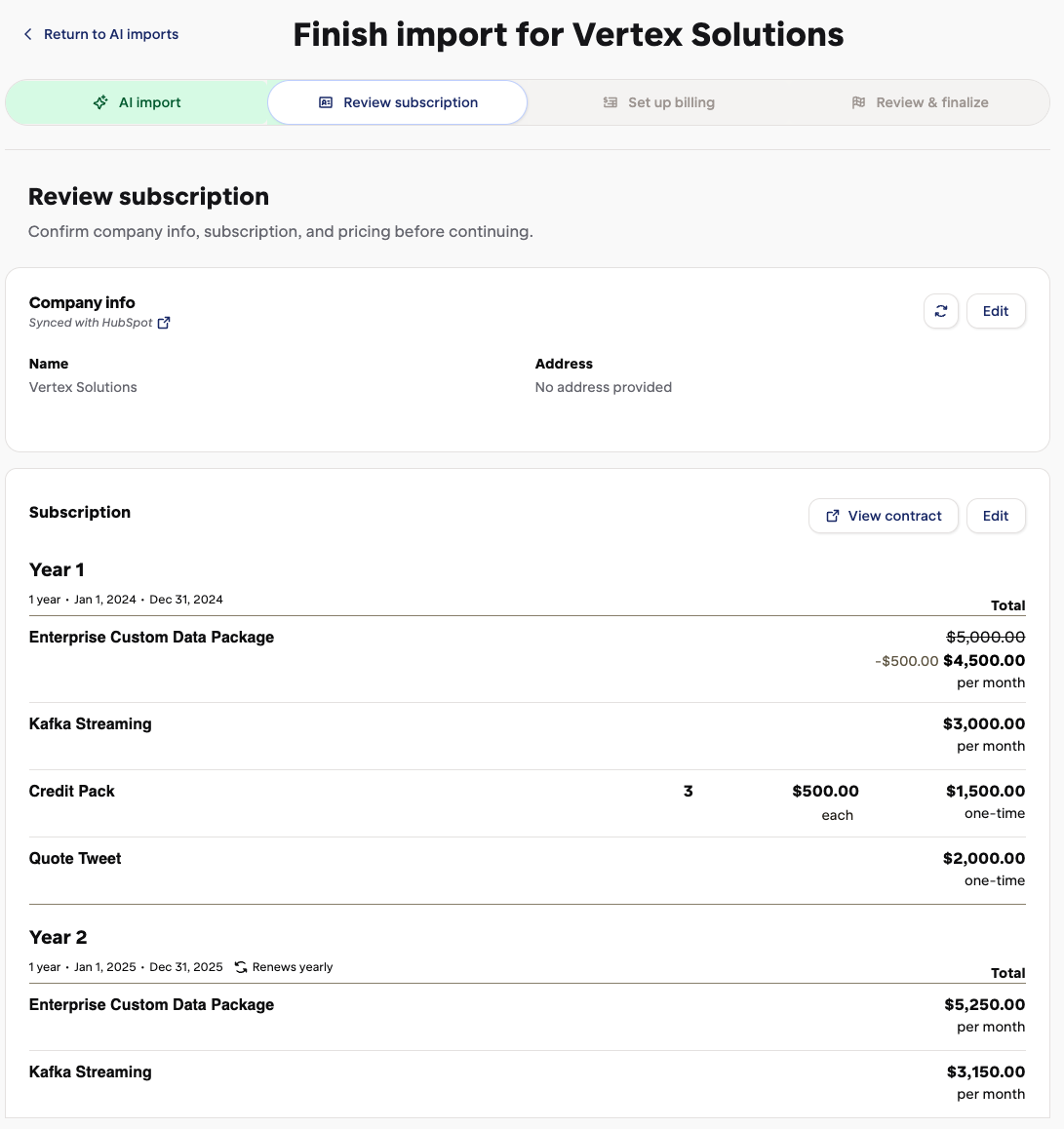
The platform stores contract terms as structured data, so when a sales rep closes a deal with custom terms (ramped pricing, mid-cycle start dates, usage minimums, or hybrid pricing models), those terms automatically flow into billing configurations, provisioning systems, and financial reporting. The signed quote IS the contract: no spreadsheets tracking what customers signed, no finance team manually setting up invoices.
Key Capabilities:
- Complete quote-to-cash workflow: From quote generation through invoicing and revenue recognition, with financial reporting that updates instantly as deals close
- Structured data foundation: Contract terms flow automatically into billing, provisioning, and revenue recognition
- WYSIWYG quote builder: Create professional quotes with document-editor familiarity
- Flexible pricing support: Handle any pricing model (recurring, usage-based, tiered, ramped, or hybrid) without breaking billing
- Accurate and automated billing: Invoices generate automatically from contract terms with no manual setup when quotes are signed
Pricing: $100/month + 0.6% of billing volume. Live in under one day with no developers required.
Best For: Sales-led B2B SaaS startups where founders or first ops/finance hires handle financial operations. Companies that want to prevent operational debt rather than clean it up later. Companies that need to dramatically scale sales and revenue without hiring additional finance or ops headcount. Teams experimenting with pricing models who need flexibility without breaking downstream billing.
Limitations: Less suited for companies using solely product-led growth with standardized self-service pricing, or companies requiring integration with legacy enterprise ERP systems beyond QuickBooks and NetSuite.
2. DealHub: Best for Midsize Teams with Complex Product Catalogs
DealHub is a CPQ platform emphasizing no-code configuration with native CRM integrations to automate complex quote generation for midsize B2B SaaS companies. The platform's rules engine enforces pricing logic and product compatibility constraints through guided selling workflows.
Key Capabilities:
- Native Salesforce, Microsoft Dynamics 365, and HubSpot integration without custom coding
- Powerful product configuration rules engine for complex catalogs
- Dynamic pricing calculations based on customer data and volume discounts
- Automated approval routing based on discount thresholds
- Professional quote and proposal templates with e-signature integration
- Digital sales room for buyer engagement and content sharing
- Multi-currency support for global operations
Pricing: Contact sales for custom quotes based on user count and features.
Best For: Midsize B2B organizations (100+ employees) with complex product catalogs requiring sophisticated configuration rules. Technology companies and SaaS providers with complex product catalogs that need deep CRM integration. Teams that have standardized their sales process and pricing structure who need enforcement through automation.
Limitations: DealHub's configuration depth requires working with rule formulas that take time to master. The platform wasn't originally designed for billing. In 2025, DealHub acquired Subskribe (a Q2C company) and is still integrating those capabilities. Therefore, teams requiring mature billing automation should assess the extent of that integration. It’s also less suited for early-stage companies and companies experimenting with pricing and deal structures.
3. Salesforce Revenue Cloud: Best for Existing Salesforce Customers with Dedicated Technical CPQ Resources
Salesforce Revenue Cloud is an enterprise quoting automation platform that generates complex sales quotes with product configuration, pricing rules, and approval workflows, fully integrated with Salesforce CRM. The platform offers AI-powered pricing recommendations and full subscription management for organizations already invested in the Salesforce ecosystem.
Key Capabilities:
- Quote generation handling multi-dimensional product bundles
- AI-powered pricing recommendations through Agentforce
- Native subscription management with renewal workflows
- Contract lifecycle management with amendment tracking
- Direct data synchronization across Sales Cloud, CPQ, Billing, and Analytics Cloud
Pricing: Salesforce Agentforce 1 Sales Edition (part of Revenue Cloud) at $150/user/month, which includes AI usage and advanced analytics. Implementation typically costs six figures depending on complexity. Ongoing administration requires dedicated Salesforce Revenue Cloud expertise, either internal headcount or external consultants, adding significant cost beyond the per-user fees.
Best For: Mid-sized to large enterprises (typically 500+ employees) with existing Salesforce Sales Cloud deployments. Organizations with complex product bundles requiring sophisticated configuration logic. Companies with internal Salesforce expertise or budget for ongoing platform administration.
Limitations: Implementation requires 8-16 weeks minimum with specialized Salesforce expertise or dedicated consultants. The per-user pricing at $150/month and setup complexity make this a significant investment, better matched for organizations with existing Salesforce infrastructure and internal administration resources. The platform works best for companies with well-established pricing models: pricing experimentation is slow and requires configuration changes that add overhead and cost.
4. HubSpot CPQ: Best for HubSpot Ecosystem Users with Simple Quoting Needs
HubSpot CPQ is a basic-to-intermediate quoting tool integrated within HubSpot's CRM ecosystem, best suited for mid-market B2B SaaS companies with straightforward pricing models already using HubSpot for sales and marketing.
HubSpot CPQ is part of Commerce Hub, which embeds CPQ, billing, payments, subscriptions, and invoicing into HubSpot's CRM to support quote-to-cash workflows. It has limitations compared with specialized CPQ platforms for highly complex configuration and billing scenarios.
Key Capabilities:
- AI-powered quote creation to accelerate turnaround time
- Fast product configuration with product catalogs and line items
- Basic quote approval routing functionality
- Native electronic signature capabilities
- Integrated HubSpot Payments and Stripe connectivity
- Real-time quote activity tracking integrated with CRM pipeline data
Pricing: Commerce Hub Pro (which includes CPQ) is promoted at about $57/seat/month (discounted from $95/seat/month) for new customers.
Best For: Mid-market B2B SaaS companies (100-500 employees, $2M-$50M revenue) with simple to moderately complex pricing models. Teams already using or willing to adopt HubSpot's full CRM ecosystem. Sales cycles of 30-90 days with quote values under $100K.
Limitations: Not designed for complex product hierarchies or heavily negotiated enterprise deals. Per-seat pricing adds up as teams grow, though it's more affordable than enterprise alternatives like Salesforce Revenue Cloud. Better suited for teams with straightforward pricing structures who value CRM integration over CPQ depth.
5. PandaDoc CPQ: Best When Document Automation is Your Priority
PandaDoc CPQ is a no-code light Configure, Price, Quote platform designed for mid-market B2B companies with 100-500 employees, offering visual quote creation and workflow automation without requiring technical expertise. Note that CPQ functionality is exclusively available in the Enterprise tier. Lower tiers provide only document automation.
Key Capabilities:
- No-code document editor with dynamic pricing engine
- Native bidirectional CRM integration (HubSpot, Salesforce, Pipedrive, Monday.com)
- Rules-based approval workflows and guided selling
- Payment processing integration (Stripe, Square, PayPal, Authorize.net, QuickBooks Payments, FreshBooks)
- Built-in e-signature with SOC 2 compliance
- API access and Zapier integration for workflow automation
Pricing: Enterprise tier only (the one that includes CPQ) with custom pricing requiring you to contact sales.
Best For: Mid-market B2B organizations with 100-500 employees where document formatting and presentation matter more than pricing complexity. Companies already committed to CRM-integrated workflows who can accept the Enterprise tier pricing requirement. Teams replacing basic manual quoting who don't need sophisticated billing automation downstream.
Limitations: Basic quoting is intuitive, but advanced workflow automation requires more technical configuration than the no-code positioning suggests. CPQ functionality is only available at the Enterprise tier, so teams evaluating PandaDoc specifically for quoting should confirm pricing before committing to lower-tier plans.
6. Conga CPQ: Best for Enterprise Subscription Lifecycle Needs
Conga CPQ is an enterprise Configure, Price, Quote tool designed for complex B2B sales environments. The platform offers strong subscription lifecycle management capabilities for mid-market to large SaaS companies requiring sophisticated rules-based configuration.
Key Capabilities:
- Advanced rules-based engine handling complex product configurations spanning goods, services, subscriptions, and usage-based models
- Full subscription lifecycle automation with creation, modification, and renewal management
- Sophisticated pricing models including discrete, range-based, cumulative, one-time, and recurring pricing structures
- Real-time quote validation and deal guidance tools
- Rebate management and negotiated price protection
- Single unified catalog supporting simple-to-complex product bundles
Pricing: Contact sales for pricing information. Beyond licensing fees, ongoing maintenance and administration add significant cost, as platform updates require testing and configuration adjustments that typically involve internal technical staff or external partners.
Best For: Large enterprises with $100M to $10B+ annual revenue, complex product configurations requiring rules-based logic, and multiple pricing models. The platform fits organizations with existing Salesforce infrastructure and technical resources for administration.
Limitations: Implementation requires dedicated technical resources and often involves external partners for customization. Platform updates require ongoing testing and administration, so teams should budget for continued technical investment. The platform works best for companies with well-established pricing models: frequent pricing experimentation requires configuration changes that add overhead and cost. Better matched for organizations with existing Salesforce infrastructure and internal technical capacity.
7. Oracle CPQ: Best for Large Enterprises with Dedicated Technical CPQ Resources
Oracle CPQ is an enterprise-grade, cloud-based CPQ platform designed for companies with complex product configurations, requiring a minimum investment of $240 per user per month with a 3-year commitment. The platform excels at automating complex sales workflows with AI-driven guidance and integrating subscription management, which is critical for B2B SaaS.
Key Capabilities:
- Automated product configuration with AI-driven guided selling and reusable product models
- Multiple price books with dynamic promotions and AI-powered deal insights
- Automated document generation with integrated contract management and e-signature capabilities
- Native connections to Oracle Commerce, Subscription Management, CRM, and ERP systems
- Price intelligence, deal scoring, and GenAI-generated product descriptions
- Channel partner support with dedicated channel user licenses and self-service portals
Pricing: $240 per user per month with a 3-year minimum contract commitment. Add-on costs include Channel User licenses at $35 per user per month, Salesforce Connector licenses at $5 per user per month, and external API/e-commerce interactions priced per 1,000 interactions. Implementation costs typically range $100,000 to $500,000+.
Best For: Large B2B SaaS organizations with 1,000+ employees managing complex enterprise subscription deals with ramps, mid-term upsells, and flexible discounting structures. Organizations requiring sophisticated pricing models and quote-to-cash automation.
Limitations: The platform requires specialized technical expertise for configuration and custom reporting, making it less suited for teams without dedicated CPQ administrators. Per-user pricing at $240/month plus a three-year minimum contract creates a significant financial commitment. Implementation costs typically run $100,000 to $500,000+. The platform works best for companies with well-established pricing models: frequent pricing experimentation requires configuration changes that add overhead and cost.
Eliminate Quote-to-Billing Gaps Before They Scale
The right CPQ platform depends on how you sell. If you're a large enterprise with existing Salesforce infrastructure with a fixed long-standing pricing model, you might be able to justify months-long implementations and six-figure costs. But if you're a sales-led B2B SaaS startup closing negotiated deals, you need something different: the flexibility to quote any deal structure without worrying about whether billing can handle it downstream.
That's what Turnstile does. The WYSIWYG quote builder lets you create professional quotes with document-editor familiarity, handling any pricing model (recurring, usage-based, tiered, ramped, or hybrid) without breaking billing. Because Turnstile stores contract terms as structured data, the deal you close becomes the billing configuration automatically. Ramped pricing, usage minimums, mid-cycle start dates: you quote it, and it flows directly to invoicing, provisioning, revenue recognition, and accounting. No manual re-entry, no reconciliation headaches, no billing errors.
At $100/month plus 0.6% of billing, you reclaim the hours you'd otherwise spend recreating deal terms across disconnected systems. Book a demo to see how structured contract data eliminates the quote-to-billing disconnect from your first customer.


.png)
.png)