How To Calculate and Reduce Churn Rate For B2B SaaS
Learn to calculate churn rate for B2B SaaS with customer and revenue formulas, benchmark by stage, and reduce it with proven tactics.
5 mins
March 11, 2026
.png)
Key Takeaways
Churn rate is the percentage of customers or revenue you lose over a given period. For sales-led B2B SaaS companies, it determines whether you should keep investing to acquire new customers or whether acquired customers churn quickly, prior to recovering for the cost to acquire them and deliver the service, and need to fix retention before you can grow.
When you close a $150K annual contract but lose $120K to churned customers the same month, you're left with only $30K in net new ARR; meaning 80% of that $150K annual contract went to replacing what you already had instead of actually growing.
Understanding your churn rate matters because it directly determines whether your business can grow sustainably or is stuck on a treadmill. In other words, churn is the clearest signal of product-market fit (telling you whether your growth efforts are building on a solid foundation) and determines whether your go-to-market strategy actually works.
This guide covers what churn means in B2B SaaS, how to calculate it correctly, what benchmarks to target at each stage, and the highest-leverage tactics for reducing it.
What Does Churn Mean in B2B SaaS?
A customer’s $25K annual contract ends and they decide not to renew. You just lost this year's revenue and every future year's revenue. That's churn, and in B2B SaaS (where ARR assumes customers renew year after year) it determines whether your acquisition costs pay off. However, the math only works when customers stay long enough to generate several times what you spent to acquire them, not just break even.
After all, a customer with $1,200 MRR who churns after six months represents not only $7,200 in revenue you don't collect for the rest of the year, but potentially $14,400 in lost ARR. If they had stayed a customer for three years, that’s $43,200 in lost revenue.
Revenue loss isn't limited to full cancellations. Say another customer downgrades from your $2,500/month Enterprise plan to your $120/month Starter plan. You've lost $2,380/month in recurring revenue even though they're still a customer. This is known as contraction, and it reduces your Net Revenue Retention (NRR) just like churn does.
Churn and contraction are often discussed together because both represent revenue walking out the door, just through different mechanisms and at varying degrees.
What Causes Churn And Contraction in B2B SaaS?
Understanding why customers leave helps you address the root causes before they compound.
Most churn falls into a handful of categories:
Product features, pricing, and performance
- Product gaps or competitive pressure: A competitor offers something better, cheaper, or more tailored to their evolving needs. Or your roadmap didn't address the features they were counting on, they requested or were promised.
- Reliability and downtime issues: Repeated outages, slow performance, or data loss erodes trust quickly. Customers who can't depend on your product will find an alternative they can.
- Pricing misalignment: The value delivered doesn't match the price, or a price increase at renewal triggers a reevaluation they wouldn't have otherwise done.
Onboarding, customer success, and support
- Failed onboarding and implementation: The customer bought but never reached a key activation step. They got stuck during setup, key stakeholders lost interest, or the champion who bought it left before the product was embedded in customer workflows.
- Lack of ongoing engagement: No one's checking in, usage drops, and the customer drifts away. By renewal time, they've forgotten why they bought it, have found workarounds, or went with a competitive product.
- Poor customer support: When customers hit problems and can't get timely, effective help, frustration compounds. Unanswered tickets and slow response times signal that you don't value the relationship.
Customer-specific challenges
- The champion leaves after implementation: In sales-led B2B SaaS, deals are often tied to a specific person. When that person moves on, the new stakeholder may not have the same context or commitment and may prefer tools they've used successfully in the past.
- Budget and organizational changes: Restructuring, layoffs, or shifting priorities make the tool a casualty of cost-cutting, especially if it's not deeply embedded or tied to clear ROI.
- Involuntary churn from AP friction: At $10K+ deal sizes, customers pay via ACH or wire transfer with Net 30 terms. Invoices get stuck in accounts payable workflows, budget approval cycles delay payment, or the finance contact changes without notice. The customer intends to renew, but administrative friction causes the contract to lapse.
Sales qualification miss
- Poor fit of product to customer need: Sales closes deals with customers who aren't actually a good fit. Wrong use case, wrong company stage, or expectations that don't match what the product delivers. These customers were never going to succeed.
Knowing why customers leave is only half the equation. The other half is measuring how much it costs you, which requires understanding the different types of churn metrics.
What Churn Metrics Should You Track?
Different churn metrics answer different key questions about your business performance. Understanding each metric helps you diagnose problems, devise solutions, and communicate accurately with investors.
Customer churn metrics
Customer churn (aka logo churn) measures the percentage of customers who cancel, treating every customer equally regardless of their revenue. Losing three customers from a base of 100 equals 3% customer churn, whether those customers MRR is $1,000 or $10,000.
Unlike revenue churn metrics (covered below), this metric does not capture downgrades.
Revenue churn metrics
Revenue churn is a category of churn metrics that measure the percentage of recurring revenue lost, weighting customers by their ARR. Losing a $50K annual contract hurts ARR more than losing a $20K contract, and revenue churn metrics reflect this reality.
The two main types are:
- Gross revenue churn measures losses from cancellations and downgrades and excludes accounting for any expansion revenue. This reveals the fundamental health of your existing customer base regardless of how well you're expanding existing customers.
- Net revenue churn accounts for losses alongside expansion revenue from existing customers (upsells, cross-sells, and usage growth). When expansion revenue exceeds losses, you achieve "negative net churn" or positive net revenue retention (NRR) above 100%. This metric directly reflects the net change in revenue from your existing customer base.
Revenue retention metrics
Net revenue retention (or NRR) flips the perspective from losses to the overall health of your existing customer base. NRR is the percentage of revenue retained from existing customers including churn, contraction, and expansion. An NRR of 110% means revenue in your existing customer base grew 10%.
Each metric answers a different question: customer churn tells you how many relationships you're losing, revenue churn tells you how much money you're losing, and net churn tells you whether your existing base is growing or shrinking overall.
What Does Churn Rate Mean in B2B SaaS?
Churn rate expresses lost revenue as a percentage of your starting base, showing how fast customers or revenue disappear over time. A 2% monthly customer churn rate means you lose 2 out of every 100 customers each month. A 10% annual net revenue churn rate means you lose 10% of your recurring revenue base each year.
Time periods affect how churn appears in your metrics. A 2% monthly churn rate sounds manageable, but compounds to approximately 22% annual churn when calculated correctly using the compounding formula: Annual Churn = 1 - (1 - 0.02)^12. This compounding effect means monthly churn rates that seem acceptable become unsustainable.
This compounding is precisely why churn has such an outsized impact on your ability to grow.
How Does Churn Rate Impact B2B SaaS Businesses?
Reducing churn by half doubles the lifetime revenue of every customer you acquire. This multiplicative relationship means improving retention creates outsized business value without acquiring a single new customer.
To achieve the same ARR growth goals with high churn vs. low churn, new sales goals increase exponentially as churn rises. Starting with $5M ARR and targeting 100% growth: you need $5M in new ARR at zero churn, $5.5M at 10% churn, or $6M at 20% churn. That extra $1M represents 20% more sales just to compensate for losses.
The negative ARR and customer count impact of churn grows as you scale. With 100 customers and 5% monthly logo churn, you lose five customers monthly. That's already a serious problem. Scale to 1,000 customers at the same churn rate and you lose 50 customers monthly, requiring dramatically more sales and marketing investment just to maintain your current revenue level.
Now that you understand the stakes, here's how to calculate your churn rate correctly.
How To Calculate Churn Rate for Your B2B SaaS Business
1. Customer Churn Rate
Customer churn rate divides the number of customers lost during a period by the number of customers at the start of that period, expressed as a percentage.
Formula: Customer Churn Rate = (Customers Lost ÷ Customers at Start of Period) × 100%
Starting January with 100 customers and losing 5 customers during the month produces a 5% monthly customer churn rate (5 ÷ 100 × 100%). For the denominator, use the customer count at the beginning of the period, never the end. Including new customers acquired during the period is a common mistake that produces an incorrect churn rate and masks retention problems.
2. Gross Revenue Churn Rate
Gross revenue churn rate uses the same structure but measures recurring revenue lost from cancellations and downgrades, excluding any expansion revenue.
Formula: Gross Revenue Churn Rate = (MRR Lost from Cancellations + Downgrades) ÷ MRR at Start of Period × 100%
Starting the month with $100K in MRR and losing $5,000 to cancellations and downgrades produces a 5% monthly gross revenue churn rate ($5,000 ÷ $100,000 × 100%). This metric shows losses without accounting for expansion revenue.
Why Both Customer Churn And Revenue Churn Matter
Customer churn rate and revenue churn reveal fundamentally different business dynamics. A company might show 3% customer churn but 12% revenue churn, signaling that they're losing their highest-revenue customers despite retaining the majority of your customer base.
Conversely, another company might show 12% customer churn but only 3% revenue churn, indicating that lower-revenue accounts are churning while higher revenue customers and the revenue they generate remain stable. This might warrant further analysis into the business case of serving lower revenue customers.
Always specify which metric you're reporting. For B2B SaaS, Net Revenue Retention (NRR) is typically the headline retention metric in running your business because it captures the full picture of your existing customers: churn, contraction, and expansion in a single number.
Regardless of whether customers are on monthly or annual billing, your retention and churn metrics should include all customers. So, convert everything to a consistent basis (typically MRR or ARR) to ensure you're comparing apples to apples.
What Is a Good Churn Rate for a B2B SaaS Business?
Your target customer segment determines acceptable churn more than any other factor. The table below summarizes typical and best-in-class benchmarks by ACV segment. All figures below refer to annual gross revenue churn (revenue lost from churn and contraction without accounting for expansion) and annual net revenue retention (percentage of revenue retained from existing customers including churn, contraction, and expansion):
These ranges reflect benchmarks, not hard rules. Lower-ACV customers naturally churn more often than enterprise accounts, so "good" churn performance is always relative to ACV and segment. Also note that NRR can exceed 100% even with meaningful gross revenue churn if expansion revenue more than offsets the losses.
Benchmarks by Company Stage
Companies under $1M ARR typically achieve 84% annual gross revenue retention (GRR). GRR is the percentage of revenue you keep from existing customers (excluding any expansion) and translates to 16% annual gross revenue churn. At $1M-$2M ARR, target 90% annual gross revenue retention (10% annual gross revenue churn), with an acceptable range of 5-28% gross revenue churn depending on customer segment and product maturity.
Annual contracts demonstrate approximately 30% better retention than monthly subscriptions because customers only have one decision point per year instead of twelve. If a service outage happens in month three of an annual contract, you have nine more months to prove your value and save the customer. On a monthly contract, that same outage might trigger an immediate cancellation.
Net Revenue Retention Targets
Net revenue retention (NRR) above 100% becomes realistic when you build expansion revenue infrastructure, (e.g., complementary products to upsell, pricing models that enable growth like per-seat or usage-based rather than flat-rate, and quote-to-cash tooling that makes mid-contract expansion easy), typically emerging around $2M+ ARR.
According to HighAlpha's 2025 SaaS benchmarks, companies under $1M ARR achieve a median NRR of 100% (range: 78-116%), while companies at $1M-$5M ARR reach a median NRR of 104% (range: 91-110%).
The difference matters: a $2M ARR company targeting 100% growth needs to sell $2.2M in new ARR if NRR is 90%, but only $1.8M if NRR is 110%. That's an 18% reduction in your sales target from improving retention alone.
Before $2M ARR, focus on finding product-market fit by talking to prospects and customers and iterating based on their feedback. Start building expansion capabilities around $2M ARR, when formalized customer success investment becomes operationally necessary. This is the critical inflection point when formalized customer success investment becomes operationally necessary.
Red Flag Thresholds
Certain churn levels indicate urgent action regardless of stage:
- Red flag: Monthly revenue churn above 3%: A good benchmark for B2B SaaS is monthly churn below 1%, translating to annual churn below 5%. At 2% monthly churn, you're already losing over 20% of your customer base annually. At 3% monthly, that compounds to nearly 31% annual churn, making sustainable growth nearly impossible.
- Unsustainable requiring immediate focus: Monthly revenue churn above 5%: Enters unsustainable territory where you cannot scale effectively even with strong sales performance. Your customers are telling you there’s something (or multiple things) seriously wrong!
How To Reduce Churn Rate in B2B SaaS
Some churn causes require product improvements, pricing changes, or strategic decisions that vary by company. The tactics below focus on operational interventions that address the most common and fixable causes of churn for sales-led B2B SaaS companies.
1. Address Involuntary Churn First
Involuntary churn happens when customers leave due to payment or administrative issues rather than dissatisfaction. At $10K+ deal sizes where customers pay via ACH or wire transfer, this typically stems from AP (Accounts Payable) friction, budget cycles, and payment approval workflows rather than payment failures.
Proactive outreach on Net 30 payment terms and AR (Accounts Receivable) aging analysis can catch these issues before they result in lost customers. A structured dunning process with pre-invoice reminders, escalation timelines, and clear handoffs between billing and customer-facing functions recovers significantly more revenue than ad-hoc follow-up.
2. Define Your Activation Metric and Drive New Customers to Fully Activate
An activation metric measures the specific point where a new customer first experiences your product's core value (often called the "aha moment"). To define yours, analyze customers who successfully renewed after their initial contract term and identify the actions they took in their first 14 days.
For example, a project management SaaS company like Asana might find that customers who create three projects and invite two team members within 14 days show 85% retention, while those who don't show only 40% retention. Once you identify this "aha moment," optimize your entire onboarding to drive customers toward it.
Improvements in activation rate are strongly correlated with higher retention and expansion, but the exact impact varies by product and segment. For example, OpenView’s 2022 benchmarks suggest that standout PLG companies still see only 20-30% of new users reach activation, which is a major lever for growth.
3. Build Renewal Visibility
The operational challenge is knowing when renewals are coming with enough lead time to act. When renewal dates live in spreadsheets and contract terms exist in email threads, you might notice declining usage or support issues without realizing the renewal is next month. By the time you connect the dots, the customer has already decided to leave. Even knowing about a renewal 30 or 60 days out often isn't enough time to fix low usage or poor adoption.
Effective renewal visibility means comparing product usage against renewal dates months in advance, giving you time to improve adoption before the renewal conversation starts. Turnstile surfaces upcoming renewals with contract context, so you can identify at-risk accounts early and intervene while there's still time to change the outcome.
When To Shift Investment Between New Sales, Retention, and Expansion
Early-stage companies under $1M ARR should focus on finding product-market fit. Once you cross $1-2M ARR, begin investing in retention infrastructure and expansion capabilities.
Companies should invest approximately 10% of ARR in post-sales activities including customer success, support, and renewal management. A $10M ARR company should invest roughly $1M annually in retention infrastructure. That $1M investment can yield $500K-$1M in retained ARR from churn reduction alone, plus additional expansion revenue from the existing base.
One metric can help signal when it's time to shift investment from acquisition to retention: the Magic Number. The Magic Number measures sales efficiency by dividing new ARR in a period by sales and marketing spend in the same period. When this ratio falls below 0.5, you're burning cash inefficiently on new customer acquisition.
At this threshold, shift investment toward reducing churn and driving expansion from existing customers rather than pouring more resources into sales and marketing. Reducing churn and driving expansion improves unit economics without requiring additional customer acquisition spend, making it a higher-leverage use of capital.
Prevent Churn Before It Happens
Churn rate determines whether your B2B SaaS business can scale profitably or burns through runway replacing lost customers faster than you can acquire new ones. The calculation is straightforward: track both customer and revenue churn, benchmark against your ACV segment, and watch for red flags above 3% monthly. The harder part is acting on it.
Reducing churn requires visibility into contract terms, renewal dates, and billing status before problems compound. Address involuntary churn first with structured dunning processes. Define your activation metric and optimize onboarding around it. Build renewal visibility months out, not weeks.
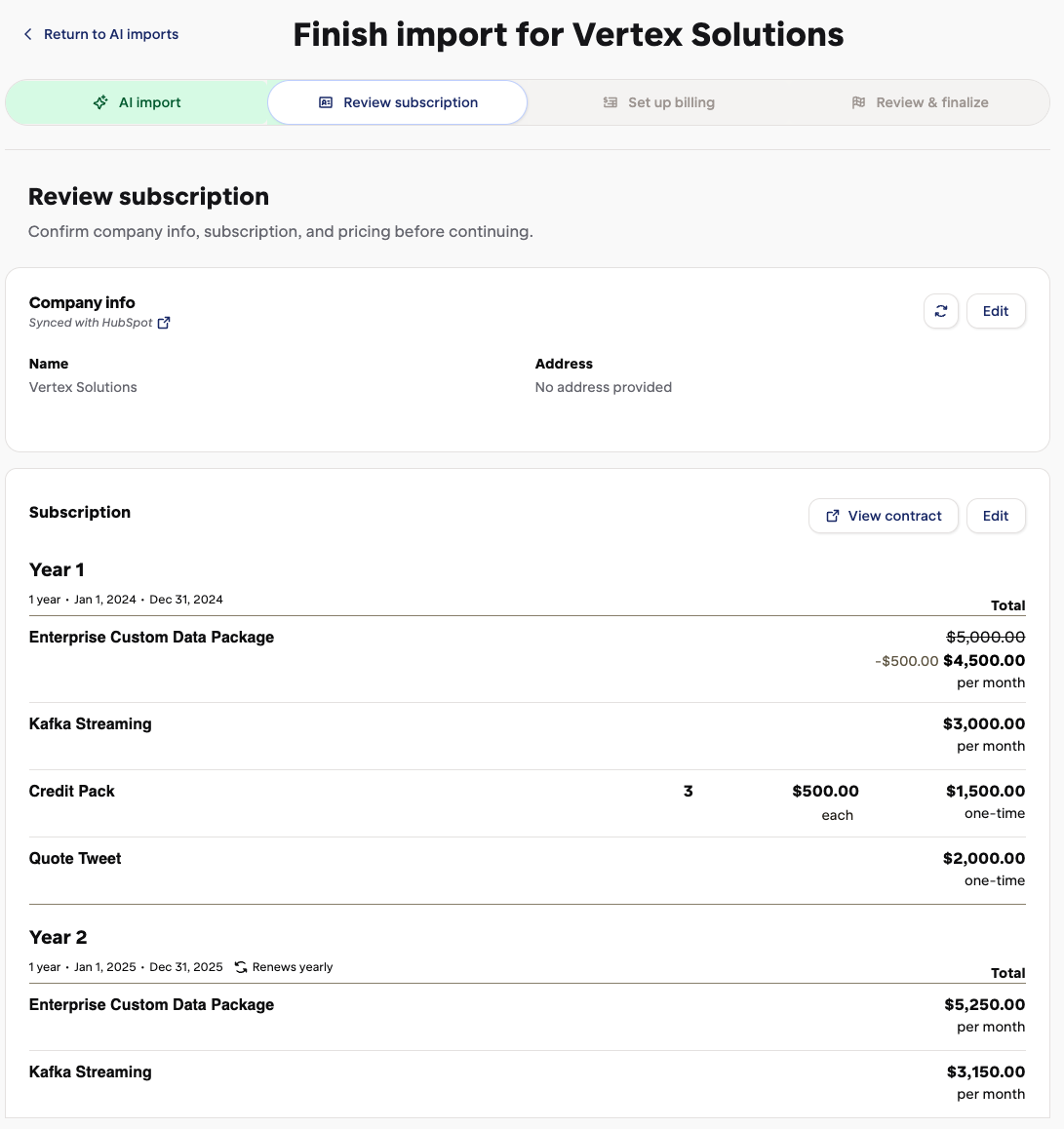
When contract data lives in spreadsheets and email threads, these strategies stay aspirational. That's where Turnstile can help. Turnstile stores commercial terms as structured data from the moment a quote is signed, so renewal dates, billing schedules, and contract terms flow automatically into dashboards where you can act on them. Every quote you send becomes the contract, automatically configuring billing and renewal tracking with no re-entry required.
Book a demo to see how Turnstile gives sales-led B2B SaaS founders the operational visibility to prevent churn rather than just measure it.


.png)
.png)