Best Invoicing Software for Sales-Led B2B SaaS Startups (2026 Guide)
This article explores the best invoicing software for sales-led B2B SaaS startups.
5 mins
January 20, 2026
Key Takeaways
Invoicing software automates how you bill customers, track payments, and manage subscription revenue. For sales-led B2B SaaS startups, basic invoice generation isn't enough: you need systems that handle custom pricing, negotiated terms, mid-cycle subscription changes, and usage-based billing calculations (in some cases).
These requirements matter because manual processes break at scale, especially when each deal looks different. When you're recreating contract terms across separate systems for quoting, billing, and accounting, you could burn up to 10-20 hours monthly on work that should take minutes. When your billing numbers don't align with sales data, you lose confidence in your financial reporting, which can be especially problematic during fundraising when investors start asking questions you can't answer.
This guide covers the top invoicing platforms for early-stage through growth-stage companies, what each platform solves best, and how to choose based on your current stage and sales motion.
Top Invoicing Tools At A Glance
The "right" system depends on your current stage and what problems you're solving today. For example, a seed-stage company validating product-market fit will need different capabilities than a more established Series C company managing thousands of customers and growing rapidly.
The breakdown below covers the top platforms by stage, with verified pricing and user data.
Quote-to-Cash Automation for Sales-Led SaaS (Early Stage And Above)
1. Turnstile: Quote-to-Cash Automation for Sales-Led B2B SaaS
Turnstile is a quote-to-cash revenue automation system built specifically for sales-led B2B SaaS startups. When you're manually creating quotes in Google Docs and separately setting up subscriptions in Stripe and separately tracking renewals in your Calendar app, you're burning 5-10 hours weekly and creating the risk of things falling through the cracks. Turnstile eliminates this.
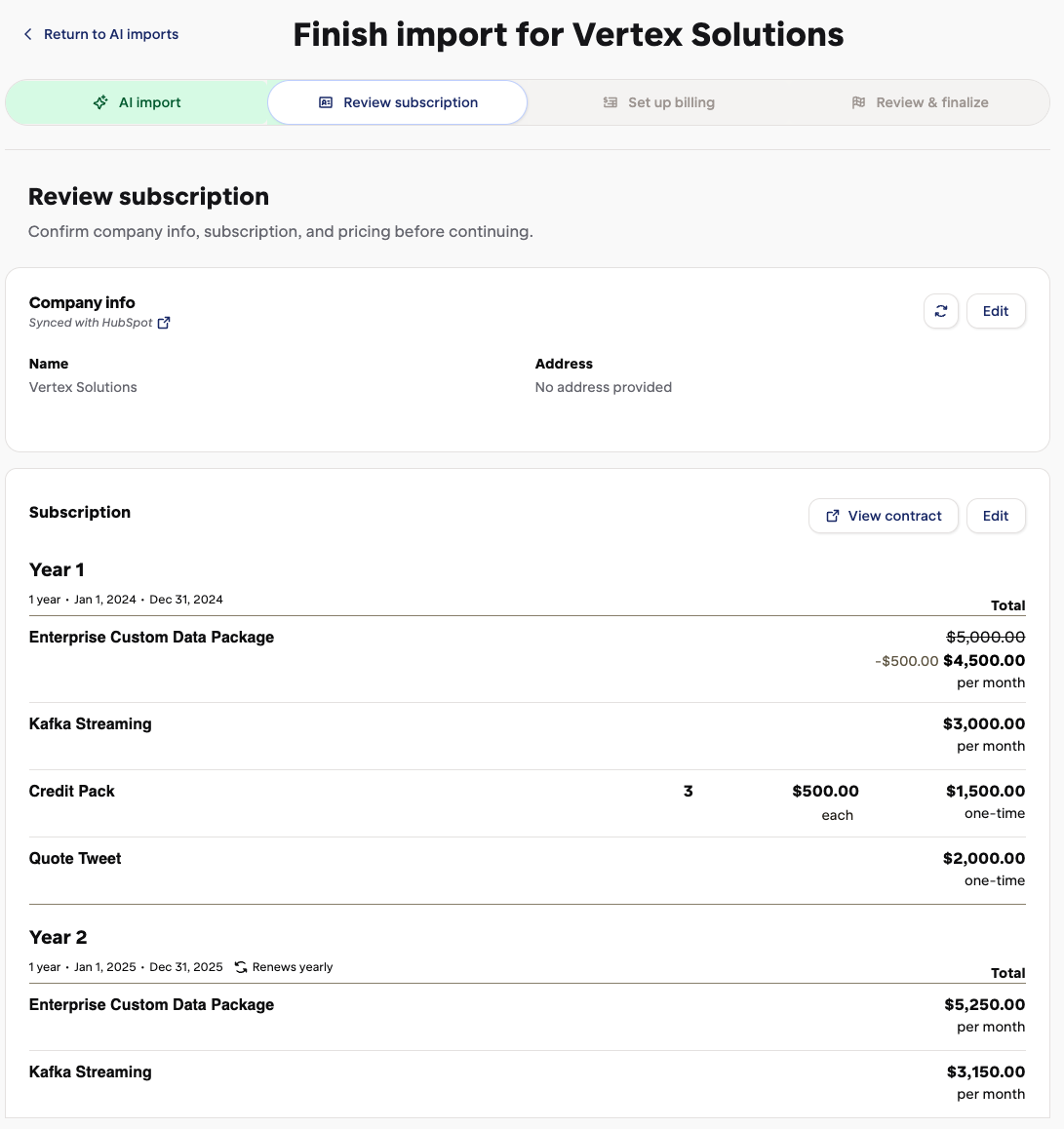
When you create a quote in Turnstile, you're building both the PDF contract your customer sees and the structured data that powers your billing simultaneously, so they match 100%. The terms in the signed PDF are identical to the data driving your invoices, eliminating potential errors that happen when someone manually recreates contract terms in billing systems.
Quote-to-cash automation handles the complete workflow from quote creation through payment collection and revenue recognition. Invoicing software only covers billing because it's one narrow piece of the full revenue lifecycle. When pricing terms exist as structured data instead of PDF text, your billing system can act on them automatically.
Turnstile also integrates with your CRM (HubSpot, Salesforce, or Attio) to pre-populate customer data in your quote. You define every commercial term (pricing, billing schedules, product configurations) in Turnstile's WYSIWYG quote builder (a visual editor where what you design matches what customers see), and that data flows directly to billing, invoicing, and revenue recognition without manual re-entry at each step.
The implementation timeline matters because most systems take weeks to months to implement. With Turnstile, you create your first quote in 15 minutes and send your first invoice within an hour.
Pricing is $100 monthly plus 0.6% of billing volume, and scales with your success.
Free-Tier Champions (Seed Stage, $0-$250K ARR)
2. Chargebee
Chargebee introduced a free tier in 2025 covering up to $250K in lifetime billing. This puts CPQ capabilities and entitlements management within reach for pre-revenue startups.
The free tier covers recurring subscriptions, usage-based billing, and ASC 606 compliance. Implementation takes several weeks due to enterprise-grade feature configuration, but you get sophisticated billing infrastructure at zero cost until you hit meaningful revenue.
3. Wave Accounting
Wave is ‘free’ for unlimited invoicing, with payments processed at 2.9% + $0.30. You can create invoices, track expenses, and manage basic accounting without monthly charges.
However, Wave wasn't designed for recurring subscriptions or complex SaaS billing, so it works best when you're bootstrapped and validating product-market fit with simple invoicing needs.
Early-Stage Accounting-Integrated ($15-70/month)
4. FreshBooks
FreshBooks’ pricing is $8.40 per month for 5 clients, $15.20 per month for 50 clients, and $26 per month for unlimited clients. The tool combines invoicing, expense tracking, project management, and time tracking, and setup typically takes 1-2 days with strong support.
FreshBooks handles recurring billing automation and includes double-entry accounting for straightforward use cases. The limitation emerges when you operate in more than 5 tax jurisdictions. It also lacks native tax compliance integration for centralized compliance management.
Mid-Market and Growth-Stage (Series A-B, $2M-$10M ARR)
5. Maxio
Maxio targets post-Series A companies requiring investor-grade financial reporting. Pricing starts at $599+ monthly with multi-month implementation requiring significant engineering resources. The platform combines subscription management, usage-based billing, revenue recognition, and financial analytics into a single system.
You’ll need dedicated finance and engineering resources to implement and maintain Maxio. This can be a good choice when investor reporting and ASC 606 compliance are non-negotiable requirements, and you have the team to support enterprise-grade infrastructure.
How to Choose the Right Invoicing Software for Your Stage
Choosing the wrong invoicing software creates problems in both directions. You either overpay for complexity you don't need yet, or you outgrow your system when you already have hundreds of customers and switching means migrating historical contracts, reconciling data, and risking billing disruptions.
The right system handles how you actually close deals today while supporting where you're headed over the next 12-18 months. The following helps you to separate software that solves real problems from tools that just check feature boxes:
1. Match Software to Your Sales Motion
Sales-led companies operate very differently from product-led businesses with standardized pricing and self-serve checkout. If every deal involves negotiation, custom pricing, flexible billing schedules, or usage-based components, your invoicing system must handle variation as a first-class concept.
However, basic invoicing tools assume uniform customers, although this is rarely the reality. So, when you negotiate custom pricing, non-standard billing schedules, or usage-based components, you either have to manually configure each variation or handle billing manually every single month if the system can't support it. That manual work can compound and become a problem as deal volume grows.
Therefore, the key question when evaluating invoicing software should be whether the system treats custom deals as edge cases requiring workarounds or as normal inputs it handles automatically.
Sales-led teams need tools designed to absorb deal variation without creating fragile, one-off configurations behind the scenes. If your invoicing process relies on workarounds every time Sales closes a non-standard deal, the software is mismatched to how your company actually sells.
2. Evaluate Integration Requirements
Your invoicing software needs to work seamlessly with your CRM and accounting system. When teams manually re-enter data between tools like HubSpot and billing or finance systems, you risk overbilling customers or missing revenue you should have collected.
Look for solutions with native integrations rather than relying on custom API work. Native connectors can usually be implemented in hours, while custom integrations often take days or weeks and introduce ongoing maintenance risk.
3. Prioritize Stage-Appropriate Features
Avoid choosing software based on hypothetical future needs. The right tool should solve today’s problems clearly while supporting where the business is headed over the next 12 months.
While it is possible to migrate systems as you scale, each transition requires time and introduces risk, especially around data integrity and historical accuracy. That said, the cost of switching later can be lower than the cost of implementing and maintaining complex features years before you actually need them.
4. Understand How the System Treats Contract Data
Not all invoicing systems treat contract information the same way. Some store commercial terms primarily as documents or free-form fields that humans must interpret. Others model those terms as data the system can act on automatically.
This distinction matters more than it appears. When pricing, discounts, billing schedules, usage tiers, and renewal terms exist only as text, every downstream step requires manual translation. Someone has to read the contract, interpret the terms, and recreate them in billing and accounting systems. That handoff is where most billing errors and reconciliation work originate.
In contrast, systems designed to treat contract terms as structured inputs allow billing logic to operate directly on those terms. Invoices, proration, renewals, and reporting are driven by the same underlying data rather than by repeated manual setup. As deal complexity increases, this difference compounds quickly.
When evaluating invoicing software, ask whether the system understands contract terms or merely stores them. The answer determines how much manual work your team will need to handle as sales volume and deal variation grow.
5. Calculate True Costs
Look beyond advertised pricing to calculate the total cost of ownership. Some platforms charge flat monthly fees, others use percentage-based billing fees or transaction fees on processed payments, and others do both.
Factor in hidden costs beyond the base price, including setup fees, integration development, per-seat pricing that scales steeply, and your team's time spent on manual workarounds when the system doesn't support your sales motion.
6. Consider Compliance and Reporting Requirements
ASC 606 revenue recognition becomes non-negotiable when investors require quarterly financial statements. Therefore, the system must automate deferred revenue tracking, handle multi-element arrangements, and provide audit-ready reporting.
For international operations, evaluate multi-currency support, global payment gateway integration, and automated tax calculations.
Eliminate Manual Invoicing Operations Before They Break
The invoicing platform you choose depends on your sales motion and stage. Sales-led B2B SaaS startups with negotiated deals need quote-to-cash automation that stores contract terms as structured data (which only Turnstile offers). Companies with standardized pricing can start with simpler subscription management. Either way, the goal is to eliminate manual processes before they consume the hours you need for growth.
Turnstile captures contract data once and flows it automatically to billing, revenue recognition, and accounting. At $100/month plus 0.6% of billing, you eliminate manual re-entry errors and reclaim the 5-10 hours weekly spent recreating deal terms across disconnected systems.
Book a demo to see how structured contract data eliminates the quote-to-invoice disconnect from day one.
FAQs About Invoicing Software For B2B SaaS Startups
What's the right invoicing system for my stage and budget?
Match your system to your current pain point. Seed-stage founders validating product-market fit need low-cost tools with basic recurring billing. According to The Kaplan Group, B2B SaaS companies face an average transaction failure rate of 7.9%, with rates as high as 14.7% in certain sectors, so you need automated payment recovery. As you scale, ASC 606-compliant revenue recognition becomes a GAAP requirement and the accuracy threshold increases as revenue grows.
What's the difference between invoicing software and billing software?
Invoicing software creates and sends invoices for one-time or simple recurring payments. Billing software handles the complete subscription lifecycle, from automated recurring charges, usage-based billing and proration calculations to failed payment recovery and subscription management. Sales-led B2B SaaS startups typically need billing automation, not just invoicing.
How do I automate failed payment recovery?
You can automate failed payment recovery by choosing systems with intelligent dunning (automated retry attempts and reminder notifications) that automatically retry failed payments at optimized intervals and send customizable communication sequences.


.png)
.png)