Quote-to-Cash Automation: What Is It and How to Implement It
Quote-to-cash automation turns signed contract terms into billing with no re-entry. Learn what it is and how to implement it.
5 mins
June 18, 2026
Key Takeaways
- Manual handoffs leak revenue. Re-keying signed terms between quoting, billing, and accounting is where leakage and reconciliation work start.
- CPQ is only one step. It stops at signature, so billing, collections, and revenue recognition stay manual unless you automate the rest.
- Architecture decides the outcome. Shared structured data removes the signed-contract handoff, so what you sold, billed, and recognized match.
Your team is still re-entering signed deal terms into billing, invoices, and accounting by hand. Quote-to-cash, your revenue process, breaks at that handoff. Billing errors, missed invoices, and reconciliation work start there.
The cost shows up in three places: revenue that leaks, deal terms re-keyed by hand at every stage, and finance reconciling what was sold, what was billed, and what was recognized. Those three numbers should match, and rarely do.
RevOps leads end up stitching these handoffs together by hand. Finance operators spend each monthly close hunting across quoting, billing, and accounting systems that were never built to agree.
What Quote-to-Cash Automation Actually Means
Quote-to-cash automation is the process of automating every step from creating a sales quote through collecting payment and recognizing revenue. The part where automation matters most comes after signature, when signed terms either become billing data automatically or get re-entered, hopefully accurately, by hand. If your team re-types signed deal terms into billing after the customer signs, the process is still manual where it counts.
CPQ (Configure, Price, Quote) is a software category for creating sales quotes. These tools help sales teams configure products, apply pricing, and generate quotes. CPQ ends at signature. Quote-to-cash is the broader revenue process that includes everything CPQ does and extends through order management, invoicing, payment collection, and revenue recognition.
Treating CPQ as the entire quote-to-cash process creates an organizational blind spot. The first step of the revenue lifecycle gets automated while billing, collections, and revenue recognition remain manual.
Automation across the full process depends on one architectural decision: whether the terms in your quote are captured as structured data (contract terms stored as data your systems can read and use, not just text in a PDF) or locked inside a static document. When pricing, billing schedule, ramp structure, and payment terms exist as machine-readable fields, every downstream system can consume them directly. When those same terms exist only as text, a human must interpret and re-enter them at every stage. A system of record (the authoritative source of truth for specific data across your company) must keep those fields usable after signature. Static signed PDFs turn those terms back into text that people have to interpret.
Each of the seven steps that follow tests your architectural decision.
The Seven Steps of Quote-to-Cash
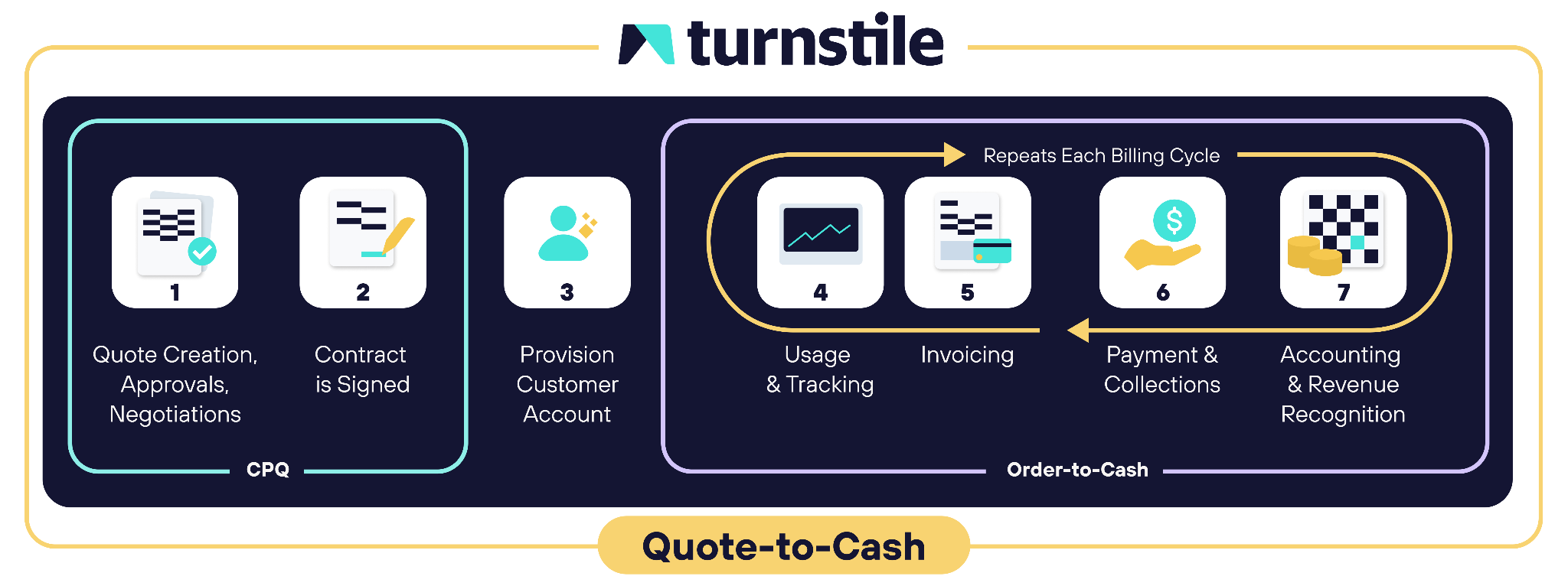
Each step from initial quote to recognized revenue either runs automatically from structured data or stalls and introduces risk of errors while someone re-enters it by hand. The breaks show up wherever that data stops flowing.
- Quote creation, approvals, negotiations. Sales configures pricing, secures internal approval for discounts or custom terms, and negotiates with the prospect. The terms locked here, pricing model, ramp schedule, billing frequency, payment terms, become the source of truth for every subsequent step.
- Contract is signed. The customer signs, and the signed quote becomes the contract that governs billing. If the terms from Step 1 were captured as structured data, they carry into downstream systems automatically. If they live only in a static PDF, someone has to re-enter them.
- Provision customer account. Operations (or an automation) sets up the customer's account, grants access, and delivers onboarding materials as contracted.
- Usage and tracking. For usage-based and hybrid models, the system monitors consumption against contracted thresholds. This data feeds into invoicing.
- Invoicing. Finance generates invoices per the billing schedule defined in the contract. Recurring invoices can run from contract terms alone. Usage-based invoices also require metered and rated consumption data from the product alongside contract terms.
- Payment and collections. Payments are typically made via ACH or wire transfer, typically on Net 30 payment terms. Dunning (automated reminder notifications for unpaid invoices) handles overdue accounts.
- Accounting and revenue recognition. Under ASC 606 (the accounting rule for when you can count revenue as "earned"), revenue is recognized as the promised work is delivered, separate from when cash arrives. Until then, it sits as deferred revenue, cash collected before delivery.
Steps 4 through 7 repeat each billing period. Mid-contract amendments (upgrades, downgrades, add-ons) re-enter the process at Step 1 and flow through Steps 2 through 7 with updated terms.
In practice, the breaks usually appear at the seams between separate tools.
Why Point Solutions Fail at Quote-to-Cash Automation
Each system boundary is another place for signed terms to drift. Each stage of the quote-to-cash process has a purpose-built tool category: quoting or CPQ tools for Steps 1 and 2, billing and subscription management tools for Steps 5 and 6, and revenue recognition tools for Step 7.
Every handoff between tools creates a manual re-entry point and terms can drift. Sales closes a two-year, $200K deal with a first-year discount in the CPQ tool. Someone in finance re-enters those terms into the billing system. The discount expiration date gets missed. The second-year invoice goes out at the same rate as the first when it should have been higher. The billing system now invoices based on a slightly different version of the deal than what the customer signed.
This produces the three-number reconciliation problem: what was sold (in the CRM), what was billed (in the billing system), and what was counted as earned revenue (in the accounting system) should match for every deal. In a stitched-together stack, they rarely do. The divergence triggers monthly Slack threads, spreadsheet reconciliation, and debates between sales and finance over whose numbers are right.
API integrations between point tools reduce the problem but do not eliminate it. Multi-tool stacks still require teams to define and maintain the quote-to-cash process themselves. Every product update risks breaking the sync, and maintaining integrations requires ongoing engineering resources.
The cumulative cost is the loss of confidence in financial data. When the CRM says $150K and the invoice says $147K for the same deal, every downstream decision built on that data inherits the uncertainty.
This matters for running the business. ARR and MRR (annual and monthly recurring revenue) are only useful as predictable subscription income when they tie back to billed and collected reality. Which version of the deal your systems bill from depends on how your stack is built.
How to Implement Quote-to-Cash Automation: Two Architectures
Signed terms either cross into a second system with a second data model, or the same structured data drives quoting and billing from the start. This is the difference between managing handoffs and removing them.
From your first customer, quote-to-cash should run from structured data captured in a system your downstream tools can use.
Option 1: Quoting and Billing Handled Separately
This is a common architecture at growth-stage companies. A quoting or CPQ tool handles product configuration, pricing, discounting, and signature. A separate billing tool handles invoicing, subscription management, payment collection, and revenue recognition. The two systems communicate through API integrations, middleware, or manual export and import.
The stack typically includes a CRM for the deal record, a CPQ tool for quote generation, an e-signature tool, a billing tool for invoicing and payments, and an accounting system for the general ledger. Each tool does its job. The most critical gap lives at the boundary between signature and billing configuration.
At the moment a customer signs, the billing system needs correct pricing, accurate quantities, the right billing schedule, proper ramp terms, and any custom discounts with their expiration dates. In this split architecture, this configuration requires someone to read the signed agreement and re-enter those details into the billing system's own data objects. That re-entry step is structurally required because the billing system maintains its own data model, separate from the quoting tool's.
The operational cost of this handoff scales with deal complexity. A $150K multi-year deal with a ramp structure, usage-based charges, a first-year discount that ends at renewal, and quarterly billing requires precise translation of a dozen variables. Each variable can make the billing configuration diverge from what was signed.
The reconciliation cost compounds over time. Finance must cross-check every invoice against the original signed terms to identify any variance. In separate systems, sales commitments, billing logic, and finance exception handling can end up fragmented across different systems, and money slips uncollected.
That architecture may feel manageable when complexity and volume are low, but the handoff still exists. It preserves avoidable operational debt from the first customer because the signed boundary still depends on translation. A unified architecture removes that translation step entirely.
Option 2: Quoting and Billing Handled Together
A shared data model removes the highest-risk handoff by keeping quoting and billing in one place. They operate within a single system of record and share one data model. The terms a sales rep enters while building the quote are the same structured data fields the system reads when generating invoices. Invoices are generated from the same shared data model.
When a customer signs, billing begins automatically, with no handoff and no re-entry. The pricing model, ramp schedule, billing frequency, discount terms, and payment method exist as structured fields that drive invoicing directly.
This architecture eliminates the manual handoff at the signed boundary. The specific failure modes of the separated stack, such as ramp schedules simplified during re-entry, discount expirations missed, and billing frequency set incorrectly, cannot occur because the original structured fields drive billing.
Mid-contract amendments are handled within the same quote-to-cash system, usually as a distinct workflow. When a customer on a $150K annual contract upgrades to a $250K plan mid-year, the amendment updates the structured data, and mid-cycle adjustments follow. Proration (the partial-period calculation used when a contract changes mid-cycle), adjusted invoices, and updated revenue schedules flow from the change automatically.
A unified model stores contract terms as structured data from the moment they are created inside a single system of record. That keeps invoicing, payment collection, and financial reporting connected to the same underlying data.
Mapping the Decision
Your process either tolerates re-entry risk or removes it. The separated architecture keeps that risk in place. The together architecture removes it.
A separated architecture can look fine when pricing is simple and stable (standard seat-based subscriptions with no custom terms), the handoff surface area is small, and billing volume is low. The data re-entry risk is still designed in because manual reconciliation remains part of how the stack works.
The together architecture removes re-entry risk at any deal volume. The advantage compounds as deal complexity increases with custom pricing, ramp deals, usage-based components, coterminous add-ons, and multi-year structures, precisely the deal complexity that sales-led B2B SaaS companies encounter as they move upmarket.
The OpenView SaaS Benchmarks Report from 2023 found that 27% of SaaS companies don't know or don't track their finance, tax, and compliance back-office costs, and that for those who do, the costs can represent 5 to 9% or more of annual revenue. Those are broader back-office costs, but they show how expensive manual finance operations become.
The more complex your deals get, the more that difference costs you.
Quote-to-Cash Automation Works When Billing Starts from Signed Terms
Quote-to-cash automation works when billing starts from the same structured data captured at quote creation. When that data stays intact through invoicing, payment collection, and revenue recognition, the gap between closed-won and collected closes.
Turnstile runs quote-to-cash from a single system of record, storing signed contract terms as structured data so finance can work from signed terms instead of rebuilding the deal downstream.
Book a demo to see how Turnstile turns signed terms into automatic billing for sales-led B2B companies.


.png)