Tokenomics: How CFOs Can Budget for the AI Era Without Breaking the Bank
AI features ship faster than finance can forecast them, and the token bill that lands weeks later doesn't follow seat-based SaaS logic. This piece breaks down why software spend has decoupled from headcount, where the usual budgeting fixes fall short, and how to match your approach to your company's size and margins. The payoff: a core-versus-experimentation model that keeps spend predictable without stalling innovation.
5 mins
June 25, 2026

Key Takeaways
Finance teams are facing a quiet crisis. Founders and product leaders are shipping AI-powered features at a blistering pace, often celebrating rapid user adoption and engineering velocity. A few weeks later, a different reality lands on the desk of the customer’s Chief Financial Officer: a massive token and compute bill. The financial reality of building with large language models is hitting balance sheets faster than most corporate planning cycles can adapt.
For a long time, the CFO was tasked with managing relatively predictable variables: headcount, real estate, and fixed software licenses. Today, their job has become significantly harder. They are suddenly forced to forecast a highly volatile, usage-driven line item without the benefit of historical data or established benchmarks. This unpredictability creates structural tension between the company’s desire to innovate and the finance team's goal to grow efficiently and predictably. To bridge this gap, finance leaders must move past the comfort of static contracts and embrace budget frameworks that align spend with measurable value.
To build these new frameworks, finance teams must first dismantle the foundational assumption that software expenditure naturally scales with headcount.
Decoupling Output From Headcount: Why the Old SaaS Playbook No Longer Works
For decades, software budgeting relied heavily on seat-based licensing. If a business planned to hire ten new customer support representatives, the finance team could easily project the accompanying software costs to determine a fully burdened customer support rep. cost. The relationship between headcount and software spend was linear and predictable.
Generative AI alters this dynamic. Token-based pricing models separate internal headcount from software output. A single engineer can deploy an automated agent that independently processes millions of data queries, customer interactions, or code executions. The resulting resource consumption can spike overnight, regardless of whether the company is growing its team or undergoing a hiring freeze.
Consequently, software spend is now decoupled from internal capacity. CFOs can no longer rely on standard hiring plans to estimate software costs, turning software from a predictable fixed expense into an unpredictable one. This shift explains why early, reactive attempts to control these budgets frequently miss the mark.
Evaluating the Early Frameworks: Where Common Strategies Stumble
As organizations scramble to manage these variable costs, finance leaders frequently experiment with a few approaches to balance spend against outcomes, often with mixed results.
- The Variable Output Allocation: This approach attempts to replicate a variable incentive model, similar to sales compensation, by capping a department's token budget as a fixed percentage of their operational targets or milestones. The underlying assumption is that compute spend should scale dynamically with a team's productivity (goal achievement, which need not be directly revenue-linked) per unit of cost. The challenge is that token consumption happens upfront during development and testing, long before productivity is realized. Forcing a team to fund their experimental compute out of a budget tied to lagging performance targets frequently starves initiatives before they can mature.
- The Open-Ended Innovation Pool: The second common strategy is the top-down innovation mandate. Eager to avoid falling behind the technology curve, leadership sets aside a broad corporate fund for departmental hackathons and unstructured AI pilots. While this encourages a culture of experimentation, an open-ended fund lacking guardrails frequently leads to massive spend on the new technology with negligible (or negative) return on investment.
Because neither rigid output percentages nor unrestricted corporate pools provide the right balance of financial discipline and technological agility, finance leaders require a more tailored methodology. However, designing the right system requires acknowledging that financial risk looks entirely different depending on a company’s scale and margin profile.
The Solution Is Not One Size Fits All
Before deploying a new budgeting framework, finance leaders must consider two key items that dictate their organizational tolerance for risk: company scale and gross margins.
Company Size
For a 50-person startup, the primary threat is runway destruction. With exploding token costs and VC subsidies drying up in line with the upcoming IPOs of Anthropic and OpenAI, a single inadvertent loop that runs overnight can shorten the company's survival timeline by months. At this stage, the framework requires strict, developer-level visibility and hard spend caps built directly into the development environment. The goal is immediate containment.
For a Fortune 1000 enterprise, the risk shifts from corporate survival to margin degradation and earnings predictability. These organizations cannot manage compute by manually throttling users. Instead, they require structural cost-allocation systems, mapping token consumption back to specific business units or product lines. The goal here is governance and defending the broader corporate margin profile.
Gross Margins
Beyond company size, a business must evaluate its underlying gross margin profile to determine its structural tolerance for compute volatility. Most token expenses function as a direct cost of goods sold (CoGS), meaning an unoptimized deployment directly erodes gross profitability.
For an organization operating on thin gross margins, such as 20%, there is very little room for error. A sudden spike in API usage or an inefficiently routed query can immediately turn a profitable customer transaction into a net loss. In these environments, finance teams cannot afford to wait for monthly reporting cycles. They must collaborate with engineering to establish automated, real-time circuit breakers that either throttle usage or automatically downgrade model tiers the moment a specific margin threshold is breached.
Conversely, an enterprise operating with 80% software margins can choose to prioritize market velocity over near-term efficiency. These companies have the financial cushion to absorb short-term compute waste if it helps them secure a competitive product advantage. The risk for high-margin businesses is structural complacency. If left unmonitored, temporary compute inefficiencies can become permanently embedded in the core product architecture, quietly degrading the long-term margin profile that drove the company's valuation. For these organizations, the budget should focus on trigger-based milestones, permitting a feature to run at a lower gross margin only until it reaches a predefined user adoption target.
Once these baseline constraints are understood, finance leaders can implement a two-part operational strategy built on intelligent enablement and a structured core versus experimentation framework.
Strategy 1: Enablement and Model Selection
Optimizing token spend requires a shift in how teams across the entire organization select their underlying technical infrastructure. Runaway compute costs are no longer a risk confined strictly to product engineering. Because AI accessibility has democratized across functions, some of the most unpredictable expenses now originate within marketing, human resources, or operations as non-developers prompt an LLM without awareness of the underlying costs or ways to optimize queries.
The primary driver of this waste is model over-provisioning, often caused by employees who are least familiar with token economics. When an individual sets out to automate a manual spreadsheet, analyze a legal contract, or summarize customer feedback, they naturally default to selecting the most capable model. The LLMs encourage it - if you saw these options, would you pick a model with a lower version number that is positioned as bad for complex tasks?
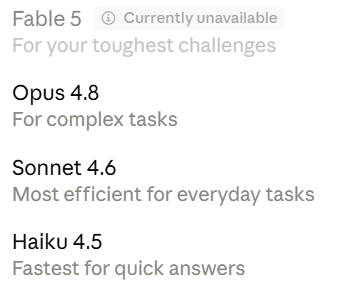
A non-technical user might route a repetitive task to a top-tier model, Fable, when an efficient, mid-tier option like Sonnet would achieve the exact same outcome for one third the cost. While premium models are necessary for complex reasoning, using them for basic data processing creates unnecessary financial liabilities.
To counter this, finance and operational leaders must establish clear, company-wide model hierarchies. Mature organizations implement automated guardrails or routing layers within their internal tools using emerging software such as Merge Gateway, which routes AI queries LLMs to balance price and quality automatically. By matching the complexity of a task to the cost profile of a model, companies can eliminate systemic waste without hindering employee autonomy. This architectural control provides the predictable foundation necessary to manage actual capital allocations.
Strategy 2: The Core Versus Experimentation Budgeting Framework
This strategy lies in adopting a model from performance marketing, an area where finance teams have long been comfortable managing variable, outcome-driven spend. Performance marketing teams routinely split their capital into two distinct buckets: predictable baseline operations and experimental campaigns. Applying this structure to token consumption allows companies to isolate risk while fueling growth.
1. The Core Budget
The core budget is reserved for proven use cases. These are AI features or internal workflows with validated unit economics and highly predictable consumption patterns. For example, if an automated customer service tool consistently resolves tickets at an established, acceptable cost per resolution, its funding sits in the core budget. If transaction volume increases, the budget scales naturally because the underlying unit economics and gross margin impact are known in advance.
2. The Experimentation Budget
The experimentation budget acts as a sandboxed allocation for unproven initiatives. When a team wants to test a new model or launch an unverified AI feature, they receive a capped, time-bound budget - this budget is managed as a strategic bet rather than an open-ended entitlement.
To move an initiative from the experimentation budget into the core budget, companies must enforce a clear graduation mechanism.
Step 1: The Unit Economic ROI Gate. The initiative must first prove its underlying financial viability. For customer-facing features, this means verifying that the projected compute cost does not degrade the targeted product gross margin. For internal workflows, the team must demonstrate that the token cost is lower than the quantifiable labor hours or legacy software costs the tool replaces.
Step 2: The Model Optimization Audit. Once the business case is validated, the workflow must pass an infrastructure review. This is where the team can right-size their model choices. For example, if a marketing or HR automation tool defaults to an expensive flagship model for basic text processing, graduation is deferred until the workflow is configured to run on a more economical, mid-tier model.
Step 3: The Circuit-Breaker Risk Reduction. Before leaving the sandbox, the initiative must be insulated against sudden anomalies. Teams must hardcode guardrails, such as daily API spend caps or query throttling layers, directly into the deployment. This ensures that a loop error or a sudden surge in user adoption cannot trigger an unmanaged budget overrun.
Step 4: Set The Consumption Stability Baseline. The workflow must run within its capped experimental allocation for a consecutive thirty-day observation window, allowing finance to transition from projections to analyzing actual consumption data. This baseline period establishes a verified, predictable run-rate for the tool, which finance uses to budget.
Step 5: The Core Budget Graduation. After completing the thirty-day stability window, the initiative officially graduates into The Core Budget. Finance assigns the verified run-rate from step 4 to the department’s core operating budget, removing it from the experimental pool entirely.
This systematic approach shifts the finance department from a defensive gatekeeper into an active partner in corporate innovation
Budgeting in the Tokenomics Era
In the era of tokenomics, predictability no longer means achieving a flat, unchangeable software invoice at the end of every month. For the modern CFO, true predictability means maintaining control over margins, even when underlying usage scales rapidly.
The organizations that build sustainable advantages in this landscape will not necessarily be those that deploy AI models the fastest. Instead, success will belong to the companies that modernize their financial architecture to match the fluid reality of modern software consumption.


.png)