Billing Management For B2B SaaS: What It Is & Why It Matters
Manual billing creates operational debt for B2B SaaS companies. Learn what billing management is and how structured data helps B2B SaaS companies grow.
5 mins
February 3, 2026

Key Takeaways
Billing infrastructure rarely makes anyone's list of reasons to start a company. The excitement comes from solving real problems for customers. But here's what catches early-stage B2B SaaS startups off guard: billing management needs to be right from day one, before you scale, not after.
A B2B SaaS team managing $35K annual contracts with Net 30 payment terms (meaning customers have 30 days to pay after receiving an invoice) quickly finds the billing reality messy. Net 30 often stretches to day 35-45 once you factor in email back-and-forth, procurement approvals, and payment processing delays.
When proper billing infrastructure doesn’t exist, founders, finance leaders, and ops teams run into missed invoices, angry customers disputing charges, or revenue recognition challenges that stall growth opportunities.
Getting billing right from day one prevents these crises entirely. This article examines what billing management means for sales-led B2B SaaS startups, why it matters, the core components you need to get right, and why structured data is an essential foundational component from day one.
What is Billing Management?
Billing management is how you invoice customers, collect payments, and reconcile revenue: the complete workflow from a closed deal to recognized revenue.
For sales-led B2B SaaS companies, this means managing subscription lifecycles, calculating usage-based pricing, applying contract-specific terms, and recognizing revenue.
The traditional operational workflow includes:
- Invoicing: Generating detailed bills reflecting contracted services, including various phases, discounts, terms, and usage-based pricing
- Collections: Managing ACH transfers and wire payments with payment reminders
- Reconciliation: Matching payments against invoices
- Revenue reporting: Providing real-time visibility into ARR and MRR
- Revenue recognition: Recognizing revenue and staying compliant with ASC 606 (the accounting rule on when revenue can be recognized as "earned")
However, the foundation of effective billing management for SaaS companies is treating the signed quote as the source of truth. Pricing terms, payment schedules, and usage parameters must be captured as structured data fields the moment deals close, not transcribed later from signed PDFs.
When contract terms live scattered across signed PDFs, Gdrive, email threads, and Slack messages, you create a systematic risk of billing errors. In fact, 61% of late payments in B2B SaaS stem from billing errors, with the financial team spending 3 to 7 days identifying and correcting those errors.
That’s because sales-led B2B SaaS startups face billing complexity that standard billing platforms, which were mostly built for product-led businesses, weren't originally built to handle.
A $35K annual contract with quarterly billing and Net 30 terms requires different infrastructure than a $3K/month self-serve subscription. Your billing system needs to track that Customer A gets 20% off for six months, Customer B pays based on API calls consumed, and Customer C has milestone payments tied to implementation dates.
CPQ software (Configure, Price, Quote) helps sales teams generate accurate quotes with complex pricing, including negotiated and custom terms. However, most CPQ tools stop at the signed contract, requiring someone to manually re-enter contract terms into billing systems to generate invoices, which creates handoff gaps that cause billing errors.
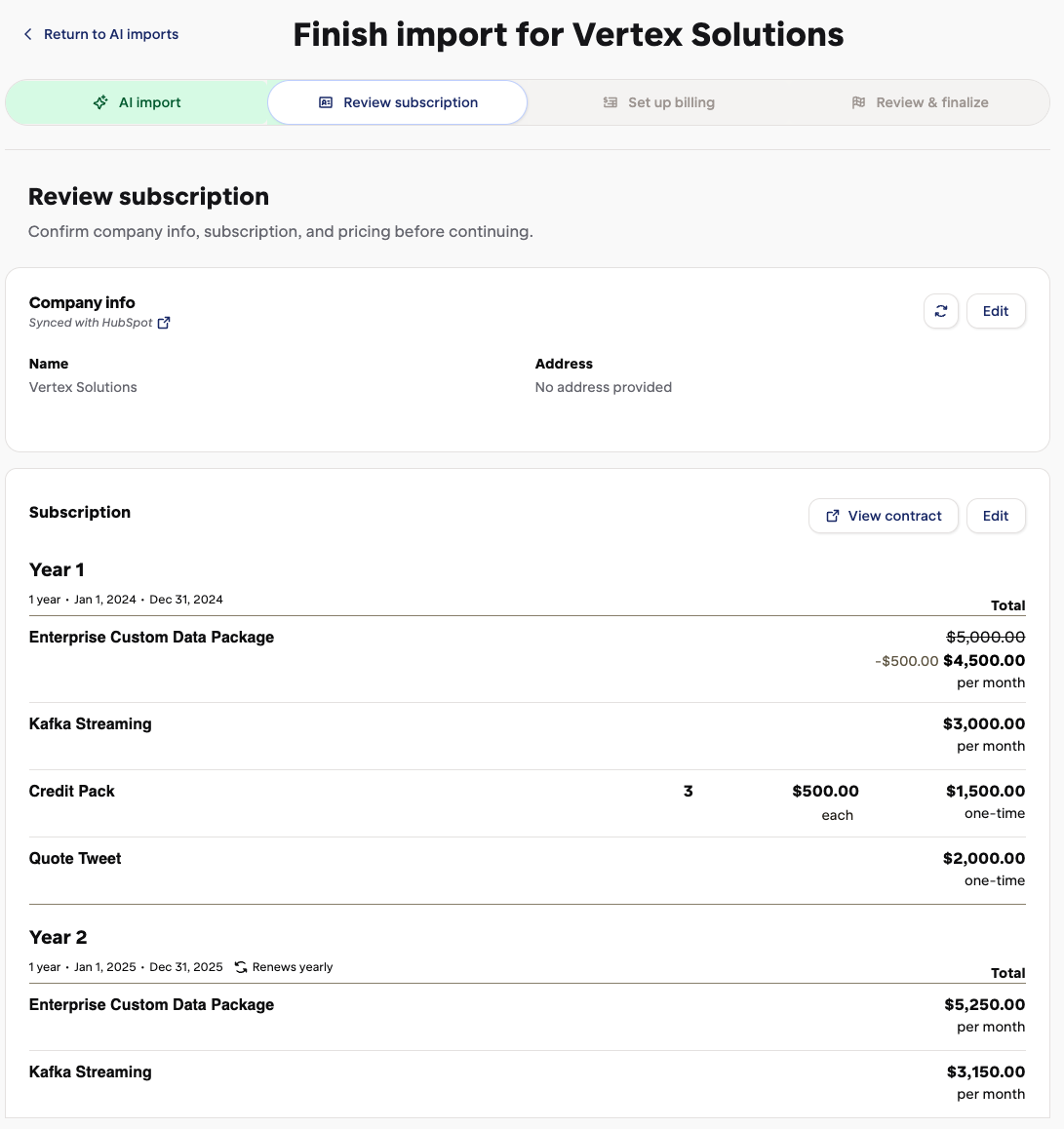
Turnstile solves this by serving as a single system of record: one platform where contract terms are captured as structured data and automatically flow into billing, reporting, and revenue recognition without re-entry across disconnected tools.
Why Billing Management Matters for Sales-Led B2B SaaS Startups
Broken billing creates cascading problems that hit early-stage B2B startups especially hard:
Collection Delays Cause Revenue Leakage
Invoices sitting in accounts payable queues for 45+ days instead of 30. When you're running a $500K ARR business, a 15-day average delay across your customer base means $20K+ in cash that should be in your account but isn't.
For an early-stage startup, that income gap can mean missing payroll or delaying a critical hire. Unlike established companies with financial reserves, you don't have the buffer to absorb these delays; every late payment directly impacts your ability to operate.
Manual Processes Consume Resources
Every hour you spend chasing a $7,500K invoice is an hour not spent on a prospect who could become your next $50K customer. When billing administration consumes over 10 hours a week, that's time you can't spend on product development, customer conversations, or business growth.
The opportunity cost compounds: while you're debugging invoice discrepancies, competitors are building relationships with your prospects.
Billing Errors Drive Churn
Over-billing damages trust; under-billing quietly drains margin. A single billing dispute can undo months of relationship building, and customers who lose trust in your billing rarely give you a second chance.
For early-stage startups, every customer represents a disproportionate share of revenue. Losing one of your first 20 customers to a billing error hurts your ARR, impacts your reference pool and case study pipeline, and potentially undermines your ability to expand into that customer's network.
When you're trying to establish market credibility, billing disputes create reputational risk that extends far beyond the lost contract.
Financial Flow Unpredictability Threatens Survival
Early-stage startups operate with thin margins. When you can't predict when payments will arrive, you can't plan hiring, can't commit to annual software contracts, and can't confidently project your burn rate. A founder or ops team spending energy worrying about whether the next payroll is covered isn't focused on building a category-defining company.
Core Components of Billing Management
The following are the core components of billing management:
Invoice Generation and Contract Management
Creating accurate invoices from negotiated contract terms is where many sales-led B2B SaaS startups first encounter billing complexity.
Consider a $35K annual contract billed upfront: the customer pays the full amount immediately, but you can only recognize about $2,917 as earned revenue each month. The remaining $32,083 is deferred revenue (money in your bank account that isn't "earned" yet).
Collections and Dunning Management
Enterprise customers rarely have payment failures in the traditional sense. Instead, invoices sit in AP queues waiting for approval. Dunning is the systematic process of following up on unpaid invoices, and the operational discipline that turns invoiced revenue into collected revenue.
Without structured dunning workflows, invoices fall through cracks. So, you could find yourself with a $35K invoice that has been unpaid for 60 days, and no one followed up.
Accounts Receivable Automation and Reconciliation
Cash application becomes critical when enterprise wire transfers lack remittance details, making it difficult to identify which invoice a payment covers. A common issue is small fees, often $10-$20, deducted from wire transfers, which compound the problem by creating mismatches between invoice amounts and actual payments received.
A $28K payment arrives from Acme Corp, but they have two open invoices. Someone has to email their contact to find out and dig through emails to figure out which invoice got paid, or whether a single payment covered both invoices. Until your team gets an answer, that cash sits in "unallocated" while your books stay incomplete.
Revenue Recognition and Financial Reporting
The B2B SaaS billing cycle involves three distinct steps:
- Invoicing: When you bill the customer
- Cash collection: When payment arrives (Net 30 typically)
- Revenue recognition: When you can count money as "earned" according to ASC 606 rules
Your billing platform needs automated revenue allocation based on contract terms, complete audit trails for compliance and investor due diligence; capabilities that require Turnstile’s single system of record.
Common Billing Models for Sales-Led B2B SaaS Companies
Your billing model determines how complex your billing infrastructure needs to be.
- Subscription billing works for predictable enterprise B2B SaaS. Annual contracts with quarterly billing provide revenue forecasting certainty, improved cash flow from upfront payments, and enhanced retention through long-term commitments.
- Usage-based billing works for infrastructure products, APIs, and data processing services with variable consumption. Revenue directly correlates with customer value, and usage grows with customer success without sales intervention. However, revenue unpredictability complicates income flow forecasting, and billing infrastructure must handle metering, aggregation, and real-time usage tracking.
- Hybrid models combine a base subscription with usage-based charges. This provides a revenue floor with upside potential. In 2025, up to 61% of B2B SaaS companies adopted hybrid pricing models, with “base platform plus seat licenses” being the most common option at 41%, followed by per-user plus usage overage (33%) and tiered flat-rate plus usage (26%).
Whichever model you choose, your billing infrastructure needs to capture these terms as structured data from the moment contracts are signed.
How Sales-Led B2B SaaS Startups Can Improve Billing Management
These warning signs indicate accumulated operational debt from skipping day-one infrastructure, all of which is preventable:
- Customer dissatisfaction and loss of trust due to billing errors: A customer emails asking why they were charged $12,500 when their contract states $12K. You check the spreadsheet and realize someone fat-fingered the monthly amount six months ago. Now you owe a refund and an apology.
- Billing delays causing cash flow problems: Invoices go out late because someone has to manually pull contract terms from a PDF, double-check pricing in a spreadsheet, and copy details into an invoice template. A three-day delay across 20 customers each month means cash arrives weeks later than it should.
- Reconciliation backlogs consume team time: Your finance team spends hours each week matching payments to invoices because wire transfers arrive without clear references. A $23K payment sits in "unallocated" while someone digs through emails to figure out which customer it belongs to.
- Data gaps prevent accurate forecasting: You can't answer "what's our ARR?" without opening 5 tabs and cross-referencing HubSpot deals with a billing spreadsheet and QuickBooks. Renewal dates live in contract PDFs that no one has time to audit.
- Investor questions you can't answer about contract composition: Due diligence stalls when investors ask about your average contract value, renewal timing, or revenue concentration. The data exists somewhere, but pulling it together takes days instead of minutes.
If anyone on your team spends time on manual billing tasks (from copying contract terms into invoices, reconciling payments in spreadsheets, or chasing down missing payment details), you're experiencing the consequences of unstructured data.
Why Structured Data Is the Foundation of Scalable Billing
The difference between billing management that breaks at 50 customers and billing that scales to 500 comes down to one thing: structured data.
Unstructured billing data lives in signed PDFs, email threads, Google Docs and Spreadsheets, and CRM notes. Someone has to read a contract, interpret the terms, and manually enter them into an invoicing system.
Every handoff introduces error risk. Every custom deal requires human judgment about how to bill it. As your customer base grows, these manual processes don't scale; they just take up more time and lead to more mistakes.
Structured billing data captures contract terms as discrete data fields from the moment a deal closes: customer identifiers, pricing tiers, usage metrics, billing frequency, payment terms, contract dates, and custom provisions. These fields flow automatically into invoicing, collections, and revenue recognition without human transcription.
The impact is measurable:
- No billing errors from custom deals. When Customer A has a 6-month discount, and Customer B has usage-based pricing, those terms are stored in data fields that automatically drive billing. The discount expires when it should. The usage charges are calculated correctly. No one has to remember.
- No manual invoice creation. The contract terms you agreed to become the invoice that gets sent, automatically, on schedule, with the correct amounts. No one has to pull pricing from a PDF and re-enter it into QuickBooks.
- No reconciliation surprises. When a $35K payment arrives, your system already knows which contract it belongs to and how to allocate it. Month-end close takes hours, not days.
- No rebuilding funding for infrastructure. Companies that start with spreadsheets typically rebuild their entire billing infrastructure when they reach 20-30 customers. Structured data from day one means the system that handles your first customer handles your hundredth the same way.
The solution is Turnstile's workflow: a single system of record where contract terms live as structured data from day one, and everything flows seamlessly from contract to billing to payments.
Book a demo to see how Turnstile handles the complete revenue lifecycle for sales-led B2B startups.


.png)
.png)