Usage-Based Billing Automation: A Guide for Sales-Led Teams
Usage-based billing automation works differently in sales-led companies. Here's how to close the gap between negotiated pricing terms and invoices.
5 mins
April 17, 2026
Key Takeaways
- Usage-based billing automation fails in sales-led companies because negotiated rates live in PDFs, not in systems that billing workflows can read.
- The fix is structural: store contract terms from your signed quotes as structured data so rating, invoicing, and amendments run automatically without manual re-entry.
- The earlier you capture terms as structured data, the less operational debt you accumulate. Retrofitting a billing system across 50+ negotiated contracts is significantly harder than building it correctly from the first deal.
Many guides to usage-based billing automation assume you have one rate card and thousands of self-serve customers. That is not your company. You close $15K+ annual contracts with negotiated per-unit rates with tiers, minimum commitments, and credits, and every customer's deal looks slightly different. In that environment, the challenge is not metering usage. Once every customer has different pricing terms, the hard part is making sure those negotiated terms flow through to billing correctly. The real automation gap sits between the pricing terms your sales team negotiated and the pricing terms that actually appear on the invoice.
Founders, finance leaders, and ops teams run into the same failure mode: pricing terms live in signed PDFs, someone manually re-enters them to your billing system, and errors start to proliferate. Rates get transposed, amendments get missed, and a mid-cycle pricing change sits in an email thread while last month's pricing terms keep getting applied. The fix starts earlier than most teams expect: at the quote. Contract terms need to be stored as structured data (machine-readable fields to a billing system, not locked inside PDFs) from the moment a deal closes. When they are, billing workflows read the correct pricing terms for each product for each customer automatically. When they are not, someone re-reads the contract and types numbers in manually every cycle.
The result is not just revenue leakage (money you earned but never collected). It is hours per month spent re-reading contracts to verify what you should be charging, and financial data you cannot trust at month-end close.
Why Sales-Led Usage-Based Billing Automation Works Differently Than PLG (Product-Led Growth)
In product-led companies, every customer on the same plan pays the same rate. Automation is straightforward: one pricing table, applied uniformly, at scale. In sales-led companies, rates are different per customer because every deal is negotiated. That distinction changes the entire automation problem.
When your first five customers each have a different per-unit rate, those rates need to flow programmatically from the quote into whatever system generates invoices. If they do not, someone must type them in manually, slowing down the process and increasing error rate. According to OpenView, 61% of B2B SaaS companies now use some form of usage-based pricing. But many billing tools were built for the PLG version of this model, where a single published rate applies to every account.
Sales-led billing introduces three problems PLG companies do not face:
Per-customer pricing logic. Each account operates under unique terms. Your billing workflow cannot apply a universal rate table. It needs to know that Customer A pays $0.12 per API call while Customer B pays $0.09, with a volume discount kicking in at 50,000 calls.
Mid-cycle amendments. Deals change. A customer upgrades three months into an annual contract, and the new rate applies retroactively to the start of the current billing period. Now you are tracking two rate structures for the same customer.
Pricing method variability. Your system also has to understand the difference between volume-based and graduated pricing, because applying the wrong method to the same usage data produces a different invoice amount. With graduated pricing (where different rates apply to each usage tier), 60 units are charged at the rate for each bracket they pass through. With volume pricing (where all units are charged at the rate of the highest bracket reached), all 60 units are priced at the top bracket rate. On identical usage, the two methods typically produce different invoice totals.
The point: in PLG, usage-based billing automation is an engineering implementation. In sales-led, it is a contract data problem. If negotiated terms are not captured in a way your billing workflow can read, automation never gets off the ground.
Metering, Data Mediation, and Rating: Three Problems, Not One
Most founders treat metering and rating as a single challenge. They are not. Metering is counting usage in your product. Rating is applying the correct price to that usage. Conflating them leads to solving the wrong problem first.
Think of the electricity meter on a house. The meter counts kilowatt-hours. But the bill depends on the rate structure your utility applies: flat rate, tiered, or time-of-use. The meter is identical regardless of your plan. The rate is what determines the invoice amount.
The missing middle: mediation and contract data
Metering, data mediation, and rating are three distinct steps:
- Metering: Capture usage in your product (API calls, compute hours, transactions).
- Data mediation: Clean and map raw events to the right customer (deduplicate, filter non-billable events, handle attribution).
- Rating: Apply the customer's contracted pricing terms to the mediated usage data.
Why rating break in sales-led billing
Most engineering teams can build reliable metering with focused effort. Rating is where sales-led billing works differently, because it requires negotiated, customer-specific pricing terms that change over time. That means applying account-level discount schedules, managing minimum commitments, calculating charges, and deducting from prepaid balances.
Data mediation matters here, too. Raw usage data needs to be cleaned, mapped to the correct customer, deduplicated, and filtered for non-billable events before pricing logic can be applied. Without this step, even perfect metering feeds garbage into rating.
For a founder managing 15 or 20 custom deals, this is where automation either works or falls apart. At $2-10M ARR (annual recurring revenue), the problem scales: you might have 100+ negotiated contracts across a growing sales team, and every "small" amendment becomes a recurring coordination problem. If your billing workflow cannot access customer-specific rates programmatically, someone reads the contract PDF, finds the negotiated price, and manually calculates the charge every month for every customer.
Where It Gets More Complex: Credits, Minimums, Tiers, and Amendments
Simple per-unit billing is only the starting point. Real sales-led deals layer in pricing structures that add variables your billing workflow must track against the original contract terms.
Prepaid usage credits. Customers purchase a block of credits upfront and draw them down over time (the model Snowflake uses). Your system must track the remaining balance in real time, apply consumption against the correct credit pool, and handle what happens when credits expire or roll over. Revenue can only be recognized as credits are consumed, not at purchase. This is the principle behind deferred revenue (revenue collected but not yet earned because the service hasn't been delivered). Your billing and revenue data diverge until drawdown catches up.
Minimum commitments. The customer commits to a usage floor, say $2,000 per month, and pays additional charges above it (the model Plaid uses). This requires monitoring actual usage against the contractual minimum each billing period. A customer who uses $1,200 worth of API calls still owes $2,000. A customer who uses $3,500 worth of API calls owes $3,500. Your billing workflow has to calculate this correctly without manual intervention.
Tiers. Tiered pricing adds another layer of contract logic because the invoice depends not just on how much usage occurred, but on how the contract says each usage band should be priced.
That means your billing workflow has to know whether the signed deal uses graduated pricing or volume pricing, because the same usage can produce different totals depending on the method. With graduated pricing, different rates apply to each tier the customer moves through. With volume pricing, all usage is billed at the rate for the highest tier reached. If your billing workflow does not know which tiering method the signed deal uses, the system can calculate the wrong amount even when the usage data itself is correct.
Hybrid models. Many sales-led deals combine elements: a $20K annual minimum that includes a set number of credits, with graduated pricing on usage above the included amount, billed quarterly in arrears. According to SaaStr's analysis, companies using hybrid models often back-bill for additional usage at the end of every quarter based on actual usage, adding cash flow timing complexity on top of the rate calculation.
None of these are edge cases. They are common structures in $10K-20K+ annual contracts.
The real stress test is amendments. When a customer's deal changes mid-cycle (e.g., new rate, higher minimum, additional credit purchase), the billing workflow either handles it automatically or someone creates the invoice by hand. A retroactive rate adjustment means recalculating charges on already issued invoices, generating a credit or additional charge, and updating the contract record so future billing periods reflect the new terms.
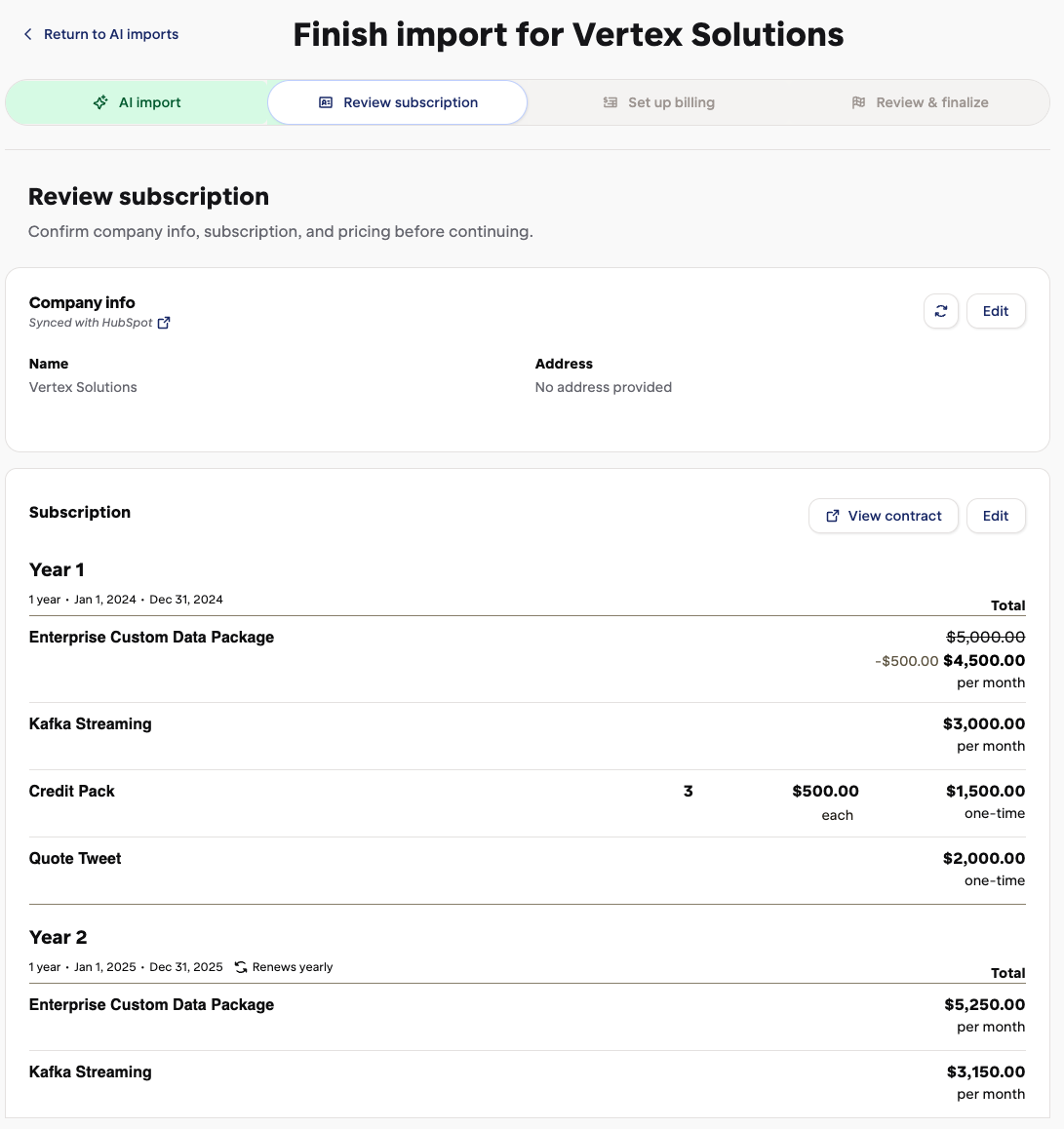
Turnstile handles this by syncing amendments to billing automatically. When contract terms change, the downstream billing configuration updates to reflect the new rates, minimums, or credit balances without any manual intervention.
What a Usage-Based Invoice Needs to Communicate
Getting the math right is not enough. The invoice has to clearly lay out usage quantities, unit prices, applicable credits or minimums, and the total amount. Your customer should be able to tie the invoice back to their signed quote and the metered usage they can see in your product's dashboard without calling you.
This matters more than most founders realize. Disputes are typically not caused by wrong numbers. They are caused by accurate numbers that nobody can verify or understand. When customers cannot tie an invoice back to their signed terms, your finance team fields the difference.
A usage-based invoice typically needs to communicate:
- The billing period
- Metered usage for each billable product
- The contracted unit price (which may differ from your published pricing)
- Credits applied and remaining balance (if applicable)
- Minimum commitment adjustments (if applicable)
- The amount due
If any of these are missing or ambiguous, the customer's accounts payable team will flag the invoice. On a Net 30 payment term, a flagged invoice typically means another full approval cycle before payment is collected.
A common source of payment mismatches is prorated amounts that are not clearly itemized, customers pay incorrect amounts or generate support tickets because they cannot follow the charges shown.
Bad automation makes this worse, not better. An automated invoice that dumps raw usage data into a PDF without context creates more support work than a manually prepared invoice that someone took the time to annotate. The goal is to remove the manual work that does not require judgment (rate lookup, usage calculation, credit application) so the humans involved can focus on clarity and customer communication.
Turnstile addresses this by generating invoices directly from structured contract terms coupled with metered usage from your product, so line items reflect the exact pricing, credits, and usage breakdowns from the customer's signed quote. The customer sees the same language and rates they agreed to, without translation errors introduced by manual re-entry.
Build Your Business with Structured Data, Not Retroactive Cleanup
Usage-based billing automation in sales-led B2B SaaS comes down to one thing: negotiated terms must exist as structured data your systems can read. Capture them at the quote, and rating, invoicing, and amendments stop depending on someone re-reading PDFs.
Turnstile is a quote-to-cash platform and system of record for commercial terms: one system that covers the complete workflow from quote through payment collection, where what was agreed always matches what gets billed. It goes live in under one day. Usage rates, billing schedules, credits, and minimums flow from the signed quote into billing with no manual re-entry.
Book a demo to see how Turnstile automates usage-based billing for sales-led B2B SaaS startups.


.png)
.png)