What Is Billing Frequency? And Why It's a Day-One Decision for B2B SaaS Companies
Billing frequency affects cash flow, valuations, and growth. Learn how different billing frequency impacts sales-led B2B SaaS companies and why structured data matters.
5 mins
February 3, 2026
Key Takeaways
Billing frequency is the cadence at which you invoice for products and services. For sales-led B2B SaaS companies, whether you're closing your first $25K contract or scaling from $2M to $15M ARR (annual recurring revenue, your predictable subscription income measured yearly), the difference between monthly and annual billing directly affects your capital position.
Here's why: with monthly billing at $15M ARR, you're collecting ~$1.25M per month and carrying 12+ months of uncollected revenue. With annual prepaid billing, you collect the full contract value upfront, meaning $15M in cash on hand rather than $1.25M.
But cash position alone doesn't determine long-term success; how you manage that cash through your billing infrastructure does.
It’s why B2B SaaS companies should treat quote-to- cash billing infrastructure (the complete workflow from generating a customer quote to collecting payment and recognizing revenue) that stores contract terms, billing schedules, and revenue recognition as structured data rather than spreadsheets, as a day-one decision.
Many companies don't think about quote-to-cash infrastructure until a revenue crisis forces them to. But billing infrastructure is one of the few operational decisions you can get right immediately. Setting up the right foundation before your first invoice means you never accumulate the operational debt that creates these crises in the first place.
Common Billing Frequency Options
For founders, ops leaders, and finance teams, understanding the trade-offs between billing frequency is critical:
Monthly Billing
Monthly billing invoices are sent every month. For a $30K annual contract with the same products and services each month, you invoice $2,500 monthly.
The trade-off is cash flow. With monthly billing, the customer acquisition cost payback (known as CAC, and includes the time it takes for customer payments to cover acquisition costs) extends significantly. If you spend $6,000 to acquire a customer paying $2,500/month, you're cash-negative on that customer for nearly 3 months, and that's before accounting for churn risk.
While customers rarely cancel mid-contract, monthly billing gives them more leverage; they haven't committed significant capital upfront, making it easier to deprioritize your product or negotiate harder at renewal.
Annual Billing
Annual billing invoices the full contract value upfront, typically with a 10-20% discount. That $30K contract becomes $25,500 on day one with a 15% annual discount (equivalent to "two months free").
Annual billing delivers immediate CAC payback. Payment arrives before onboarding completes. For companies with $6,000 acquisition costs, collecting $25,500 upfront means you're $19,500 cash-positive per customer on day one.
Annual billing also provides a retention buffer. Monthly customers can churn quickly when something goes wrong (a product outage, a missed feature launch, or a support issue). If they're paying month-to-month, you have days to save the relationship. With annual prepaid billing, a customer three months into their contract gives you nine months to recover.
That runway transforms potential churn into retention opportunities. It’s why B2B SaaS companies that predominantly have annual contracts command a 1.5- to 2.5-times premium in public markets.
Quarterly Billing
Quarterly billing invoices four times a year. For that $30K contract, you invoice $7,500 quarterly. Quarterly billing reduces sticker shock compared to annual prepayment while providing more predictable cash flow than monthly billing.
Mixed Billing
Mixed billing is common and scalable. While only 78% of early-stage SaaS companies offer a combination of billing frequency options, that number climbs to 95% for companies between $8M–$15M ARR.
The reason is that offering mixed billing helps companies scale more efficiently, reduces the risk for both B2B SaaS companies and customers in terms of cash flow, and allows customers to upgrade more effectively, if required.
The reason early-stage companies don't offer mixed billing isn't strategic; it's because they lack the infrastructure to support what their customers actually want. That's a missed opportunity: flexible billing options drive more conversions and reduce friction in the sales process.This infrastructure is available now, not just for companies at scale.
The difference is whether you build it today, when it takes hours, or retrofit later while managing hundreds of active subscriptions and reconciling data scattered across Google Sheets, email threads, Slack, Docusign, and payment processors. Turnstile supports mixed billing frequencies from your first customer, so you don't have to re-architect when growth demands flexibility.
How to Choose the Right Billing Frequency
The right billing frequency depends on your growth stage and what you're optimizing for: revenue collection, customer acquisition, or both. Getting this decision right has direct valuation implications.
- If you're closing your first 10-20 customers: Start with the billing frequency your customers prefer, but build on infrastructure that supports multiple frequencies. Early-stage pricing is experimental; you'll likely offer annual discounts to some customers and monthly flexibility to others based on how conversations go. The worst outcome is locking yourself into a single billing frequency because your spreadsheet can't handle the complexity of both.
- If you're in an early-stage growth: Push annual contracts. Annual upfront billing immediately improves CAC payback periods. Three annual prepaid contracts at $30K each deliver $90K in cash, potentially 2-3 months of extended growth. That same revenue collected monthly would take a full year to materialize, and you'd carry the churn risk the entire time.
- If you're past $2M ARR and scaling: offer both monthly and annual options. Your customer base typically segments naturally into:
- Larger customers with procurement processes prefer annual billing because it simplifies their vendor management
- Smaller or faster-moving customers prefer monthly billing because it reduces upfront commitment and supports better cash flow
- If you're proving product-market fit: Prioritize finding product-market fit by signing customers and growing revenue. Annual vs. monthly billing should be a distant afterthought at this stage. Accept the cash flow trade-off: you can shift toward annual contracts once you've demonstrated traction.
The key is having a billing infrastructure that lets you offer monthly now and transition customers to annual later without manual rework.
Why Billing Infrastructure Decisions Start at Day One
Most founders assume billing complexity is a "scale problem" they'll solve later. This thinking creates operational debt: the accumulation of manual workarounds, disconnected spreadsheets, and undocumented processes that eventually require dedicated headcount or months of rearchitecting to unwind.
The pattern is predictable: companies cobble together Google Docs for quotes, spreadsheets for tracking, Docusign for signatures, Slack threads for context, an invoice or billing provider, and Stripe for payments.
It works until it doesn't, and by the time a revenue crisis forces action (a missed renewal, an audit flag, a meeting where sales and finance report different ARR), they're already underwater. The opportunity is recognizing this pattern before you're in it.
Then, there’s the ripple effect of repairing the unstructured manual billing process.
A customer loses trust if you send an incorrect invoice. So they dispute it; you find a typo in the contract value; you dig through Slack to find the original conversation; you fix it in three places; and you apologize.
If this process takes 2 hours to resolve, multiply that by 10, and that’s 20 hours per month. At 100 customers, that same process takes 200+ hours. You're spending more time investigating mistakes than closing new deals.
This is why billing infrastructure matters from day one. When contract terms, billing schedules, and revenue recognition live in a single system as structured data, there's nothing to reconcile; the invoice matches the contract because they're the same record.
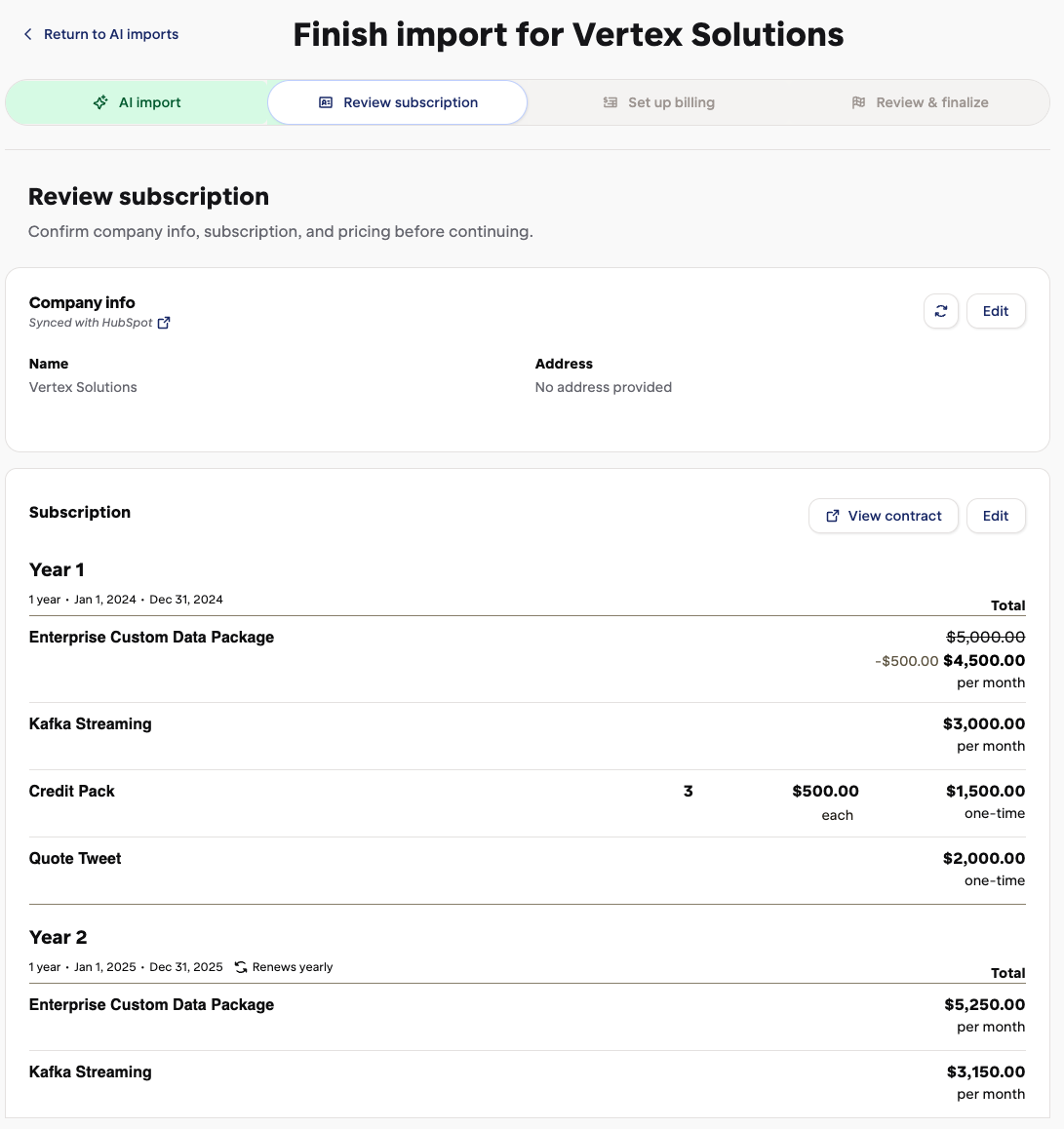
Turnstile eliminates the manual stack entirely with a quote-to-cash infrastructure. As a single source of truth quote-to-cash platform, quotes become signed contracts, signed contracts become active subscriptions, and the system generates invoices automatically from the terms you already agreed to.
The Cost of Billing Without Proper Infrastructure
Billing without proper infrastructure can lead to:
- Invoice errors. According to Kaplan Group's 2025 research, manual invoicing results in a 12.5% error rate. Furthermore, they also found that 61% of late payments stem from billing errors. These errors lead to customer confusion, broken trust, and loss of revenue.
- Sales and finance report different ARR. Contract terms live in Salesforce, billing schedules live in a Google Sheet, signed documents live in Google Drive, and revenue recognition happens in QuickBooks; four systems, zero connection between them. Quote-to-cash infrastructure prevents this entirely by storing contract terms, billing schedules, and revenue data as structured data into a single point, reducing discrepancies between sales and finance reporting.
- Pricing changes create billing chaos. SBI found that 80% of B2B SaaS companies made pricing and packaging changes in the past year. The lack of a consistent single system means individual sellers have to update their contracts and quote templates, creating chaos for financial reporting and business outcomes.
Rearchitecting billing systems while managing active customers is painful. Every migration risks incorrect invoices, revenue recognition errors in your next audit, and board meetings where sales and finance report different numbers. This is the cost of treating billing infrastructure as a scale problem instead of a day-one decision.
Stop Wrestling With Multiple Billing Schedules
Billing frequency sits at the intersection of cash flow, customer preferences, and operational complexity.
The key is treating contract terms, billing schedules, and revenue recognition as not separate, but as connected data, so changes to one don't break the others.
When a customer asks to switch from quarterly to monthly billing, that should be a configuration change, not a scramble through three different systems.
Turnstile stores contract terms, billing schedules, and revenue recognition as structured, connected data; not scattered across Salesforce, Google Sheets, and QuickBooks. Enter the contract terms once, and the system handles invoicing, revenue recognition, and CRM updates automatically. No rearchitecting required because there's nothing to migrate.
Book a demo to see how it works.


.png)
.png)