How To Improve Customer Renewals: 4 Top Strategies for B2B SaaS
Learn proven strategies to improve customer renewals for B2B SaaS. Reduce churn, increase retention, and build predictable revenue growth.
5 mins
March 11, 2026
Key Takeaways
Customer renewals are the recurring revenue you retain when existing contracts end and customers choose to continue their subscription. For sales-led B2B SaaS founders, renewals aren't just a growth lever. They're existential.
Your first customer just signed a $15K annual contract. Celebration? Sure. But here's the reality: founders under $2M ARR quickly confront: customer acquisition costs often take 12 months or longer to pay back, especially at lower ACVs.
If that customer churns at the 12-month mark, you haven't just lost future revenue. You've lost the money you spent acquiring them in the first place. Scale that pattern across your customer base, and the business doesn't stagnate. It ceases to exist.
For early-stage companies under $500K ARR, typical gross revenue retention rates hover around 73-97%, depending on segment, with net revenue retention around 79-100%. That means you're losing 3-27% of your revenue base annually. Without strong renewals, every new customer you sign just backfills the ones you lost. This guide shows you how to fix that.
The good news? Customer renewals follow predictable patterns. The strategies that improve retention don't require sophisticated analytics platforms or dedicated customer success teams. They require systematic processes you can implement starting today, whether you're managing 10 customers or 100+.
Understanding Customer Renewal Metrics
Before diving into strategies, you need to understand the metrics that reveal your renewal health.
- Gross Revenue Retention (GRR) is the percentage of baseline revenue you keep from existing customers, excluding any expansion. It reveals whether you're keeping the revenue you already earned. For early-stage B2B SaaS under $1M ARR, achieving 85%+ GRR signals strong product-market fit. Good companies typically see GRR between 73-97%. Below 75% signals retention challenges requiring immediate attention.
- Net Revenue Retention (NRR) adds expansion revenue into the equation: upgrades, additional seats, and usage-based growth. NRR matters, but focus on GRR first. Customers who are considering cancellation aren't thinking about upgrading, so expansion opportunities only matter once you've stopped the churn. Preventing churn creates the stable base that makes expansion meaningful.
Understanding these metrics reveals the scale of the problem. But metrics only tell you what's happening. To improve them, you need to understand why customers actually leave.
Why Customers Don't Renew
Customers churn because they never experienced enough value to justify the cost. This manifests in two predictable patterns:
1. Product-market fit issues top the list
When your product doesn't solve a critical enough problem, customers may sign on, but then find they can live without it, and leave at the first renewal instead of embedding it into their business processes. One way to measure this is to track the percentage of customers who report they'd be "very disappointed" without your product. You can do this by sending a simple survey asking: "How disappointed would you be if you could no longer use our product?" and tracking the percentage of respondents who report being "very disappointed."
Superhuman's founder Rahul Vohra turned this into a systematic approach. When he surveyed users, only 22% said they'd be very disappointed without the product. That was well below the 40% threshold that Sean Ellis (growth leader in the early days of Dropbox, LogMeIn, and Eventbrite, and later coined the term "growth hacker") identified as the benchmark for strong product-market fit (later known as product market fit or PMF score) after studying nearly a hundred startups.
A PMF score above 40% indicates strong renewal potential. At or below 40%, you're likely still searching for true product-market fit.
Vohra used that gap as a roadmap: he segmented users by persona, doubled down on what his happiest users loved (speed and keyboard shortcuts), and addressed what held others back. Within three quarters, Superhuman's product market fit score jumped from 22% to 58%, well above the 40% threshold.
2. Ineffective onboarding means customers never reach activation
An activation metric measures the specific point where a new customer first experiences your product's core value (often called the "aha moment"). For a CRM, it might be closing their first deal using your pipeline. For an analytics tool, it might be generating their first report that surfaces an insight they wouldn't have found otherwise. Customers who never reach this moment are far more likely to churn at renewal.
Superhuman onboarded every user through 30-minute 1:1 sessions for their first several thousand customers (even at $30/month) because they believed it was essential to activation. That level of investment isn't always practical, but it illustrates how seriously high-retention companies take onboarding.
Even customers who activate successfully can drift away over time. Early warning signs like usage drops and communication delays appear before critical churn risk, giving you a window to intervene. The strategies below show you how to catch these signals and act on them.
Strategy #1: Make Your Product Indispensable
Customers renew when your product becomes embedded in their daily operations. The goal is to deliver value that compounds over time, creating depth of integration and workflow dependency that makes your product genuinely hard to replace:
- Help customers get more value by connecting to their existing tools. When your product integrates with the systems customers already rely on, it becomes more useful. A standalone tool solves one problem. A tool that connects to their CRM, syncs with their billing system, and feeds into their reporting creates compounding value across their workflows.
- Become the source of truth for something important. The most retained products store data customers can't easily recreate: historical records, institutional knowledge, or operational data they reference daily. When customers build processes around your product and train their teams on it, you've become infrastructure rather than a nice-to-have.
- Solve more than one problem. During onboarding, look for the second and third problems your product addresses for each customer. A customer using your CRM for contact management alone gets limited value. A customer using it for contact management, email automation, and pipeline reporting sees the product become central to how they operate.
- Make accumulated data increasingly valuable. Design your product so that the longer customers use it, the more useful it becomes. Trend analysis, benchmarking against their own history, and insights that only emerge over time turn your product into something customers actively want to keep, not just something they haven't gotten around to canceling.
When your product genuinely helps customers do their jobs better, retention follows. But you still need systematic processes to ensure healthy customers don't slip through the cracks as renewal dates approach.
Strategy #2: Build Your Renewal Process From Day One
Expert consensus recommends initiating renewal conversations 90-120 days before contract end date. Starting at this timeline provides sufficient time for addressing customer concerns, coordinating multi-stakeholder approvals, and demonstrating value. Waiting until 30 days before the contract ends puts you in crisis mode.
Follow this structured timeline:
- At 90-120 days before renewal: Conduct health assessment
- At 60 days: Present quantified value and discuss roadmap
- At 30 days: Send renewal proposal
- At 15 days: Execute contract
Build systematic renewal infrastructure before manual processes break, not after. Around 30-40 customers, spreadsheet tracking starts failing: you miss renewal dates because no one's monitoring the sheet, you can't find the original contract terms buried in email threads, and you discover pricing discrepancies only when a confused customer asks why their invoice changed.
You need to track customer name, contract dates, contract value, health score, and next action required. As your customer base grows, you're spending hours hunting through folders to find original contract terms, manually updating spreadsheets when pricing changes, and reconciling what the spreadsheet says against what you actually invoiced.
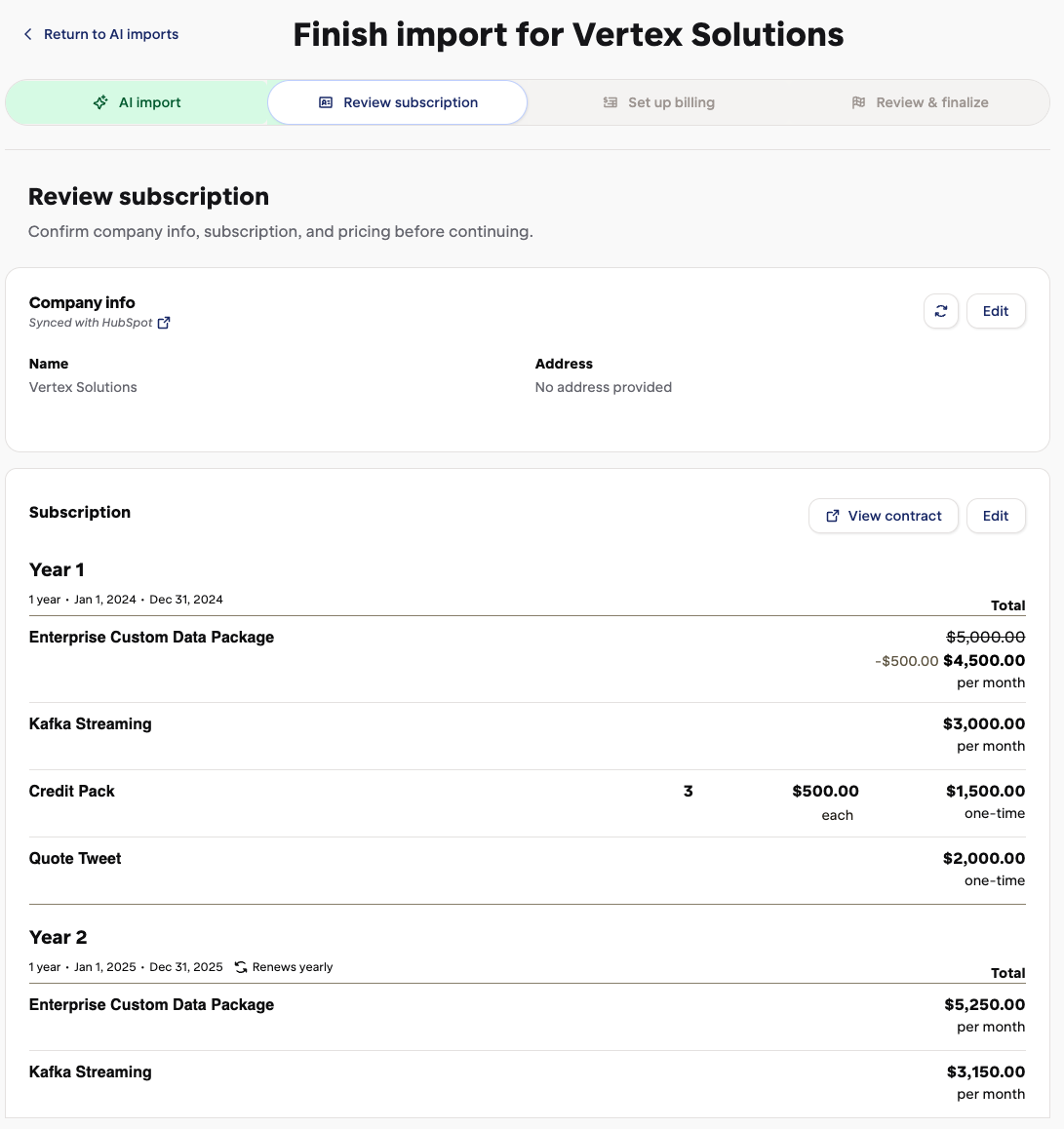
Turnstile also supports renewal management, so the subscription can be set to autorenew, avoiding cancellation. Turnstile also lets you see your upcoming renewal dates, so you can proactively engage in health assessments.
Strategy #3: Spot At-Risk Customers Before They Churn
Identifying churn risk early gives you time to intervene. Here are the warning signs to monitor:
- Login frequency drops: Decreased login frequency below once per week increases churn risk by 3x. Review weekly login reports and flag any account dropping below this threshold. Send a re-engagement email within three days. Make it a genuine check-in asking if they're experiencing blockers or if their needs have changed, not a sales pitch.
- Support ticket spikes followed by silence: Support ticket volume spikes of 3x normal levels signal serious problems. Here's the counterintuitive pattern: customers who spike ticket volumes and then go completely silent have most likely mentally checked out. The silence is more concerning than the complaints. When a previously engaged customer stops responding within five business days across multiple channels, try different communication methods. Try phone instead of email, or LinkedIn instead of support tickets.
- Champion turnover: Contact role changes elevate risk even with strong usage and warrant immediate attention. Set up LinkedIn alerts for key contacts and maintain relationships with 2-3 stakeholders per account. Within 48 hours of learning about a champion's departure, request an introduction to their replacement and schedule a reintroduction conversation.
- The "Silent Decline" pattern: This pattern represents critical risk requiring immediate intervention. Usage drops 30%+, support tickets decrease to zero (signaling resignation rather than satisfaction), and response times progressively increase. This combination warrants immediate founder personal outreach to leadership at your customer.
For every customer who actually churns, at least one more is at high risk. If your churn rate is 5%, actively flag and monitor 5% of your total customer base as "At Risk" requiring weekly founder attention.
Spotting at-risk customers prevents churn. But retention also depends on how you structure pricing to align value with customer growth.
Strategy #4: Price and Package for Long-Term Retention
Value-based pricing is consistently more profitable than cost-plus or competitor-matching strategies, and customers prefer it too. When price scales with the value they receive, customers feel the relationship is fair: they pay more only when they're getting more. That alignment builds trust and makes renewals feel like a natural continuation rather than a cost to justify.
Studies by Bain & Company have also shown that increasing customer retention rates by just 5% can boost profits by 25–95%. This makes retention‑focused pricing among your highest‑leverage activities as a founder.
- Start with a single simple value metric: the unit you charge for that aligns to customer outcomes (per user, per booking, per contact, or per transaction). Customers should easily understand and predict their costs while the metric scales naturally with their growth.
- Implement staged discount reductions over multiple renewal cycles rather than sudden price increases. If a customer signed with a 20% discount, reduce it to 10% at the first renewal and eliminate it at the second. Gradual changes give customers time to adjust and demonstrate continued value, while sudden jumps trigger price-shopping behavior.
However, monthly billing typically achieves higher initial conversion rates due to lower commitment barriers. You can capture this benefit while maintaining annual contract terms by offering annual contracts with monthly invoicing. This gives you the retention advantages of a 12-month commitment with the cash flow accessibility that lowers purchase friction.
Getting pricing right sets the foundation. But as your customer base grows, you'll need tools to execute these strategies systematically.
When to Start Caring About Renewals
Start caring about renewals from day one, not 30-60 days before contract end date. The work that sets the foundation for a determines renewal success happens during onboarding and the first 90 days. Begin formal renewal conversations 90-120 days before the contract ends.
At 30-40 customers, the transition to systematic processes begins. Manual tracking starts breaking down. You're experiencing last-minute scrambles, getting surprised by churns, and spending a significant amount of time on renewal management. At this stage:
- Implement customer health scoring based on usage and engagement metrics
- Create documented renewal workflows with clear ownership
- Begin customer segmentation
Hire your first dedicated Customer Success Manager when renewal management starts pulling you away from product development and customer acquisition. The signal is usually when you're spending multiple hours per week on renewal-related tasks: health check calls, contract negotiations, churn save conversations, and the administrative work of tracking it all.
Build Renewals Into Your Growth Engine
In a SaaS business, renewals determine whether you fail or succeed. Lose 15% of your customers annually, and every new deal you close just replaces the ones who left. Improve revenue retention to 90%, and your sales effort actually grows the business instead of keeping it flat.
Manual renewal tracking creates operational debt that compounds with every customer you add. You're hunting through folders for contract terms, manually updating spreadsheets when pricing changes, and reconciling what the spreadsheet says against what you actually invoiced. By the time you hit 30-40 customers, you're spending hours on administrative work instead of building relationships that prevent churn.
The fix is treating contract terms as structured data from day one. When renewal dates, pricing schedules, and subscription details are queryable rather than buried in PDFs and email threads, you can generate renewal quotes directly from existing subscription data. That's what Turnstile does for sales-led B2B SaaS startups.
Book a demo to see how Turnstile automates renewal workflows for sales-led B2B SaaS startups.


.png)
.png)