Why Revenue Leakage Starts at Contract Ingestion (And How to Fix It)
5 mins
October 10, 2026
Transitioning a sales-led software business off manual spreadsheets into an automated billing platform often grinds to a halt at migration: your commercial history is trapped inside signed PDF agreements, emails, and Slack messages. When deal terms include customized ramps, pilot phases, and milestone triggers, finance teams hesitate to migrate out of fear of breaking active invoicing or breaking revenue reporting. Modern contract ingestion eliminates migration challenges by converting unstructured PDF terms into verified subscription data, allowing companies to launch automated billing infrastructure in an afternoon.
Key Takeaways
- The Onboarding Bottleneck: Transitioning to a dedicated billing system is frequently delayed because commercial terms remain locked inside signed PDF agreements.
- High Cost of Manual Data Entry: Manual contract re-keying carries error rates up to 25%+ (IBM), driving between 1% and 5% of EBITDA in annual revenue leakage across sales-led software companies (Forbes).
- Automated Ingestion Mechanics: Modern contract ingestion uses artificial intelligence to extract customer details, pricing tiers, durations, and custom prices directly from PDF documents into structured draft subscriptions in minutes.
- Control Over Active Contracts: Finance teams can set explicit billing takeover dates for active contracts, ensuring historical records remain untouched while future invoicing is accurate and automated.
- Unified Platform Architecture: Structuring contract data at ingestion powers automated billing schedules, automated revenue recovery (AI dunning), ASC 606 revenue recognition, and real-time ARR reporting within a single system of record.
Moving Signed Contracts into a Billing System Without Operational Friction
Adopting a dedicated billing platform is often stalled by a practical hurdle: commercial terms remain locked inside signed PDF documents, emails, and Slack messages.
When a sales-led software company grows, deal structures evolve beyond basic credit card checkouts. Sales teams negotiate customized agreements containing multi-year ramps, pilot periods, usage thresholds, and custom payment terms - these vary greatly across customers. Finance teams are then faced with migrating dozens or hundreds of these signed agreements into a billing system. Interpreting years of unstructured PDF terms manually is time-consuming and error prone, forcing sales-led B2B companies who sell with 1+ year contracts to delay billing software deployments and continue relying on spreadsheets or billing systems fit for self-serve monthly recurring subscriptions.
This setup carries financial costs. Research from Forbes indicates that operational gaps across the quote-to-cash lifecycle cause between 1% and 5% of EBITDA revenue leakage annually. Furthermore, data entry benchmarks from IBM demonstrate that manual data transposition carries an error rate of up to 25%+. When a negotiated ramp or pricing tier is manually miskeyed into a CRM or billing schedule, invoices go out with errors, payment collection stalls, and reporting differences develop across finance, sales, and customer success teams.
Modern contract ingestion addresses this migration bottleneck by using artificial intelligence to extract commercial terms directly from PDF documents. By converting unstructured contract text into machine-readable draft subscriptions, finance leaders can verify commercial terms in a side-by-side interface and automate their billing within an afternoon.
The Onboarding Architecture: AI Import
AI is good at reading contracts. But it shouldn't decide what you bill. In Turnstile, AI drafts the subscription from your PDF contract, a person confirms it against the signed PDF, and a deterministic billing engine takes it from there. Every invoice traces back to a clause someone approved.
The high level steps:
- Document Upload: The user uploads the contract PDF directly into the Turnstile ingestion interface, via our web application, or for those that wish to operate headless, via MCP or API. The document is stored securely as the source record for the subscription.
- Automated Field Parsing: The AI model extracts commercial attributes, including customer metadata, product line items, unit pricing, billing frequency, service start dates, contract duration, auto-renewal clauses, and structured contract phases.
- Draft Subscription Generation: The parsed output populates a draft subscription record.
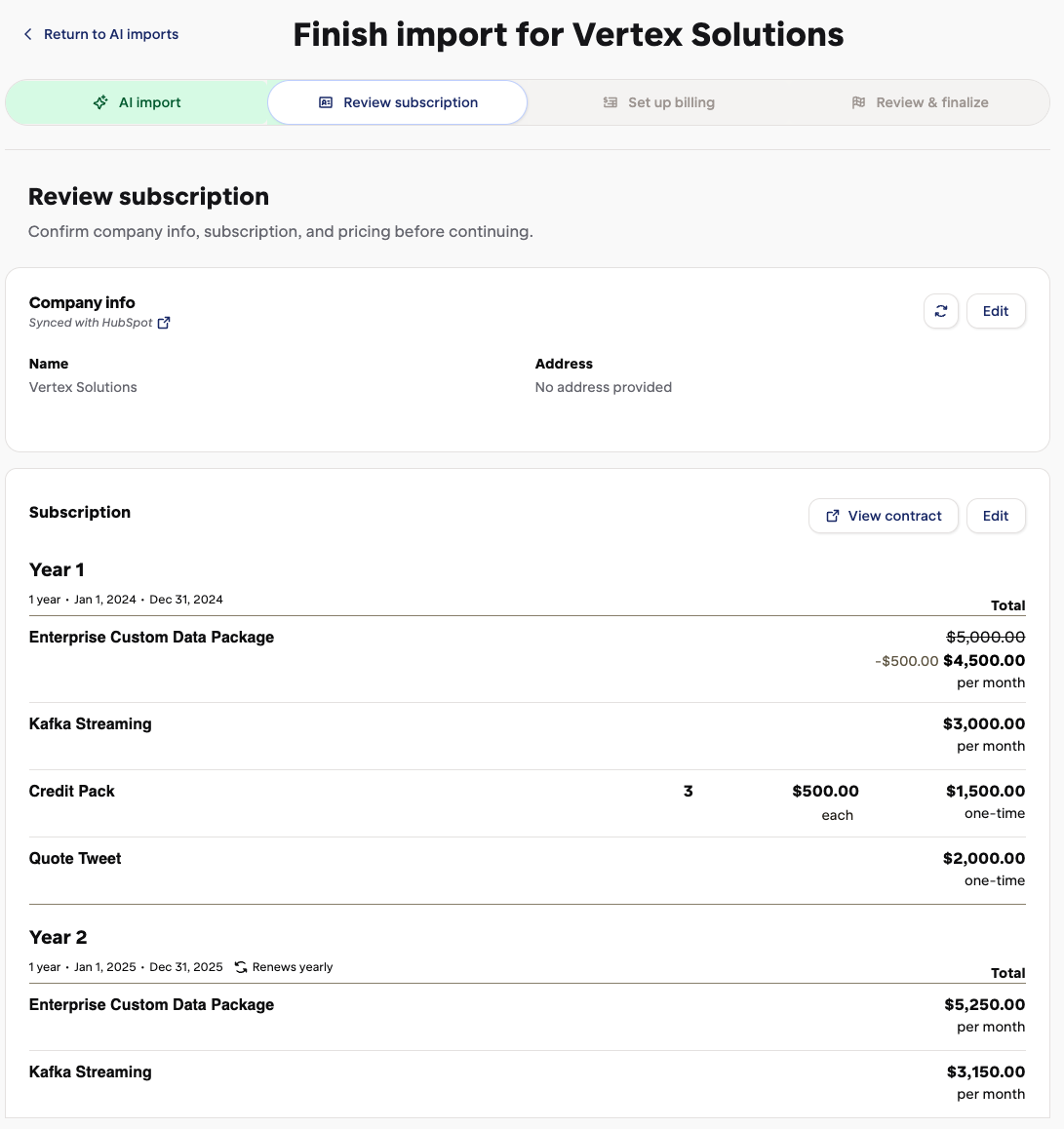
- Side-by-Side Human Verification: A dual-pane review interface displays the uploaded PDF directly alongside the extracted structured fields. The finance user reviews customer company information, product pricing, and invoice configurations against the source document before finalizing.
Bi-Directional CRM Synchronization
Data accuracy must extend beyond the finance team. When company details or customer attributes are verified during contract ingestion, updates sync directly back to the connected CRM (Salesforce, HubSpot, Attio, etc.). This maintains data consistency across sales, customer success, and finance, eliminating record drift across systems.
Extracting structured fields from static PDFs resolves data ingestion challenges, but that’s just the start. These contracts are often mid-flight and the billing takeover timing in the new system must be clear.
Billing Takeover Dates and Ramps / Phases
Ingesting an existing contract is rarely as simple as setting a start date and generating a recurring invoice. The contract is often mid-flight and the terms may vary in the future (e.g., ramped seats, yearly price increases).
Configuring Billing Takeover Dates
When migrating active agreements into Turnstile, the original contract start date may have occurred months or even years in the past. Sending retroactively scheduled invoices would create upset customers, duplicate charges, and accounting errors.
To handle mid-flight contracts, finance teams use the Billing Takeover Date. The system preserves the original Service Start Date for contract duration tracking, revenue recognition, and revenue reporting purposes. The user then selects a specific invoice within the schedule to establish the Billing Takeover Date. Turnstile assumes invoice generation from that exact date forward, leaving historical billing records intact within legacy tools while managing all future invoicing cycles accurately and automatically.
Structuring Ramps / Phases
Sales-led contracts frequently incorporate structured phases, such as discounted trial periods, annual step-up pricing escalators, milestone-contingent activations, or usage tiers that change. Turnstile ingests these structures, resulting in accurate and automatic invoice generation for the entire contract period.
Setting clear contract terms and establishing billing takeover dates gives finance teams a verified data foundation. This foundation connects directly to the rest of Turnstile's platform modules.
Unified System of Record for Commercial Terms and Billing
Contract ingestion is the entry point to Turnstile's quote-to-cash platform, not a standalone utility. Once terms are structured, the leaks downstream of the contract close: invoices match what was signed, overdue invoices get chased automatically, and revenue is recognized on the right schedule. Disconnected billing tools, manual dunning scripts, and offline revenue recognition spreadsheets give way to one system of record.
Automated Invoicing and AI Revenue Collections
Once a draft subscription is finalized and active, Turnstile's billing engine automatically generates invoices according to the schedule, billing frequency, and payment terms.
If payments fall past due, the system triggers automated AI automated invoice collection workflows.
ASC 606 Revenue Recognition and Real-Time Reporting
Billing data must convert cleanly into financial reporting and GAAP-compliant accounting outputs. Manual contract management requires finance teams to spend days reconstructing revenue schedules in spreadsheets prior to board meetings or financial audits.
Once your existing contracts are ingested to Turnstile, Turnstile’s Revenue Recognition just works, like it does with quotes signed directly in Turnstile.
Eliminating Implementation Debt in Modern Revenue Operations
Legacy quote-to-cash implementations have long carried a reputation for being expensive, slow, and overly rigid. SaaS and recurring revenue companies growing past their early stages were historically forced to choose between two imperfect setups: maintaining fragile spreadsheet models or committing to inflexible legacy enterprise billing platforms. Enterprise platforms required 3 to 6 months of consulting work, dedicated administrative staff, and six-figure software contracts.
Turnstile was designed to eliminate this implementation debt. Growing SaaS and recurring revenue companies can sign up, connect their CRM, ingest existing contracts, and launch automated billing in an afternoon.
Contract agreements don't need to stay static PDFs locked in Drive folders. As structured data, they drive billing schedules, collections, and a permanent system of record for revenue. AI Import fixes the contracts you already have. Quoting in Turnstile means you never have to fix another one: the terms are structured before the customer signs.
Frequently Asked Questions (FAQ)
How does Turnstile handle active contracts that are already mid-way through their term?
Turnstile uses a Billing Takeover Date for each AI ingested contract. The platform preserves the original Service Start Date for revenue reporting and contract duration tracking, but invoice generation begins from the exact billing takeover date you select. This prevents duplicate invoicing for periods previously billed in legacy systems while ensuring all future invoices generate accurately and automatically.
What happens if a contract contains custom pricing phases or milestone triggers?
These are captured during AI Import as phases. Phases accommodate trial pricing, annual step-up escalators, or milestone activations. Milestone phases activate based on completed operational triggers (such as integration sign-off) rather than static calendar dates.
Does ingesting a contract update customer details in our CRM?
Yes. Turnstile syncs bi-directionally with connected CRM platforms (Salesforce, HubSpot, Attio, etc.). When customer details or company attributes are updated during the contract review step, those changes mirror back to your CRM to ensure sales and finance operate from identical up-to-date records.
How does contract ingestion impact ASC 606 revenue recognition?
Because AI ingestion extracts product line items, service durations, billing intervals, and pricing phases into structured data objects, Turnstile automatically generates GAAP-compliant revenue recognition schedules, just like it does for quotes signed in Turnstile. Revenue is amortized accurately over performance obligations without requiring manual spreadsheet calculations.
Can we ingest contracts manually if the contract is handwritten or if there’s no clean recorded contract at all?
Yes. In addition to automated AI Import, Turnstile offers a guided Manual Entry path featuring a side-by-side contract viewer. Finance users can view the original agreement on the right side of the screen while populating structured subscription fields on the left.


.png)
.png)